Delftware: Opaque Tin White Over a Porous Clay Body
Short answer
Delftware is tin-glazed earthenware, a porous clay body covered by an opaque white enamel that owes its whiteness to tin, and it is not porcelain, which Edwin Atlee Barber’s 1907 handbook calls “translucent ware” scanned page. In the cross-section further down, compare the solid white layer over the circled clay with the clear glaze over porcelain’s hatched body.
Technique sheet
- Technique
- Tin-glazed earthenware (delftware)
- Kind of work
- Earthenware body under an opaque white tin enamel
- Principle in one line
- Oxide of tin added to the enamel produces the white, opaque effect
- What to look for
- Opaque white coating over a porous, light, yellowish or pale brown body; porcelain is translucent ware
- Usual period and place
- Delft and several other places in Holland (per Barber); probably made by the late 15th century, but little is known of it until about a hundred years later
- Example in a collection
- Cleveland Museum of Art, 1969.254: plate, 1700s, probably by De Porceleyne Claeuw Factory, diameter 35.6 cm
This record as CSV (delftware-technique.csv) (notes on this file)
Data: Cleveland Museum of Art, 1969.254 and 1969.257 collection records (CC0); Edwin Atlee Barber, Tin Enamelled Pottery (1907), short phrases with page numbers
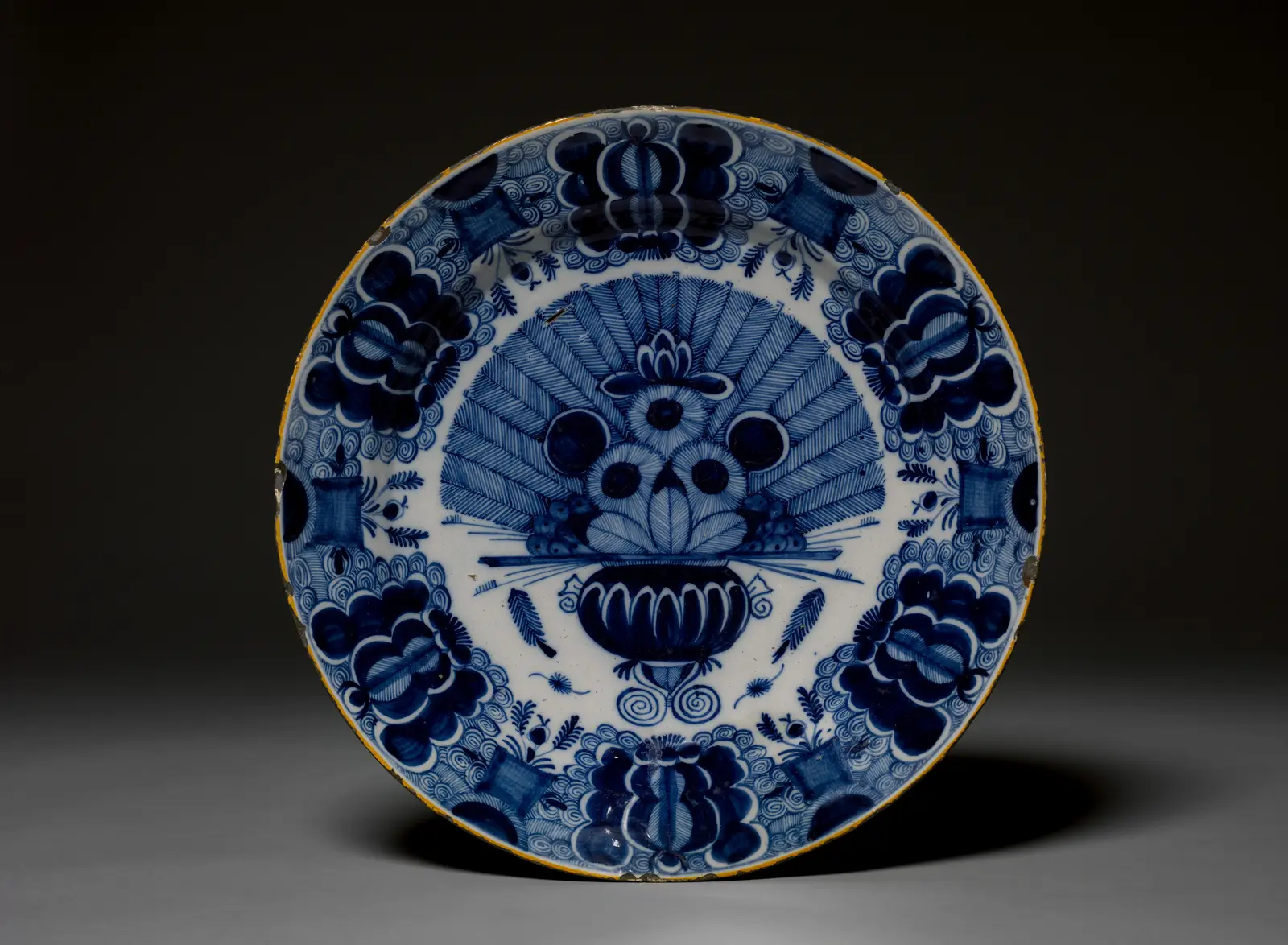
A plate of the 1700s in the Cleveland Museum of Art, probably by De Porceleyne Claeuw Factory; the record calls it Delft ware (tin glazed earthenware) and gives a diameter of 35.6 cm.
Collection: Cleveland Museum of Art, 1969.254
"Plate, probably De Porceleyne Claeuw Factory" by Cleveland Museum of Art — https://www.clevelandart.org/art/1969.254 — CC0 1.0 (https://creativecommons.org/publicdomain/zero/1.0/)
Card and share picture, a 3:2 copy of this object’s photograph: "Plate, probably De Porceleyne Claeuw Factory (card)" by Cleveland Museum of Art — https://www.clevelandart.org/art/1969.254 — CC0 1.0 (https://creativecommons.org/publicdomain/zero/1.0/); modified: padded with the photograph's own background to a 3:2 frame, left and right, with a feathered seam
Where delftware chips, a different material shows through under the opaque white. Barber described the Dutch ware in 1907 as having a body “light in weight and of a yellowish or pale brown colour” scanned page, so the porcelain appearance of a plate such as this one is a surface laid over soft, ordinary earthenware. In the photograph above, the white ground around the blue painting is that surface, and the cross-section in the next section shows what lies beneath it.
This page does not judge whether a particular piece is genuine or what it is worth; it explains what delftware is and how it was made.
What is under the white?
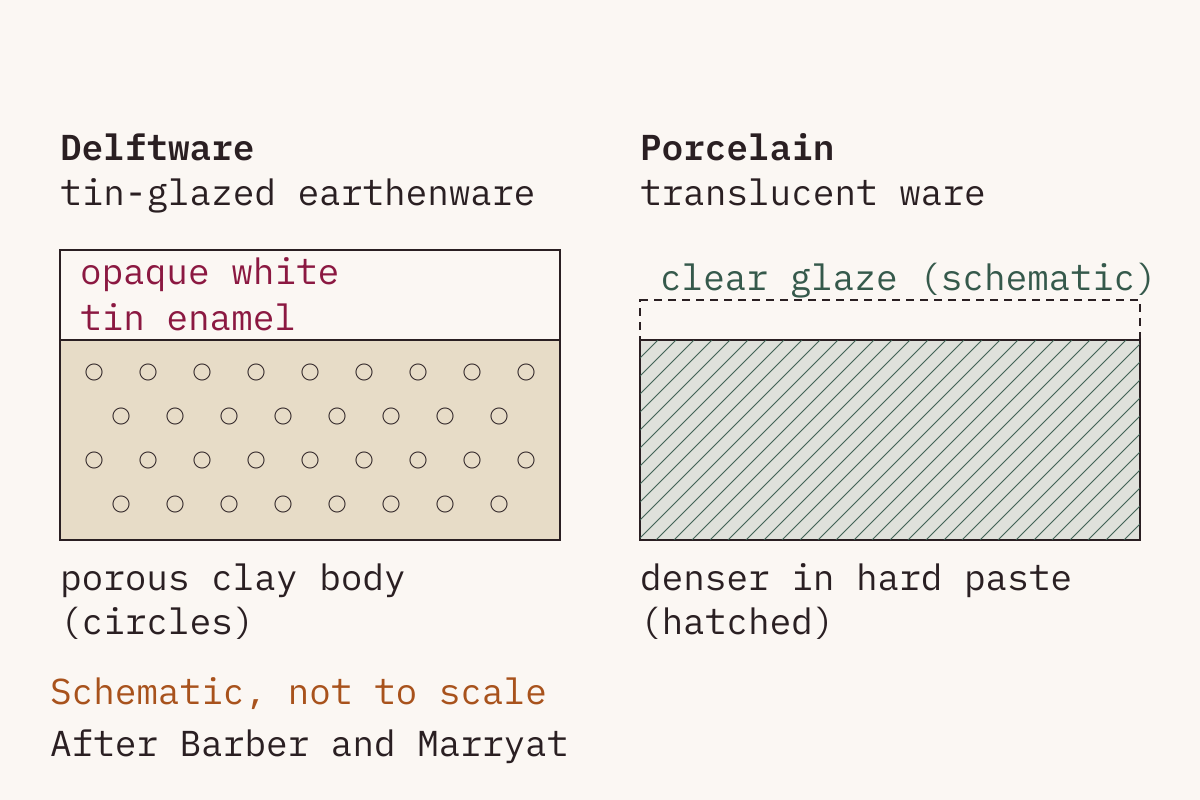 schematic, not to scale
Delftware and porcelain in section: an opaque white tin enamel over a porous clay body, against porcelain drawn with a clear glaze over a body that Marryat calls denser in hard paste. The glaze on porcelain is schematic; the sources give no layer thicknesses.
Source: Barber, Tin Enamelled Pottery (1907); Marryat, Collections towards a History of Pottery and Porcelain (1850); Cleveland Museum of Art record 1969.257
Read the figure as text
- Delftware: tin-glazed earthenware (Cleveland record)
- Delftware surface: a heavy, opaque white enamel; tin produces the white (Barber 1907)
- Delftware body: porous clay, drawn with circles
- Porcelain surface: drawn as a clear glaze, schematic; Barber 1907 defines a glaze as transparent or translucent, unlike an enamel, but does not say what covers porcelain
- Porcelain body: translucent ware (Barber 1907), a denser body in hard paste (Marryat 1850), drawn with hatching
"Delftware and porcelain: what each layer does" by Kiln, Easel & Anvil, https://kilneaselandanvil.com/fired-clay/delftware/ — CC BY 4.0, https://creativecommons.org/licenses/by/4.0/
Data: Edwin Atlee Barber, Tin Enamelled Pottery (1907); Joseph Marryat, Collections towards a History of Pottery and Porcelain (1850); Cleveland Museum of Art, Covered Vase, 1969.257, collection record (CC0)
The Cleveland Museum of Art records the plate as “Delft ware (tin glazed earthenware)” full text. Earthenware is the ordinary fired clay of everyday pottery, and the words “tin glazed” describe the white covering applied over it. Barber, a curator at the Pennsylvania Museum, opened his 1907 handbook Tin Enamelled Pottery with a definition of the whole family of wares: “a coarse, more or less porous, ware covered with a heavy, opaque, putty-like white enamel” (p. 5) scanned page.
Barber used the word enamel in a deliberately narrow sense, writing that “The word enamel, as here used, signifies an opaque coating on the ware, as distinguished from glaze, which is transparent or translucent” (p. 5). In his vocabulary, therefore, delftware is enamelled rather than glazed, because light does not pass through its white covering, and he states on the same page that “True maiolica and delft wares are enamelled”.
The whiteness comes from tin. Barber describes tin enamel as a composition of glass and oxide of lead to which a portion of oxide of tin has been added, and he writes that “The latter ingredient produces the white, opaque effect” (p. 5). Glass is one of those ingredients, which ties the enamel to the question of whether glass is a liquid. These historical enamels contain lead, so pieces decorated with them should not be used for food or drink.
The body and the coat
The clay under the enamel is the material that a chip exposes. Barber describes the Delft ware of Holland as having “a porous and friable body”, friable meaning that it crumbles easily, which was “light in weight and of a yellowish or pale brown colour” (p. 17). He adds that “The thick enamel entirely covers the ware, and is found spread over the under sides of plates, as well as on the upper surface” (pp. 17–18).
According to Barber, the two layers were unusually well matched, since “So perfectly was the enamel adapted to the body that crazing, or cracking of the surface, seldom occurred” (p. 18).
In Barber's general account, the painted decoration does not rest on top of the white. He writes that Delft decorations “were neither over nor under the enamel, but in it, the colours and enamel being liquefied and fixed at one firing”, and he names the process “inglaze painting” (p. 17). On that account, the blue painting on the Cleveland plate would be part of the enamel itself rather than a separate layer above the white; the museum record does not describe how the plate was painted.
Is all delftware blue and white?
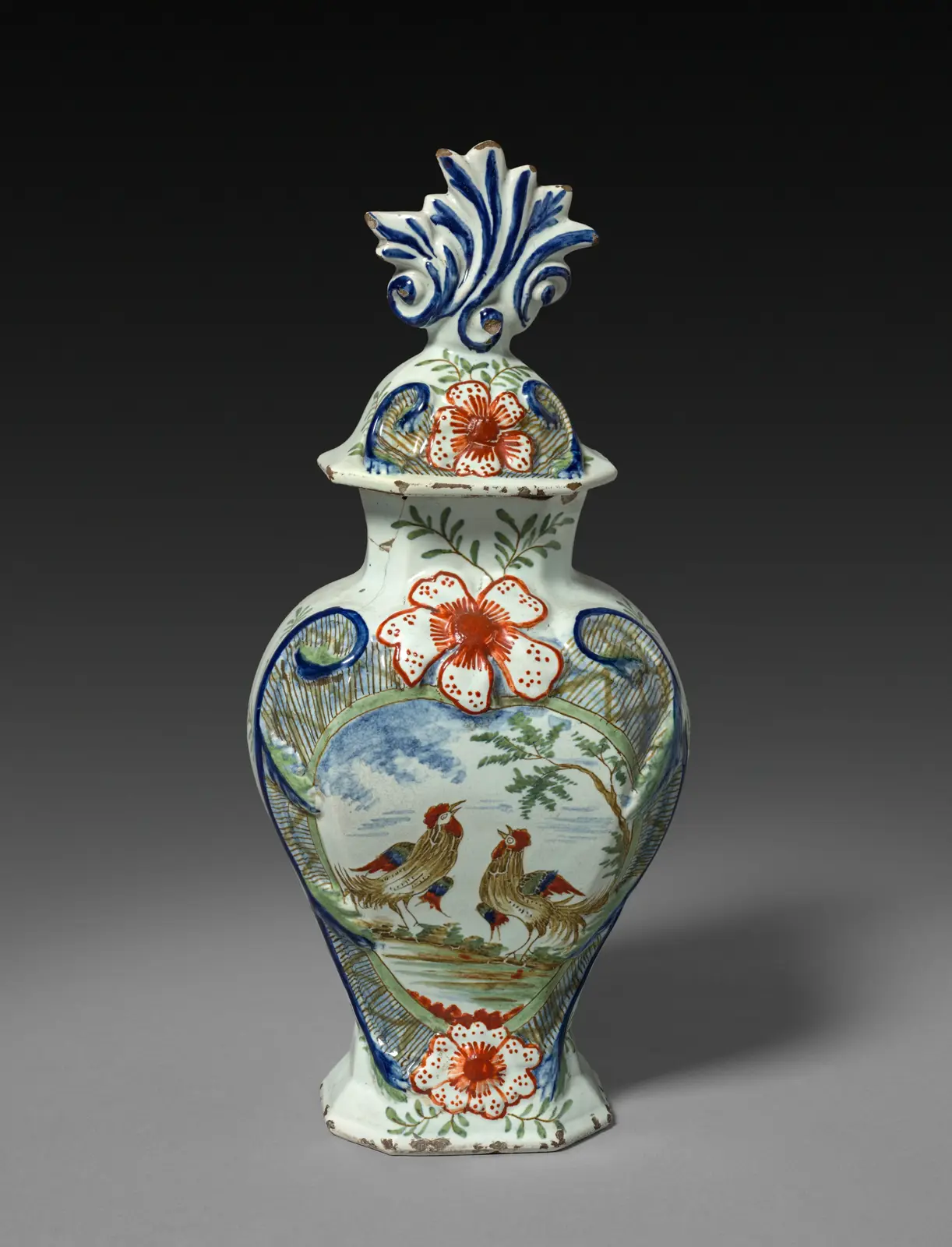
A covered vase of the mid 1700s, probably by Het Bijltje Factory; the Cleveland record gives the same material as the plate, delftware (tin glazed earthenware), and an overall height of 25.1 cm.
Collection: Cleveland Museum of Art, 1969.257
"Covered Vase, probably Het Bijltje Factory" by Cleveland Museum of Art — https://www.clevelandart.org/art/1969.257 — CC0 1.0 (https://creativecommons.org/publicdomain/zero/1.0/)
Not all of it: blue came first, and other colours followed. Barber writes that “At first the blue colour only was used, but later other colours, green, red, yellow, brown, purple and gold, were added” (p. 17) scanned page. The covered vase above illustrates the change. The museum’s photograph shows red and green decoration alongside the blue, while the Cleveland record describes it as “delftware (tin glazed earthenware)” full text, the same material as the plate.
The record gives an overall height of 25.1 cm and a height of 15 cm for the container.
Blue nevertheless remained the dominant colour. Barber observes that “While some of the Holland faience was decorated in polychrome, the blue colour predominates to a marked extent” (p. 18), polychrome meaning painted in several colours. Joseph Marryat, writing in 1850, makes the same point more briefly: “The prevailing colour is blue” (p. 46) scanned page.
Marryat also noticed that the white itself was not a pure white, describing the Delft enamel as “not a shining white, but slightly tinged with blue” (p. 46). On that reading, even the plain ground of a blue-and-white piece carries a faint tint of its own.
Barber lists other varieties as well. He records that tiles “in blue or purple monochrome, were among the earliest productions of the Dutch potters”, and he describes a “Black enamelled Delft, with painted designs in polychrome, in imitation of Chinese lacquer”, adding, in 1907, that “Examples of this variety are now rare” (p. 18).
Blue and white can also be set side by side the opposite way, with a white layer over a blue ground instead of blue painted onto white, as on the Portland Vase.
How do you tell it from porcelain?
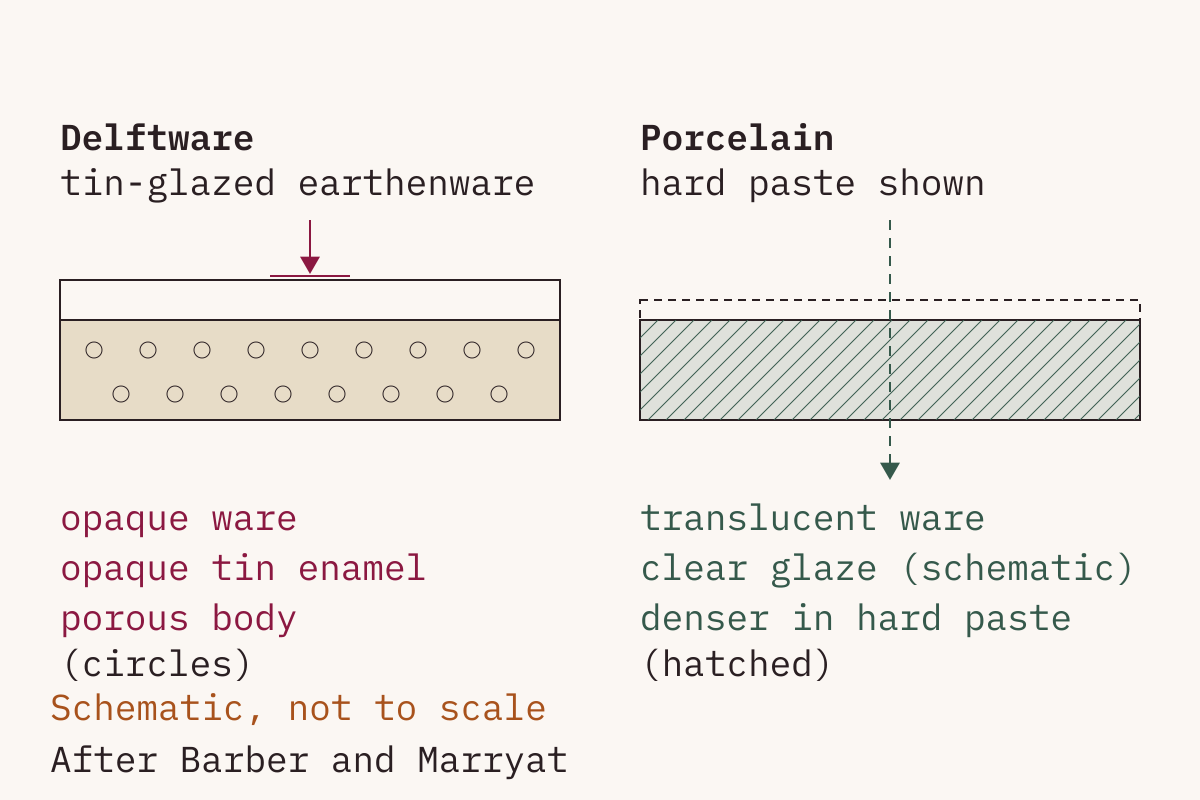 schematic, not to scale
Three differences in one view: delftware is opaque ware with an opaque tin enamel over a porous body; porcelain is translucent ware, drawn under a schematic clear glaze, with a body that Marryat calls denser in hard paste. The arrows show light stopping or passing.
Source: Barber, Tin Enamelled Pottery (1907), Prefatory and pp. 5, 17; Marryat, Collections towards a History of Pottery and Porcelain (1850), p. 93; Cleveland Museum of Art record 1969.257
"Delftware or porcelain: light, coating and body" by Kiln, Easel & Anvil, https://kilneaselandanvil.com/fired-clay/delftware/ — CC BY 4.0, https://creativecommons.org/licenses/by/4.0/
Data: Edwin Atlee Barber, Tin Enamelled Pottery (1907); Joseph Marryat, Collections towards a History of Pottery and Porcelain (1850); Cleveland Museum of Art, Covered Vase, 1969.257, collection record (CC0)
The clearest distinction between the two comes from the preface to Barber’s handbook, which explains that “pottery, or opaque ware, is classified according to glaze, its most distinctive feature, while porcelain, or translucent ware, is grouped according to body or paste” (Prefatory) scanned page. By that classification, delftware belongs on the opaque side, and the defining feature is its covering rather than its clay.
The bodies differ as well. Marryat explains that hard-paste porcelain requires a higher degree of furnace heat, which gives it “a greater density of substance than the Soft paste” (p. 93) scanned page. The body of Dutch delftware, by contrast, is the porous, lightweight clay that Barber describes. For a porcelain that Marryat counts as hard paste, see Meissen porcelain in Cleveland.
| Feature | Delftware | Porcelain | Source |
|---|---|---|---|
| How the ware is classed | pottery, or opaque ware, classed by its glaze | translucent ware, grouped by body or paste | Barber 1907, Prefatory |
| What covers the body | an enamel: an opaque coating | not stated in this source | Barber 1907, p. 5 |
| Where the white comes from | oxide of tin added to the enamel | not stated in this source | Barber 1907, p. 5 |
| The body under the coating | porous and friable, light in weight, yellowish or pale brown | not stated in this source | Barber 1907, p. 17 |
| Density of the body | not stated in this source | hard paste has a greater density of substance than soft paste | Marryat 1850, p. 93 |
| Name in a museum record | delftware (tin glazed earthenware) | not stated in this source | Cleveland Museum of Art, 1969.257 |
Download the data (CSV, delftware-vs-porcelain-table.csv) (notes on this file) Data: Edwin Atlee Barber, Tin Enamelled Pottery (1907), short phrases with page numbers; Joseph Marryat, Collections towards a History of Pottery and Porcelain (1850), short phrase with page number; Cleveland Museum of Art, 1969.257 collection record (CC0)
Why the two get mixed up
The resemblance was intentional. Barber writes that “The origin of this faience was the attempt of the Dutch potters to imitate the more costly porcelain which had been brought from the far East” (p. 17), and he describes later decorations in colours and gold, painted over the enamel, as “imitating Chinese porcelain” (p. 18).
Some of the copies came close. “The best examples of Delft ware are faithful copies of Chinese and Japanese porcelains, which at a short distance can only with difficulty be distinguished from the Oriental”, Barber writes (p. 18). Marryat, who traced the Dutch ornamental pieces chiefly to “the old Japan porcelain”, believed that “nothing short of the touch and a close inspection will suffice to detect the difference” (pp. 46–47).
The confusion has a long history. In 1850 Marryat attached a footnote to a published description of a “curious old china” dinner service in a German palace, correcting it with the words “Not porcelain, but delft” (p. 156).
His note continues that delft is the material “of which, indeed, the greater part of what is here called China really consists; a common error, which persons not cognisant of the distinction between these substances are apt to make in their descriptions” (p. 156).
Clues on the back of a plate
Barber directs attention to the underside, where the enamel “as a rule, shows on the under sides of pieces, or the backs of plates, in ridges or drops where its flow has ceased” (p. 5). He also describes the kiln supports: “Plates and other pieces were separated or supported in the kiln by three bars of fire clay, which in being detached usually left three equidistant, long, rough scars on the under side, where the enamel was torn away” (p. 18).
Such traces are clues rather than verdicts. Barber himself writes that the scars are “noticeable in a large proportion of the pieces made in Holland” (p. 18), which implies that other pieces lack them. This page does not suggest handling, scratching or testing any object, and it treats the museum record as the authority that names an object’s material.
Barber also explains that Dutch potters named their workshops after natural or artificial objects and frequently marked their wares with a picture, a name or the initials of that object (p. 19). This page reads such marks only as workshop history and provides no table of them.
Is modern Delft blue the same thing?
The name is not the test; the method of making is. A modern piece sold as Delft blue is delftware in the sense used on this page only if it is constructed the same way, with an opaque, tin-whitened enamel over an earthenware body. Barber, writing in 1907, noted that Delft ware had been manufactured “From that time down to the present” at many establishments (p. 17), but this page does not assess any modern product.
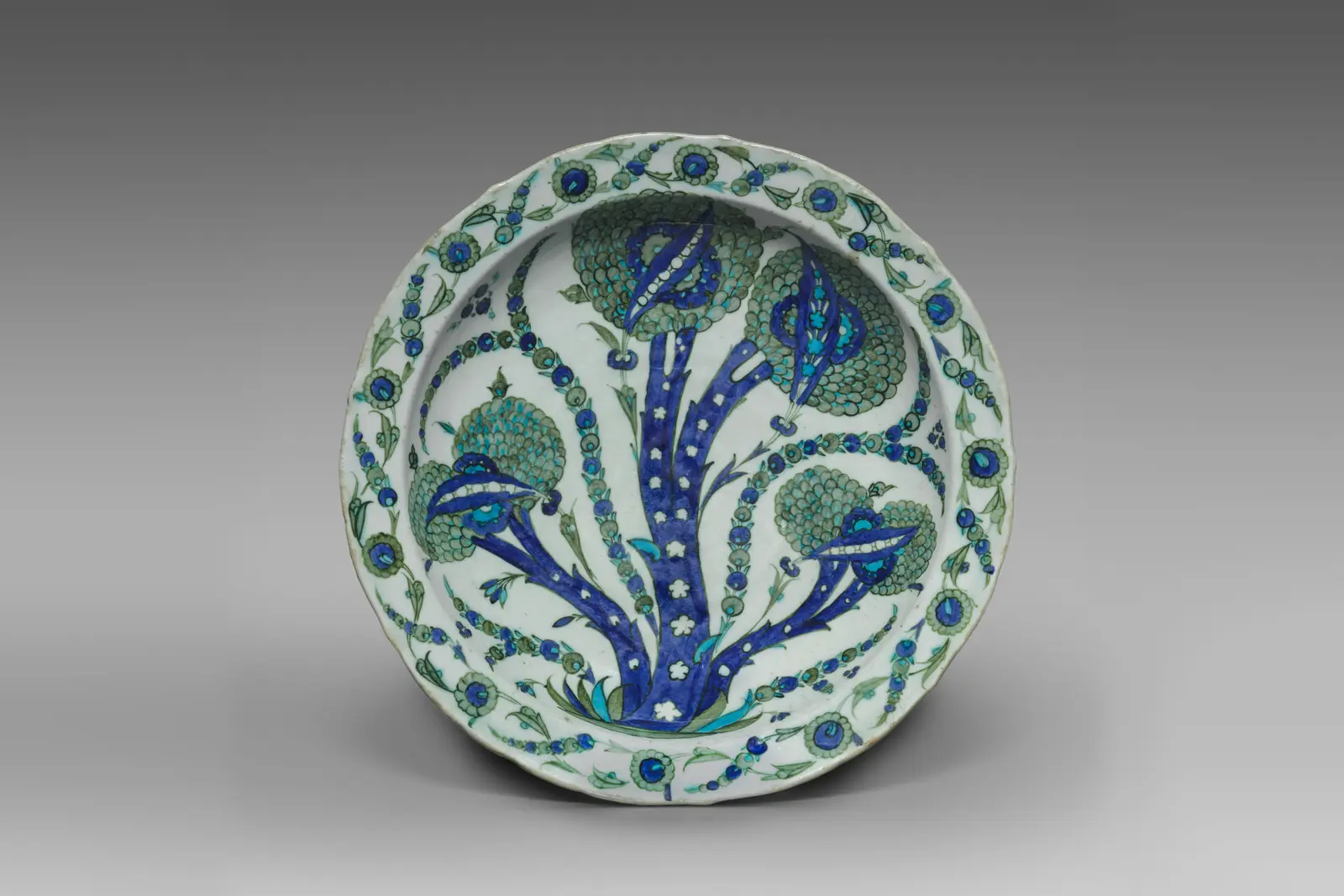
Under the loupe: look again at the white ground around the blue painting of the Cleveland plate, which on Barber’s general account would hold the painting inside the tin enamel, though the record does not say how this plate was painted. Then compare an Ottoman dish with artichokes, per the Cleveland record.
A plate of the 1700s in the Cleveland Museum of Art, probably by De Porceleyne Claeuw Factory; the record calls it Delft ware (tin glazed earthenware) and gives a diameter of 35.6 cm.
Collection: Cleveland Museum of Art, 1969.254
"Plate, probably De Porceleyne Claeuw Factory" by Cleveland Museum of Art — https://www.clevelandart.org/art/1969.254 — CC0 1.0 (https://creativecommons.org/publicdomain/zero/1.0/)
Sources and reading levels
- Edwin Atlee Barber, Tin Enamelled Pottery: Maiolica, Delft, and Other Stanniferous Faience (New York: Doubleday, Page & Company, 1907), Prefatory and pp. 5, 17–19; public domain in the US and EU (published 1907; Barber died 1916, per the Cornell University Library catalogue record on the Internet Archive) archive.org/details/cu31924020604306Read: scanned page
- Cleveland Museum of Art, Plate, 1700s, probably by De Porceleyne Claeuw Factory (Dutch), Delft ware (tin glazed earthenware), accession number 1969.254, collection online record (CC0) www.clevelandart.org/art/1969.254Read: full textText licence: CC0 1.0 (terms)
- Joseph Marryat, Collections towards a History of Pottery and Porcelain in the 15th, 16th, 17th, and 18th Centuries (London: J. Murray, 1850); public domain in the US and EU (published 1850 by an author already adult then, who cannot have died later than 1955; no readable record of his death year was found) archive.org/details/collectionstowar00marrRead: scanned page
- Cleveland Museum of Art, Covered Vase, mid 1700s, probably by Het Bijltje Factory (Dutch), delftware (tin glazed earthenware), accession number 1969.257, collection online record (CC0) www.clevelandart.org/art/1969.257Read: full textText licence: CC0 1.0 (terms)
More objects in Fired Clay
Pairs and lists
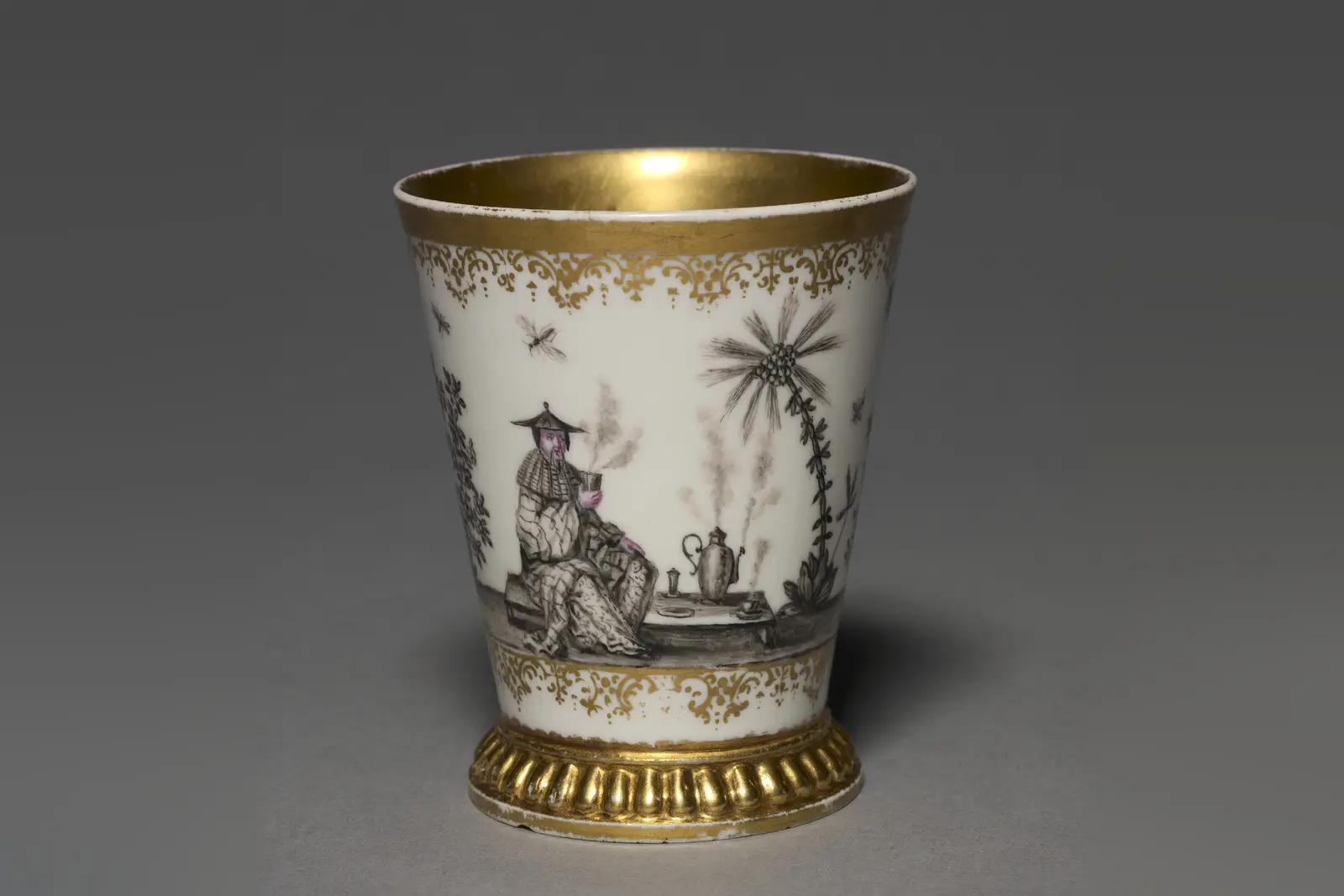
Meissen Porcelain: Kaolin Clay in the Body, per Jonveaux
Catalogued
Picture credit
"Beaker, Meissen Porcelain Factory (card)" by Cleveland Museum of Art — https://www.clevelandart.org/art/1952.452 — CC0 1.0 (https://creativecommons.org/publicdomain/zero/1.0/); modified: padded with the photograph's own background to a 3:2 frame, left and right, with a feathered seam
Telling them apart
Iznik Pottery: An Artichoke Dish, per the Cleveland Record
Catalogued
Picture credit
"Large Dish with Artichokes (card)" by Cleveland Museum of Art — https://www.clevelandart.org/art/1995.17 — CC0 1.0 (https://creativecommons.org/publicdomain/zero/1.0/); modified: padded with the photograph's own background to a 3:2 frame, left and right, with a feathered seam
Cite this page
Kiln, Easel & Anvil. “Delftware: Opaque Tin White Over a Porous Clay Body.” Published 28 November 2026. https://kilneaselandanvil.com/fired-clay/delftware/ (accessed on the day you read it).
How a record is checked Every correction, dated Report an error on this page (contact@kilneaselandanvil.com)