Iznik Pottery: An Artichoke Dish, per the Cleveland Record
Short answer
Iznik pottery is Ottoman ware made at Iznik in Turkey, and the Cleveland record of a dish from about 1535–40 describes that dish as “fritware with underglaze-painted design” full text. In the photograph, look at the centre, which the record calls an artichoke motif.
Object record
- Object
- Large Dish with Artichokes
- Maker
- Not named in the record; Turkey, Iznik, Ottoman period (1299–1922)
- Date
- c. 1535–40
- Material
- fritware with underglaze-painted design
- Dimensions
- Diameter 36.4 cm (as published)overall 6.9 cm (as published)
- Collection
- Cleveland Museum of Art, 1995.17
This record as CSV (iznik-pottery-record.csv) (notes on this file)
Data: Cleveland Museum of Art, 1995.17 collection record (CC0)
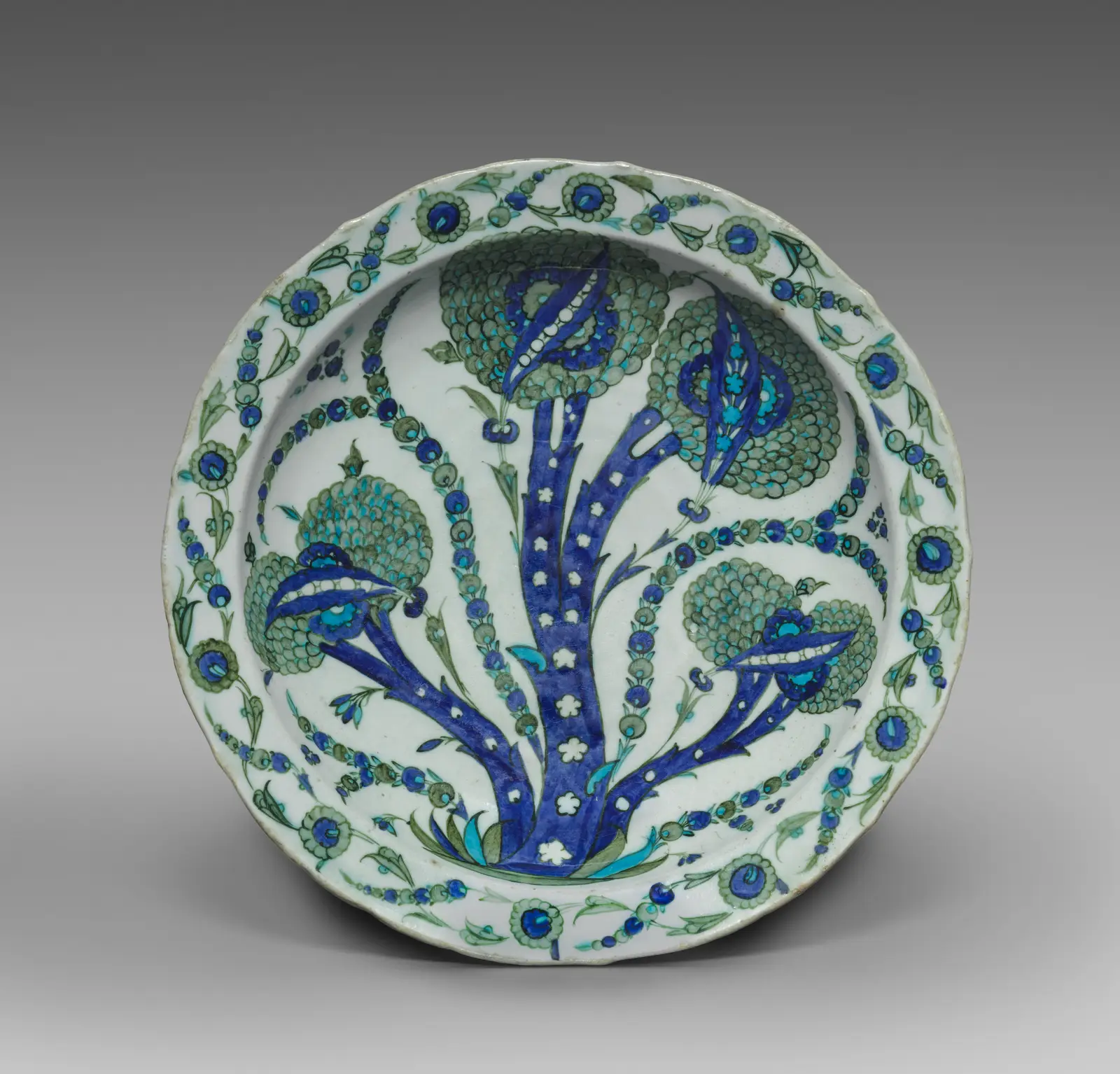
The Large Dish with Artichokes, about 1535–40, from Iznik in Turkey; the Cleveland record gives a diameter of 36.4 cm and an overall height of 6.9 cm.
Collection: Cleveland Museum of Art, 1995.17
"Large Dish with Artichokes" by Cleveland Museum of Art — https://www.clevelandart.org/art/1995.17 — CC0 1.0 (https://creativecommons.org/publicdomain/zero/1.0/)
Card and share picture, a 3:2 copy of this object’s photograph: "Large Dish with Artichokes (card)" by Cleveland Museum of Art — https://www.clevelandart.org/art/1995.17 — CC0 1.0 (https://creativecommons.org/publicdomain/zero/1.0/); modified: padded with the photograph's own background to a 3:2 frame, left and right, with a feathered seam
Start at the middle of this Iznik dish, the area its museum record fills with artichokes, rosettes and saz leaves. The record points out that an artichoke “is actually the bud of a thistle—a flower”, and it says the design “was likely inspired by luxury Italian textiles imported into the Ottoman court” full text. In the photograph above, the motif covers that whole area, as the record describes it.
This page does not judge whether a particular piece is genuine or what it is worth. Instead, it explains what Iznik pottery is and how two dated museum dishes are described, as far as their museum records and two older printed books allow.
What is on an Iznik dish?
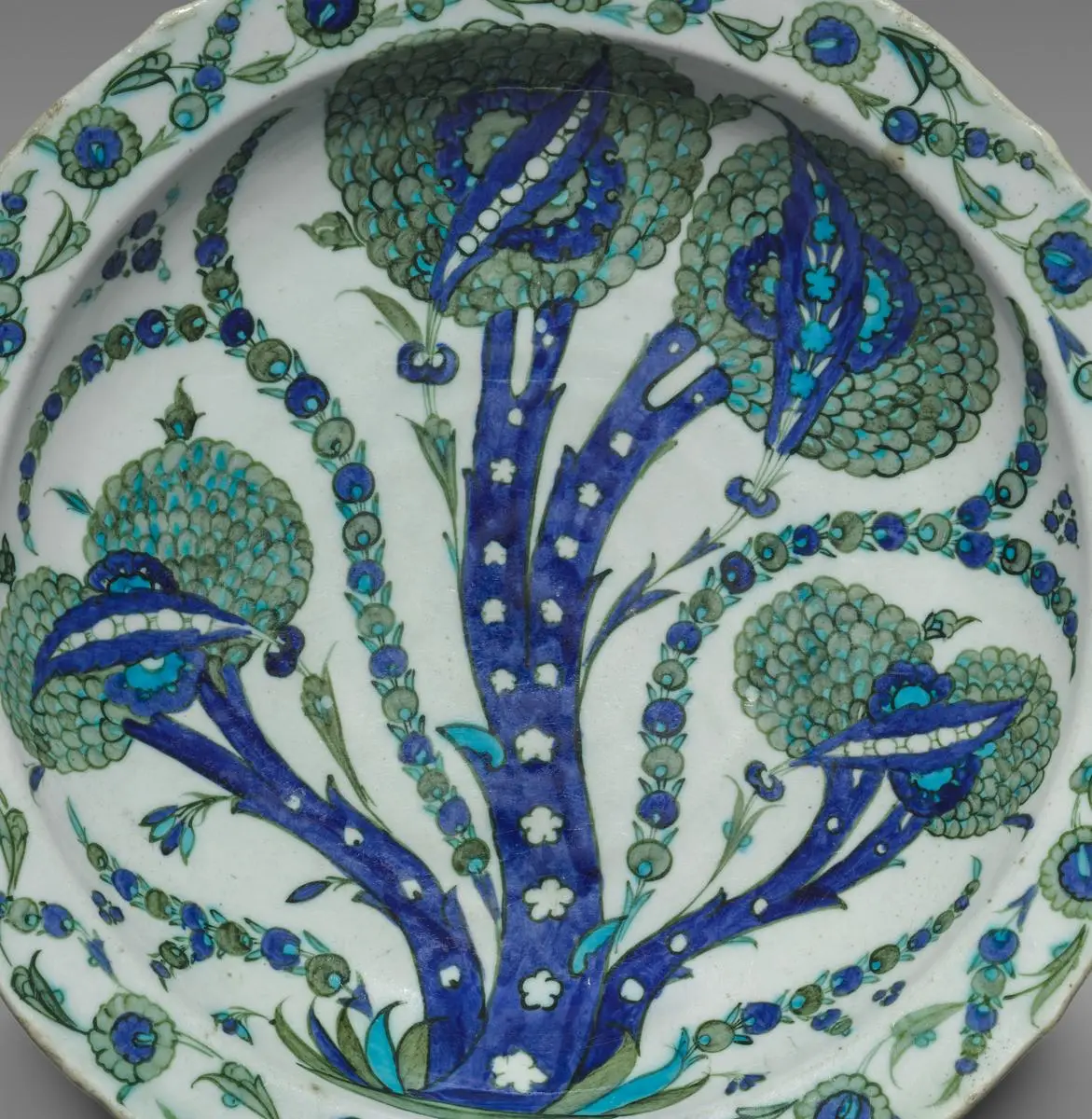
The centre of the Large Dish with Artichokes, which the Cleveland record describes as covered in an artichoke motif interwoven with rosettes and serrated saz leaves.
Collection: Cleveland Museum of Art, 1995.17
Detail. The small picture marks where it sits in the whole object.
"Large Dish with Artichokes (detail of the centre)" by Cleveland Museum of Art — https://www.clevelandart.org/art/1995.17 — CC0 1.0 (https://creativecommons.org/publicdomain/zero/1.0/); modified: cropped to the detail of the centre of the dish and resized to 1200 px on the long edge
The Cleveland record begins its description with a general rule of thumb: “Floral and vegetal motifs are a hallmark of Iznik pottery” full text. It then turns to this dish, whose centre “is covered in a dynamic artichoke motif interwoven with rosettes and serrated saz leaves.” Serrated describes an edge cut into small teeth, like a saw blade, and the record sets saz in italics. Beyond that wording, no individual shape in the photograph is identified here.
The record then gives the material as “fritware with underglaze-painted design”, so fritware is the museum’s name for the ceramic body of the dish. Underglaze means that the decoration was painted before the glaze was applied, which places the colours beneath the glassy surface rather than on top of it.
Neither the record nor the older books quoted further down provide a recipe for the body, so none appears here. Nor does the record describe the dish as porcelain. For a true porcelain on this site, see the hard-paste porcelain of Meissen, which is hard paste per Marryat's 1850 history scanned page.
Where the record places it
The record says that vessels and tiles “produced in Iznik, Turkey, for the Ottoman court in Istanbul represented the finest Islamic ceramics.” The superlative is the museum’s evaluation, quoted rather than repeated as a fact.
The record also places this dish at “a high point of Ottoman art during the reign of Sultan Suleyman the Magnificent (1520–66)”, a period in which, the record says, “European, Persian, Chinese, and Egyptian influences contributed to a distinct artistic language.”
The dimensions appear in the same record, a diameter of 36.4 cm and an overall height of 6.9 cm, so the dish is more than five times as wide as it is high.
What did a later Iznik dish look like?
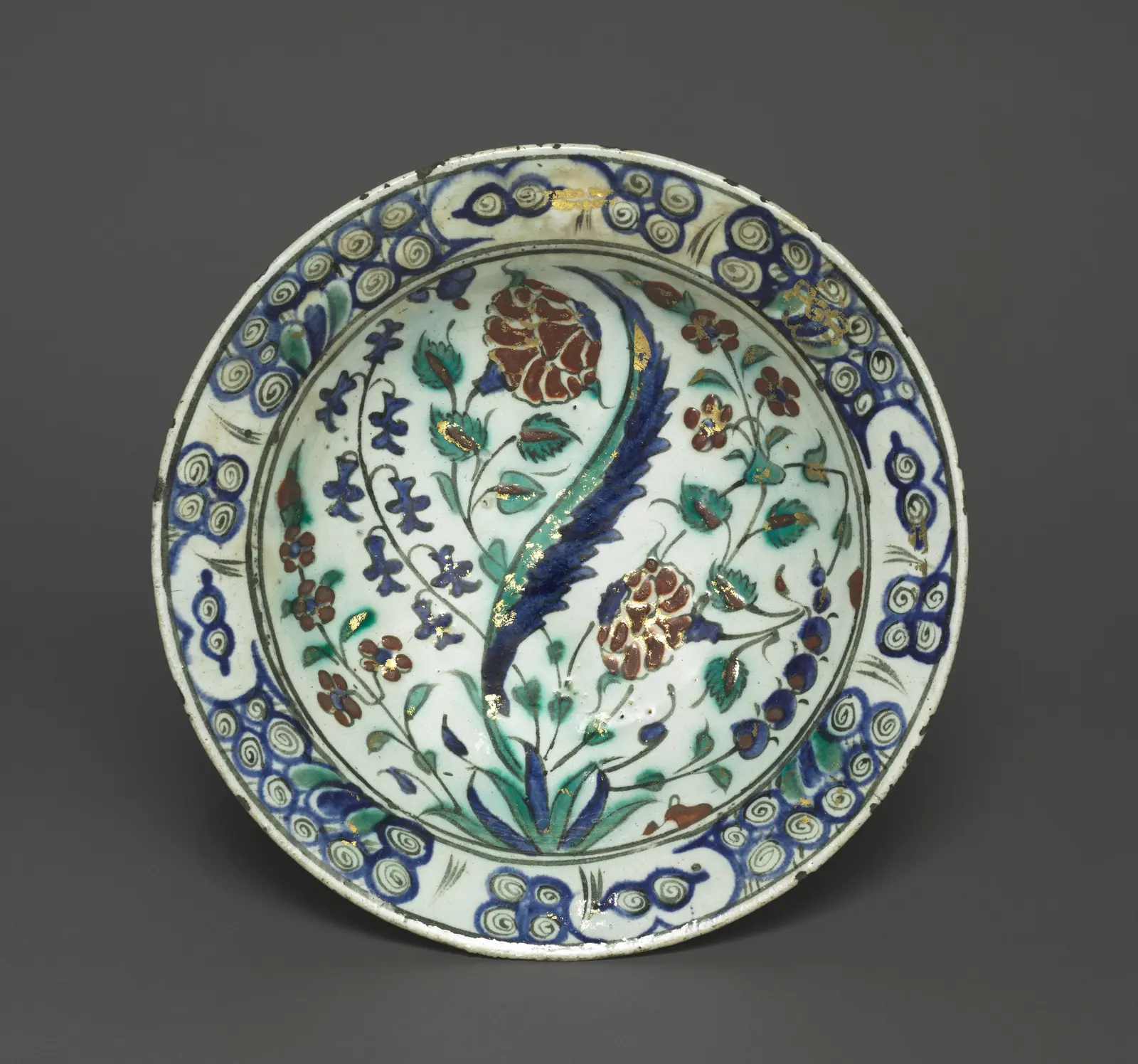
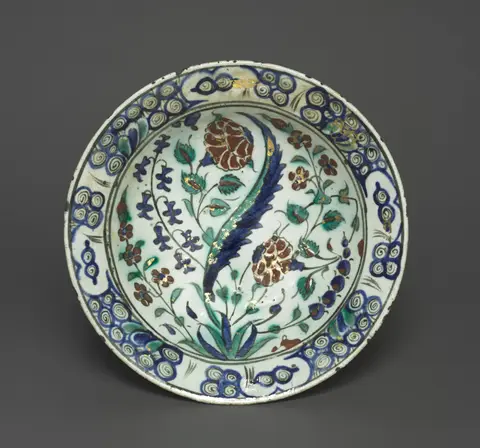
The Gilded Dish with Flowers and Leaves, about 1590, from Iznik; the Cleveland record gives a diameter of 29.8 cm and an overall height of 6.6 cm.
Collection: Cleveland Museum of Art, 1915.663
"Gilded Dish with Flowers and Leaves" by Cleveland Museum of Art — https://www.clevelandart.org/art/1915.663 — CC0 1.0 (https://creativecommons.org/publicdomain/zero/1.0/)
A second Iznik dish in Cleveland, dated about 1590 in its record, is described with materials that the first record does not mention. Its record lists “Fritware with red slip, underglaze design, and overglaze gilding” full text. A slip is a layer of liquid clay applied to the surface, and overglaze gilding is gold laid on top of the glaze, the opposite position from underglaze painting.
The record gives the red particular attention. Its description says that the design “highlights” a red, “the most difficult to achieve in ceramics, that was developed by Turkish potters”, and a short note in the same record explains that Turkish potters produced that red with a clay slip containing a large amount of iron.
According to the description, the design “is divided with a central swaying saz leaf, with red roses, blue hyacinths, and other floral elements enhanced with glittering gold”, and the gold is “a feature that rarely survives”. The colours given here for the dish are the ones named in the record, not tints identified from the photograph.
Applying gold over a glaze is one way of placing one decorative layer on another. A layered surface can also be cut back instead of painted, which is how one early account explains the Portland Vase.
How do the two Cleveland dishes compare?
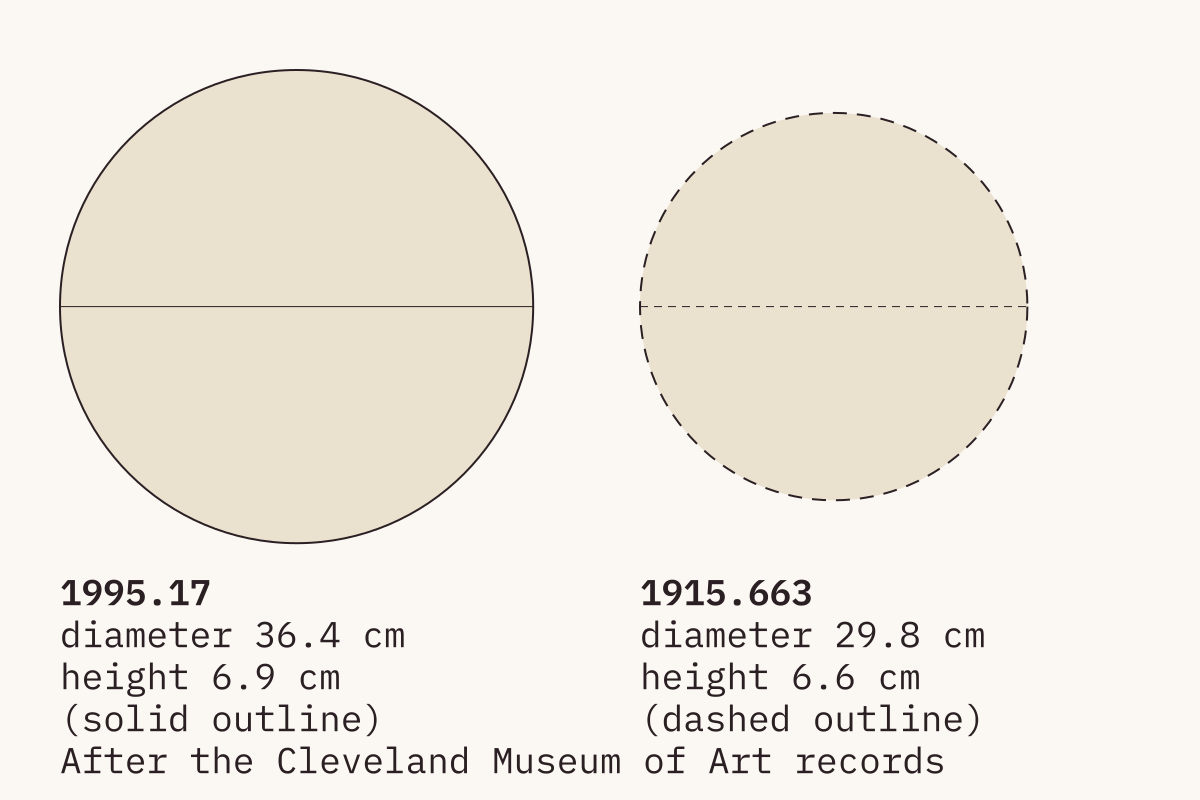
The two dishes drawn at one scale from their museum records: the Large Dish with Artichokes with a solid outline and the Gilded Dish with Flowers and Leaves with a dashed outline.
Source: Cleveland Museum of Art records 1995.17 and 1915.663 (CC0)
"Two Iznik dishes in Cleveland drawn at one scale" by Kiln, Easel & Anvil, https://kilneaselandanvil.com/fired-clay/iznik-pottery/ — CC BY 4.0, https://creativecommons.org/licenses/by/4.0/
Data: Cleveland Museum of Art, Large Dish with Artichokes, 1995.17, collection record (CC0); Cleveland Museum of Art, Gilded Dish with Flowers and Leaves, 1915.663, collection record (CC0)
Drawn at one scale, the earlier dish is the wider of the two, at 36.4 cm against 29.8 cm across, while their overall heights, 6.9 cm and 6.6 cm, are almost the same. The table below sets out the catalogue fields of both records, one museum record per row, so that the two descriptions can be compared directly.
| Object | Date | Place and period | Material and technique | Diameter (cm) | Height (cm) |
|---|---|---|---|---|---|
| Large Dish with Artichokes, 1995.17 | c. 1535–40 | Turkey, Iznik, Ottoman period (1299–1922) | fritware with underglaze-painted design | 36.4 | 6.9 |
| Gilded Dish with Flowers and Leaves, 1915.663 | c. 1590 | Turkey, Iznik, Ottoman period (1299–1922) | Fritware with red slip, underglaze design, and overglaze gilding | 29.8 | 6.6 |
Download the data (CSV, iznik-pottery-dishes.csv) (notes on this file) Data: Cleveland Museum of Art, 1995.17 and 1915.663 collection records (CC0)
What the two records name
Read together, the two record descriptions give the features this page uses to recognise an Iznik dish. Each one comes from the record of a single catalogued dish:
- A body that the museum calls fritware, in both records.
- A design painted under the glaze, in both records.
- Floral and vegetal motifs, which the record of the dish of about 1535–40 calls a hallmark of Iznik pottery.
- Saz leaves, named in both descriptions.
- A red made with an iron-bearing clay slip, named only for the dish of about 1590.
- Gold laid over the glaze, also named only for the dish of about 1590.
These are features of two catalogued dishes, not a test that can settle the origin of any other piece. The dates are also the museum’s own: the letter c. stands for circa, meaning about, and this page does not teach how to date a dish from its colours or its pattern.
Designs that crossed from one craft or country to another run through other pages on this site as well, for example a furniture style tied to the pattern book of Thomas Chippendale.
What did older books record about Iznik wares?
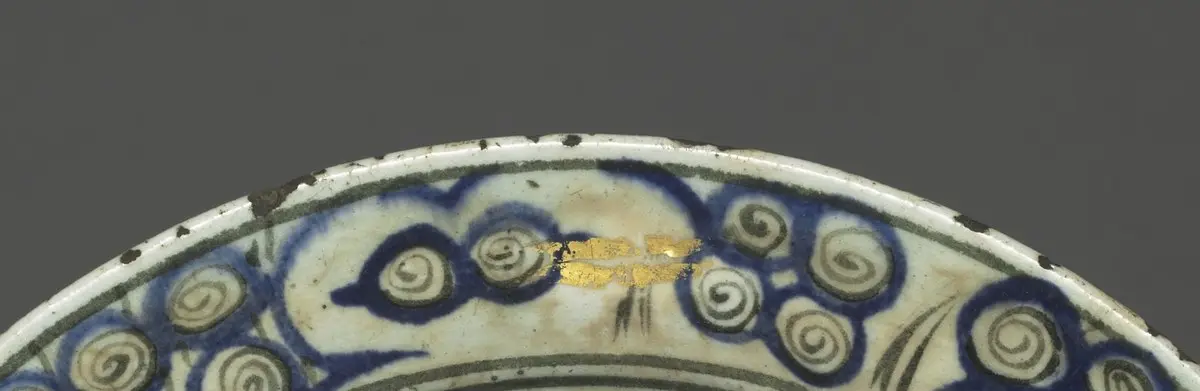
The rim of the Gilded Dish with Flowers and Leaves, which the Cleveland record describes as a simplified rock and wave design adopted from Chinese ceramics.
Collection: Cleveland Museum of Art, 1915.663
Detail. The small picture marks where it sits in the whole object.
"Gilded Dish with Flowers and Leaves (detail of the rim)" by Cleveland Museum of Art — https://www.clevelandart.org/art/1915.663 — CC0 1.0 (https://creativecommons.org/publicdomain/zero/1.0/); modified: cropped to the detail of the rim at the top of the dish and resized to 1200 px on the long edge
The rim in this detail is the one place where the record of the dish of about 1590 names an outside model. It says the rim displays a simplified rock and wave design “adopted from Chinese ceramics which were abundant in the imperial Topkapi Palace in Istanbul” full text.
The name Iznik is not the one older books used. In the second volume of his Manuel d’art musulman (1907), Gaston Migeon headed his section “Faïences turques dites de Rhodes”, Turkish faience called Rhodes ware (translated here), and wrote: “Pendant très longtemps on a désigné ce genre de céramiques du nom de faïences de Rhodes ou de Lindos” (p. 301) scanned page.
That is: for a very long time this kind of ceramic was called Rhodes or Lindos faience (translated here).
Migeon rejected Rhodes as the sole source. He argued that the wall tiles share exactly the same technique and decoration as the dishes and vases, and then observed: “Or, on n'a pas trouvé un seul de ces carreaux à Rhodes” (p. 302), that is, not a single one of these tiles had been found on Rhodes (translated here).
He pointed instead to Nicée, which in the sixteenth century, he wrote, “portait le surnom de Tschinili, Isnik Tschinili (Nicée des faïences)” (p. 302), a nickname he glossed in brackets as Nicée of the faiences (translated here).
Migeon’s dates and colours
Migeon thought it “vraisemblable”, likely, that the town supplied most of the tiles in the mosques of Constantinople and Asia Minor, and he put the high point of the art in the sixteenth century, “à l'époque de Soliman le Grand (1520-1566)” (p. 303). The same reign and the same years appear, more than a century later, in the Cleveland record of the artichoke dish.
The wares also travelled west. Migeon wrote that many seem to have been imported into Italy, because the maiolica workshop at Candiana, near Padua, made “de nombreuses imitations” of them, numerous imitations (translated here), “entre 1620 et 1650” (p. 303).
He described one well-defined group of tiles as the series “aux deux bleus et au rouge tomate”, with two blues and tomato red (translated here; p. 304). He also set a limit that this page observes: “Il est actuellement impossible de distinguer entre eux les produits des divers ateliers” (p. 303), at present it is impossible to tell apart the products of the different workshops (translated here).
Litchfield’s Rhodian faience
At least one English collectors’ guide kept the old name longer. Frederick Litchfield’s Pottery & Porcelain, in its 1912 edition, still discussed the ware under the heading Rhodian faience and described it as being “of coarse body with a thick glaze” (p. 325) scanned page. Its decoration, he wrote, was “as a rule, sprays of flowers, generally carnations, with spiky leaves spreading over the surface of the plate, jug, or tile” (p. 325).
He added that “A brownish-red colour is a favourite pigment, laid on so thickly as to stand out from the white ground in slight relief” (p. 325). That description is consistent with the red slip in the Cleveland record of the dish of about 1590, although that sentence names no town and no museum number.
On the next page, Litchfield reported that the South Kensington authorities had dropped the name for the pottery of the Salting bequest, “on the ground that the proofs of Rhodes being its proper source are unsatisfactory”. They did not, he noted, “assign any particular province or district of the Turkish Empire as the actual place of production” (p. 326).
The Cleveland records now name the place directly, since both dishes are catalogued as “Turkey, Iznik, Ottoman period (1299–1922)” full text.
Under the loupe: look again at the centre of the dish of about 1535–40, where the Cleveland record finds an artichoke among rosettes and saz leaves, then compare a tin-glazed ware from Delft.
The centre of the Large Dish with Artichokes, which the Cleveland record describes as covered in an artichoke motif interwoven with rosettes and serrated saz leaves.
Collection: Cleveland Museum of Art, 1995.17
Detail. The small picture marks where it sits in the whole object.
"Large Dish with Artichokes (detail of the centre)" by Cleveland Museum of Art — https://www.clevelandart.org/art/1995.17 — CC0 1.0 (https://creativecommons.org/publicdomain/zero/1.0/); modified: cropped to the detail of the centre of the dish and resized to 1200 px on the long edge
Sources and reading levels
- Cleveland Museum of Art, Large Dish with Artichokes, c. 1535–40, Turkey, Iznik, Ottoman period, fritware with underglaze-painted design, accession number 1995.17, collection online record (CC0) www.clevelandart.org/art/1995.17Read: full textText licence: CC0 1.0 (terms)
- Cleveland Museum of Art, Gilded Dish with Flowers and Leaves, c. 1590, Turkey, Iznik, Ottoman period, fritware with red slip, underglaze design, and overglaze gilding, accession number 1915.663, collection online record (CC0) www.clevelandart.org/art/1915.663Read: full textText licence: CC0 1.0 (terms)
- Thomas Chippendale, The Gentleman and Cabinet-Maker's Director (London: printed for the author, 1754); Smithsonian Libraries copy, scanned for the Internet Archive; public domain in the US and EU (Chippendale died 1779) archive.org/details/gentlemancabine00ChipRead: scanned page
- Gaston Migeon, Manuel d’art musulman, vol. 2, Les arts plastiques et industriels (Paris: A. Picard, 1907), pp. 301–304; quotations in French with this page’s English translation; public domain in the US (published 1907) and EU (Migeon died 1930) archive.org/details/manueldartmusulm02migeuoftRead: scanned page
- Frederick Litchfield, Pottery & Porcelain: A Guide to Collectors (London: Truslove & Hanson, 1912), pp. 325–326; public domain in the US (published before 1931) and EU (Litchfield died 1930, per the library catalogue heading “Litchfield, Frederick, 1850-1930” on other Internet Archive records of his books); only short quotations are used archive.org/details/potteryporcelain00litcRead: scanned page
- Joseph Marryat, Collections towards a History of Pottery and Porcelain in the 15th, 16th, 17th, and 18th Centuries (London: J. Murray, 1850); public domain in the US and EU (published 1850 by an author already adult then, who cannot have died later than 1955; no readable record of his death year was found) archive.org/details/collectionstowar00marrRead: scanned page
More objects in Fired Clay
Telling them apart
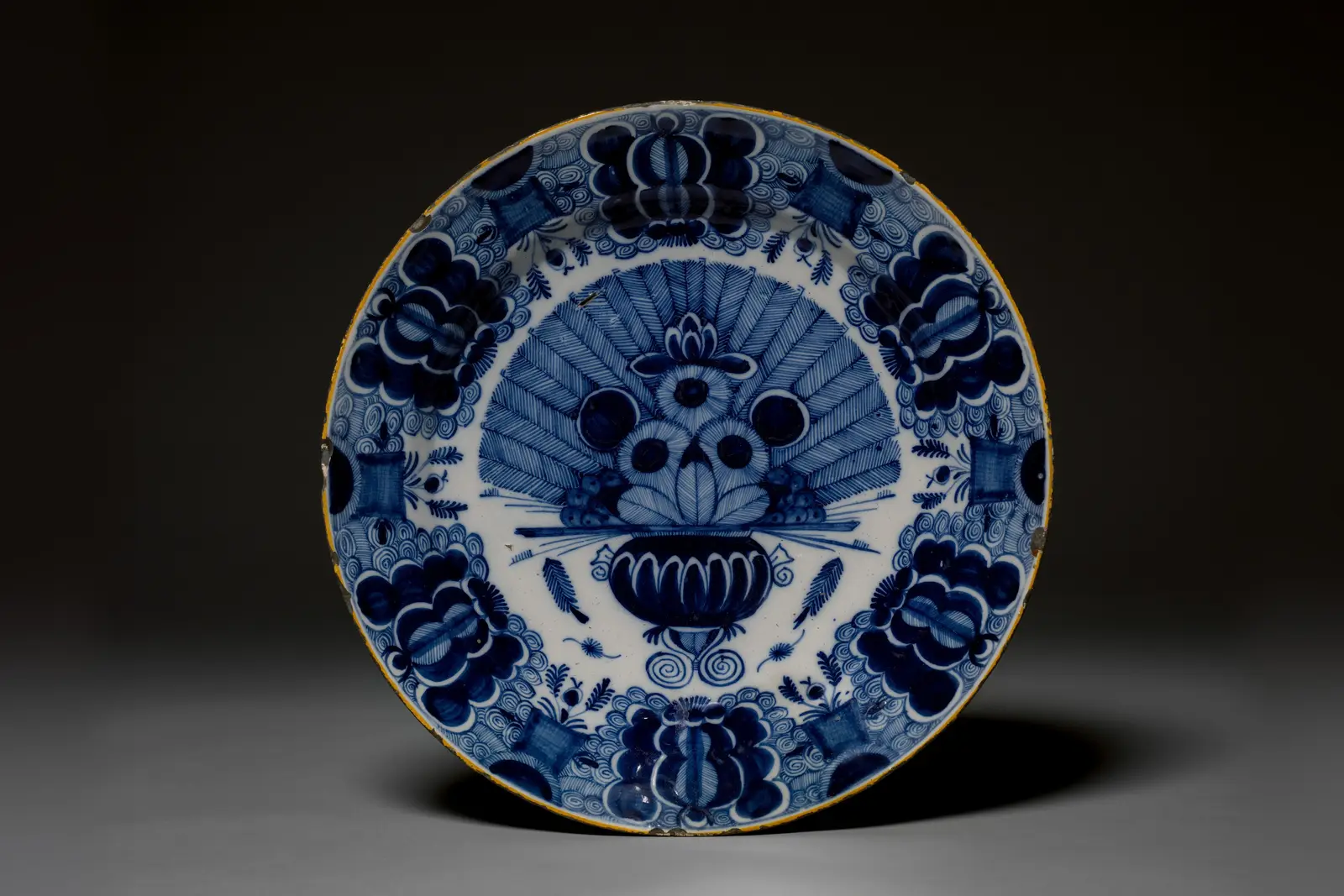
Delftware: Opaque Tin White Over a Porous Clay Body
Catalogued
Picture credit
"Plate, probably De Porceleyne Claeuw Factory (card)" by Cleveland Museum of Art — https://www.clevelandart.org/art/1969.254 — CC0 1.0 (https://creativecommons.org/publicdomain/zero/1.0/); modified: padded with the photograph's own background to a 3:2 frame, left and right, with a feathered seam
Pairs and lists
Meissen Porcelain: Kaolin Clay in the Body, per Jonveaux
Catalogued
Picture credit
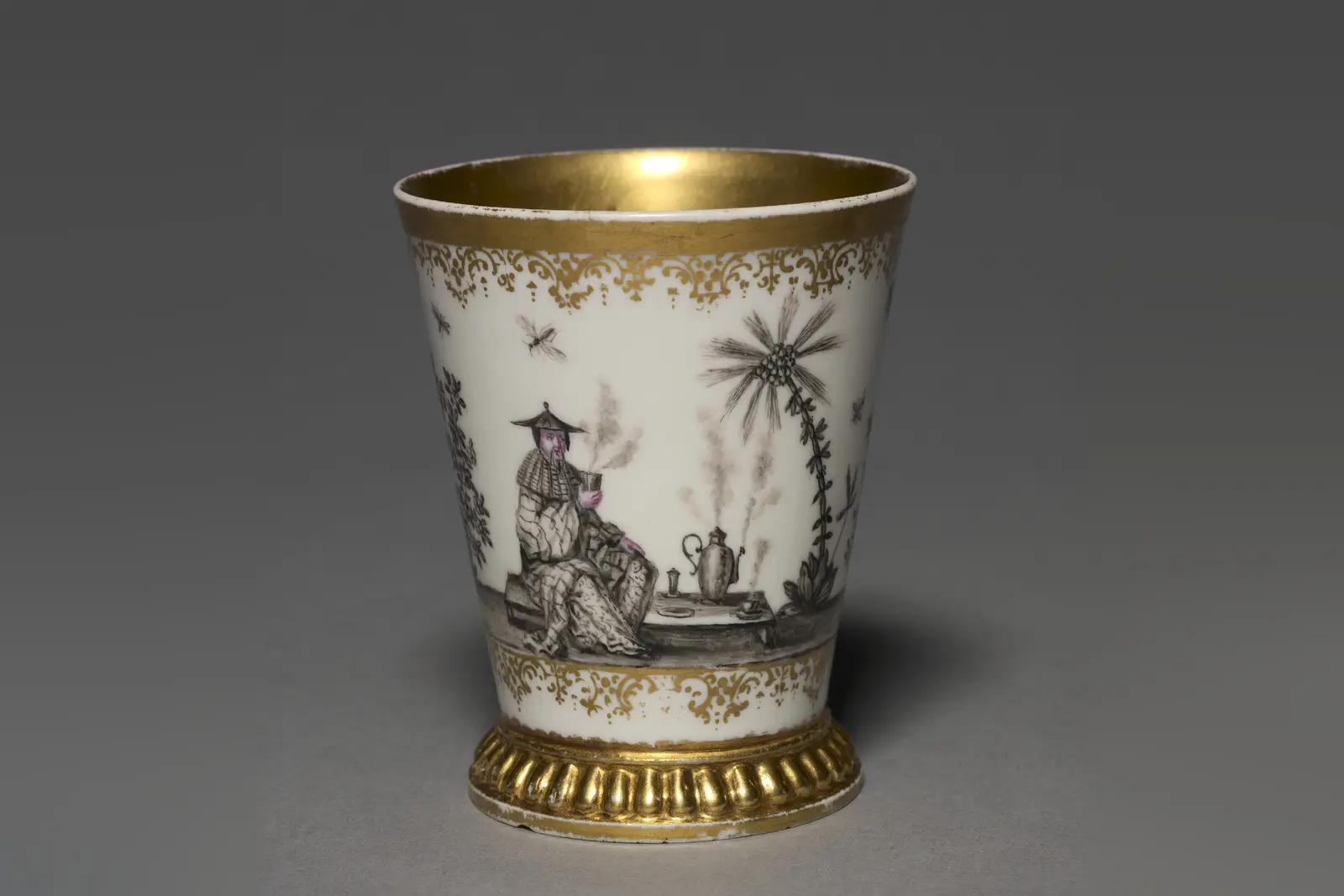
"Beaker, Meissen Porcelain Factory (card)" by Cleveland Museum of Art — https://www.clevelandart.org/art/1952.452 — CC0 1.0 (https://creativecommons.org/publicdomain/zero/1.0/); modified: padded with the photograph's own background to a 3:2 frame, left and right, with a feathered seam
Cite this page
Kiln, Easel & Anvil. “Iznik Pottery: An Artichoke Dish, per the Cleveland Record.” Published 28 November 2026. https://kilneaselandanvil.com/fired-clay/iznik-pottery/ (accessed on the day you read it).
How a record is checked Every correction, dated Report an error on this page (contact@kilneaselandanvil.com)