Technique, diagrammed
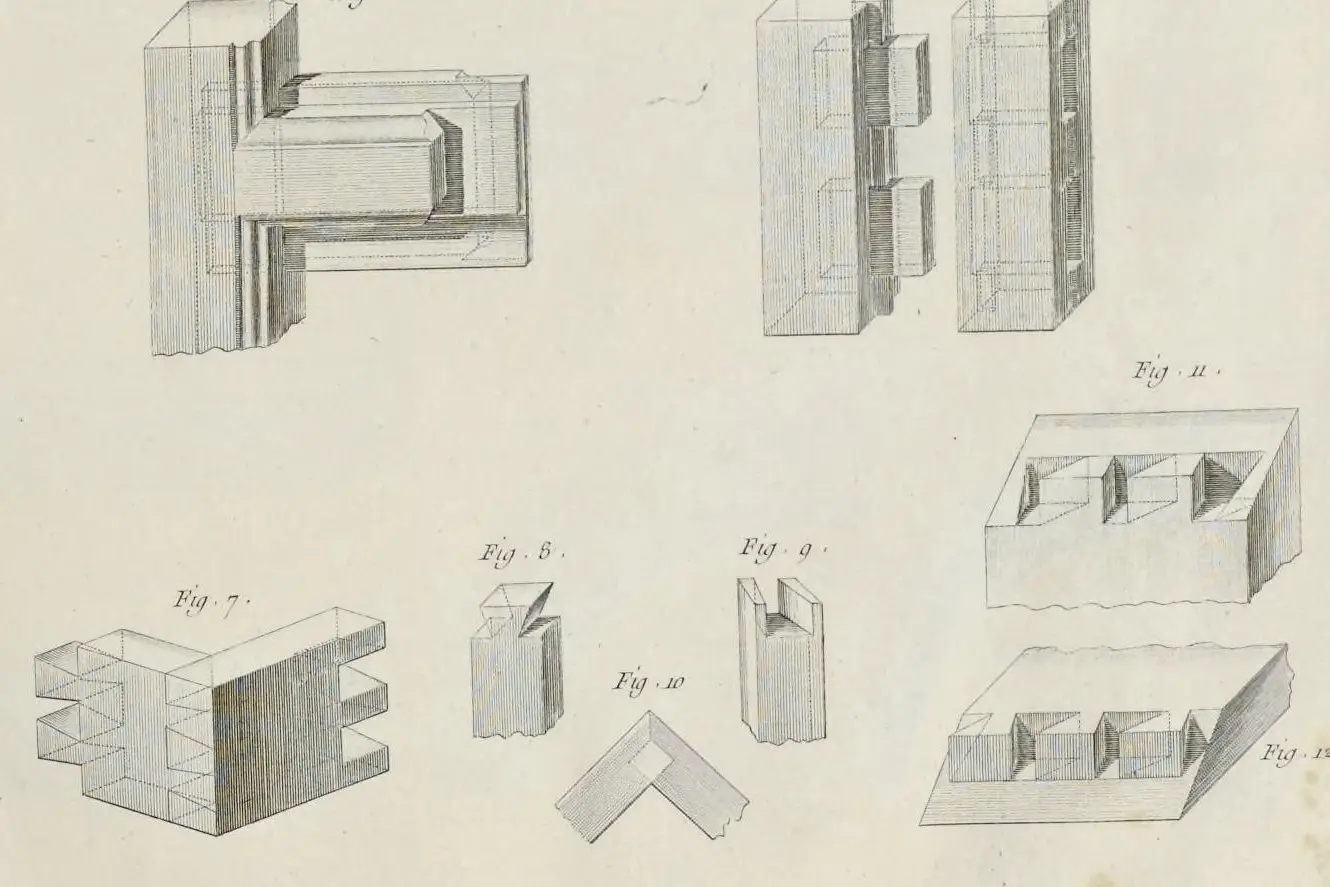
Dovetail Joint: How Roubo Placed the Tails in a Drawer
A dovetail's flared tails let two boards part one way only. According to Roubo's 18th-century manual, they go in drawer sides so a pull cannot open it.
Catalogued
Picture credit
"Assemblages doubles et à queues d'aronde, Pl. 9 of L'Art du menuisier (Roubo), detail" by André-Jacob Roubo and Berthault — https://archive.org/details/gri_33125009321916 — Public domain (US: published in 1769, before 1931; DE/FR: Roubo, who drew the plate, died in 1791 per the Getty Research Institute library record of the scan, more than 70 years ago; the engraving, published in 1769, is signed 'Berthault Sculp.' with no first name: the Internet Archive's library records name two engravers of that name working then, Nicolas Berthault, d. 1785, and Pierre Gabriel Berthault, 1748-1819 (archive.org search of creator Berthault, read 2026-11-27, rights-research/evidence/ia/search-berthault.json), so whichever of them engraved it died more than 70 years ago); modified: cropped to a 3:2 frame around Fig. 7 to 12 and the lower halves of Fig. 5 and 6