Is Glass a Liquid? Old Window Panes Don't Prove It
Short answer
Not in any way a window can show: per the abstract of a 2018 study, a medieval cathedral glass flows about 1 nm at most in a billion years, which suggests flow cannot explain old panes that are thicker at the bottom. Look at Fig. 2 of the plate below, where window glass is spun out as a flat disc.
Technique sheet
- Technique
- Window glass spun out as a flat disc, the plat
- Kind of work
- Flat glass for windows (verrerie à plats pour les vitres)
- Principle in one line
- A blown bosse is fixed to an iron rod (pontis), opened and turned until it spreads into a flat plat
- What to look for
- A centre the explanation calls the œil de bœuf, or noix
- Usual period and place
- Shown in a plate volume printed in Paris in 1772
- Example in a collection
- Encyclopédie, Recueil de planches vol. 10, Verrerie en bois, Pl. XV, Fig. 2 (Getty Research Institute copy)
This record as CSV (is-glass-a-liquid-technique.csv) (notes on this file)
Data: Encyclopédie, Recueil de planches vol. 10 (Paris 1772), Verrerie en bois, explanation pp. 5 and 7 and Pl. XV, Getty Research Institute copy (public domain)
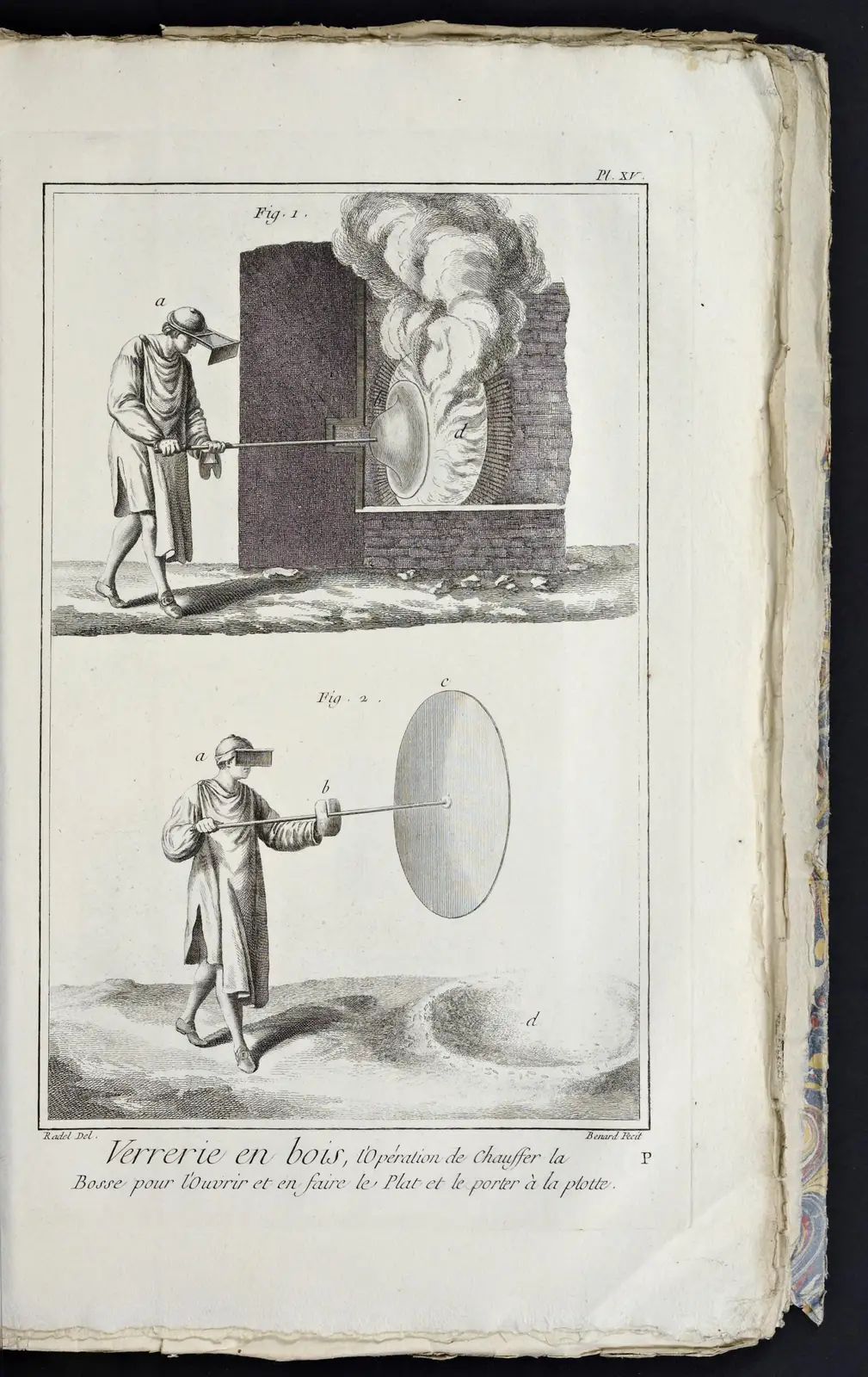
Verrerie en bois, Pl. XV, from the plate volume of the Encyclopédie printed in Paris in 1772. In Fig. 1 the bosse, a blown bubble of glass, is opened at the furnace; in Fig. 2 it has become a flat plat, marked c, on the end of the rod.
Collection: Getty Research Institute copy, Encyclopédie, Recueil de planches vol. 10 (1772), Verrerie en bois, Pl. XV
“Verrerie en bois, Pl. XV (Encyclopédie, Recueil de planches vol. 10)”, Robert Bénard after Radel / Radel (drawing) and Robert Bénard (engraving); public domain.
Complete credit
"Verrerie en bois, Pl. XV (Encyclopédie, Recueil de planches vol. 10)" by Radel (drawing) and Robert Bénard (engraving) — https://archive.org/details/gri_33125006581942 — Public domain (US: published in 1772, before 1931; DE/FR: drawn and engraved for a volume printed in Paris in 1772 (title page), so its makers died more than 70 years ago; engraver Robert Bénard born 1734 per the library record of the scan)
Card and share picture, a 3:2 copy of this object’s photograph: "Verrerie en bois, Pl. XV, Fig. 2 (Encyclopédie, Recueil de planches vol. 10)" by Radel (drawing) and Robert Bénard (engraving) — https://archive.org/details/gri_33125006581942 — Public domain (US: published in 1772, before 1931; DE/FR: drawn and engraved for a volume printed in Paris in 1772 (title page), so its makers died more than 70 years ago; engraver Robert Bénard born 1734 per the library record of the scan); modified: cropped to a 3:2 frame around Fig. 2
A wavy old window pane can look as if the glass slowly slumped. Per the paper's abstract, though, a 2018 study puts the flow of a medieval cathedral glass at about 1 nm at most over a billion years, and a nanometre is a millionth of a millimetre. Look at the disc in Fig. 2, which is how the 1772 plate volume shows glass for windows being made.
What do old window panes look like?
The question usually comes from a particular story. Per the paper's abstract, the 2018 study by Ozgur Gulbiten and three colleagues describes it as a popular urban legend: medieval cathedral windows are said to have flowed, because their glass is commonly seen to be thicker at the bottom than at the top abstract.
The plate volume of the Encyclopédie printed in 1772 shows where flat glass for windows could come from. One section covers the grande verrerie à vitres ou en plats, a large glasshouse making window glass in plats, flat round discs scanned page. Its explanation of Pl. XV says that in Fig. 2 a worker turns the opened bosse “pour finir de l'étendre & en faire un plat ou table de verre”, to finish spreading it out and make a plat, or table, of glass (translated here; Verrerie, p. 7).
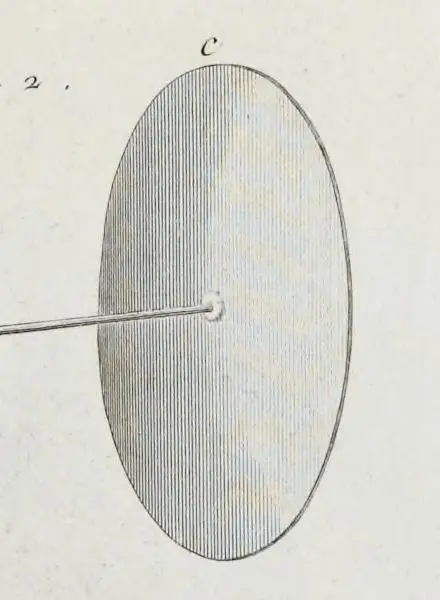
Pl. XV, Fig. 2, detail: the plat marked c, with the rod meeting it at the centre. The explanation calls it a plat ready to be laid on the pelote, a flattened heap of ash and fine embers.
Collection: Getty Research Institute copy, Encyclopédie, Recueil de planches vol. 10 (1772), Verrerie en bois, Pl. XV
Detail. The small picture marks where it sits in the whole object.
“Verrerie en bois, Pl. XV, Fig. 2, detail of the plat (Encyclopédie, Recueil de planches vol. 10)”, Robert Bénard after Radel / Radel (drawing) and Robert Bénard (engraving); public domain.
Complete credit
"Verrerie en bois, Pl. XV, Fig. 2, detail of the plat (Encyclopédie, Recueil de planches vol. 10)" by Radel (drawing) and Robert Bénard (engraving) — https://archive.org/details/gri_33125006581942 — Public domain (US: published in 1772, before 1931; DE/FR: drawn and engraved for a volume printed in Paris in 1772 (title page), so its makers died more than 70 years ago; engraver Robert Bénard born 1734 per the library record of the scan); modified: cropped to the detail of Fig. 2: the plat marked c and its centre, where the rod meets it
The same section's explanations name the middle of the disc in two more places. The rod, the pontis, is “placé à la noix de la bosse”, placed at the noix of the bosse (translated here; Pl. XIV, Verrerie, p. 7). A plat ready to be packed has an “œil de bœuf, ou noix faisant le centre du plat”, a bull's eye or knot that forms its centre (translated here; Pl. I, Fig. 2, Verrerie, p. 5).
As for why some old panes are uneven, none of the sources read for this page says how thick a plat was at its centre or its rim, or how panes were cut from one. A disc spun out from a knot on the end of a rod is consistent with glass of uneven thickness. That is an inference from the process, not a finding in any source here.
How fast would glass have to flow?
Viscosity measures how strongly a material resists flowing. Per the paper's abstract, the 2018 study looked at a typical medieval glass composition used in Westminster Abbey. The study found a room-temperature viscosity on the order of 1024 to 1025 Pa·s, per the abstract, depending on the glass's thermal history, meaning how it was heated and cooled.
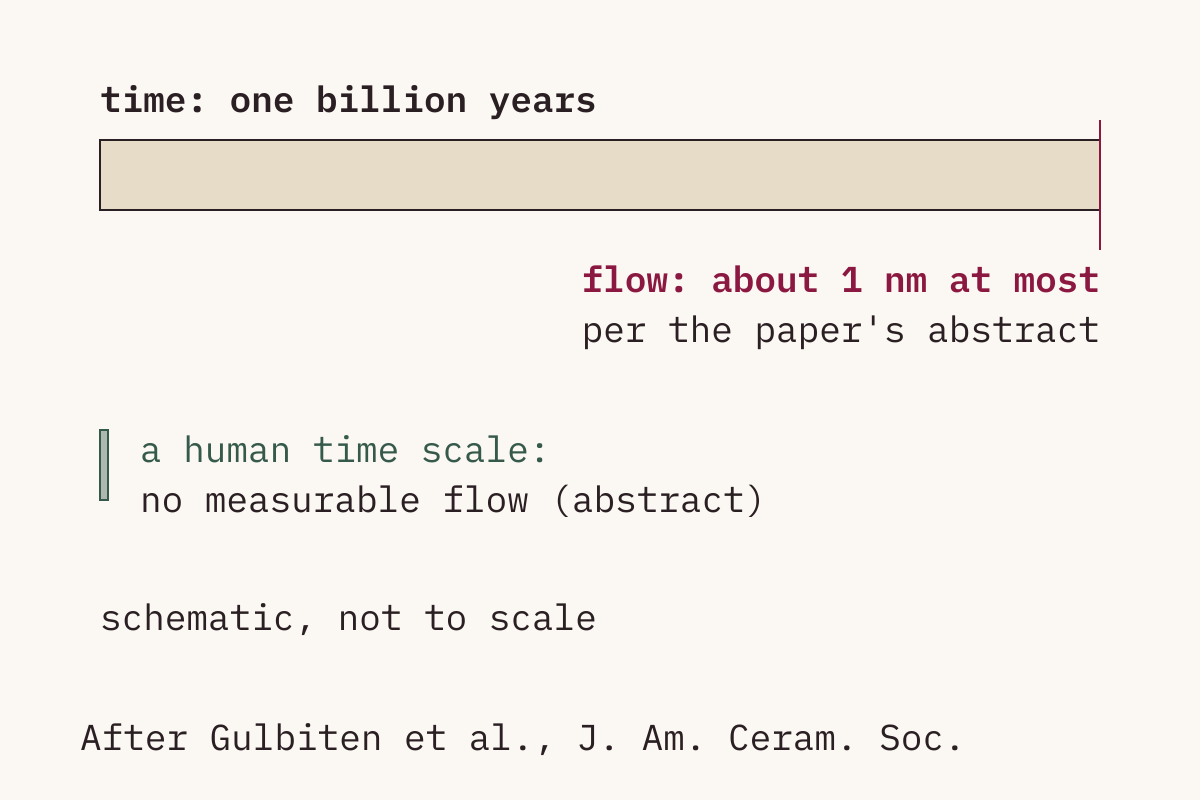
That range is about 16 orders of magnitude lower than an earlier study found for soda lime silicate glass, the abstract says. Even so, the viscosity is far too high, per the paper's abstract, for any measurable flow on a human time scale. Using expressions for glass flowing over a wall, the authors calculate, per the paper's abstract, a maximum flow of about 1 nm over a billion years.
 schematic, not to scale
How much a medieval cathedral glass could flow, per the abstract of Gulbiten and colleagues: about 1 nm at most over a billion years, and no measurable flow on a human time scale.
Source: Gulbiten, Mauro, Guo and Boratav, “Viscous flow of medieval cathedral glass”, Journal of the American Ceramic Society, January 2018 (abstract)
Read the figure as text
- Over one billion years: about 1 nm of flow at most, per the paper's abstract.
- Over a human time scale: no measurable flow, per the paper's abstract.
"Flow of a medieval cathedral glass over a billion years, per the paper's abstract" by Kiln, Easel & Anvil, https://kilneaselandanvil.com/glass/is-glass-a-liquid/ — CC BY 4.0, https://creativecommons.org/licenses/by/4.0/
Data: Gulbiten, Mauro, Guo and Boratav, "Viscous flow of medieval cathedral glass", Journal of the American Ceramic Society, January 2018 (values from the abstract)
A window a few hundred years old has had only a tiny fraction of the billion years in the abstract. On that figure, the amount of flow suggests nothing close to a difference in thickness that could be seen from the top of a pane to the bottom. The wavy pane looks like evidence of flow. The measured viscosity points the other way.
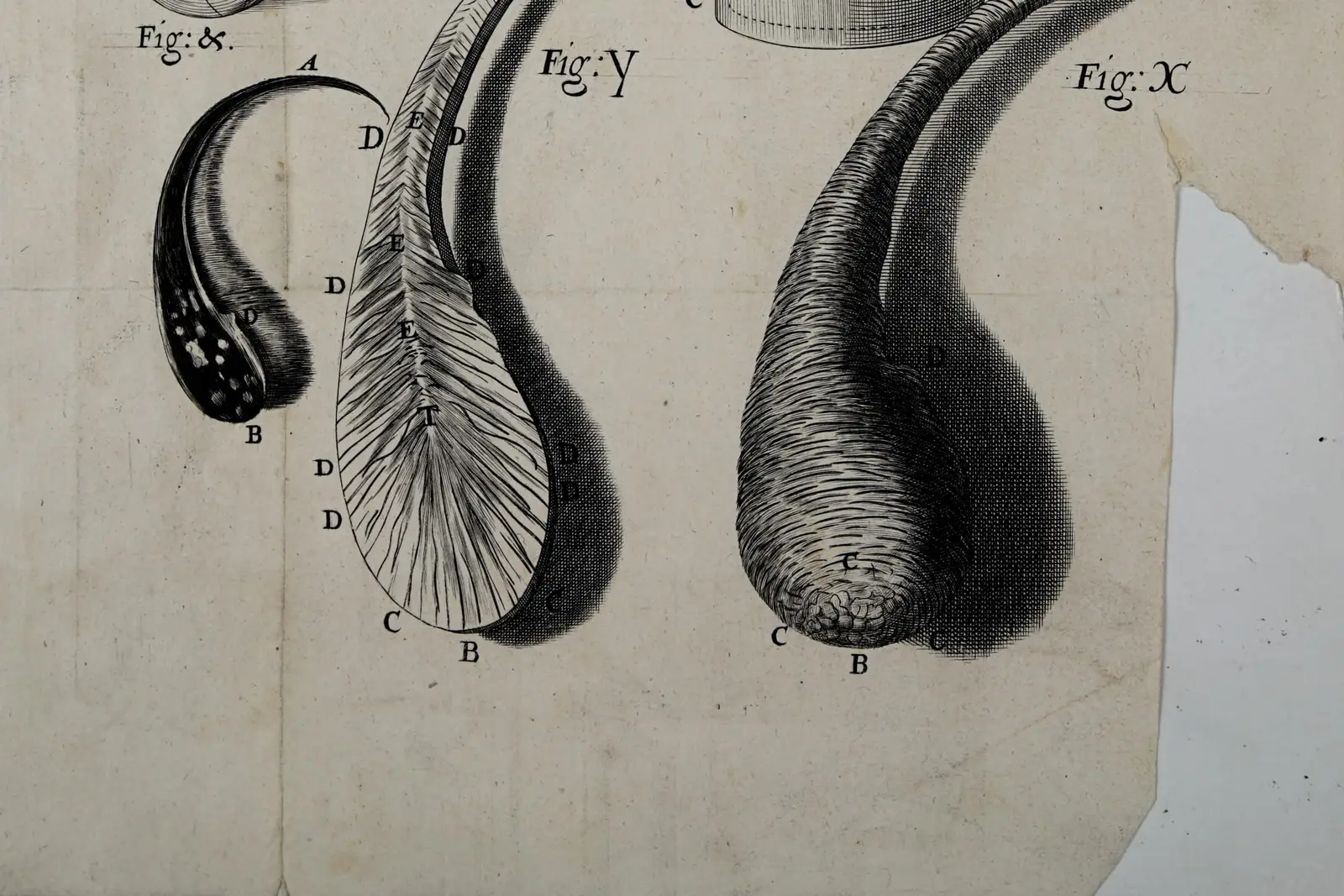
A small glass object elsewhere in this section, Prince Rupert's drop, is read through Robert Hooke's Micrographia of 1665.
Liquid, solid or glass: how do they compare?
Is glass a liquid, then, or a solid? The abstract does not settle it with either word. Per the paper's abstract, the study draws on glass transition theory and on a model of how the viscosity of glass, which is out of equilibrium, depends on its composition abstract.
The window question turns on the measured viscosity. A liquid in the everyday sense flows enough to see, and per the paper's abstract this glass does not flow measurably on a human time scale.
The 2018 study was not the first paper on the question. Its reference list includes a 1998 paper by Edgar Zanotto in the American Journal of Physics, titled Do cathedral glasses flow? bibliography. Only the citation of that paper was read for this page, so its findings are not reported here.
What each source says about old panes and flowing glass, with the level at which each source was read.
Source: Gulbiten, Mauro, Guo and Boratav, Journal of the American Ceramic Society, January 2018 (abstract); Zanotto, American Journal of Physics, 1998 (citation only)
Read the figure as text
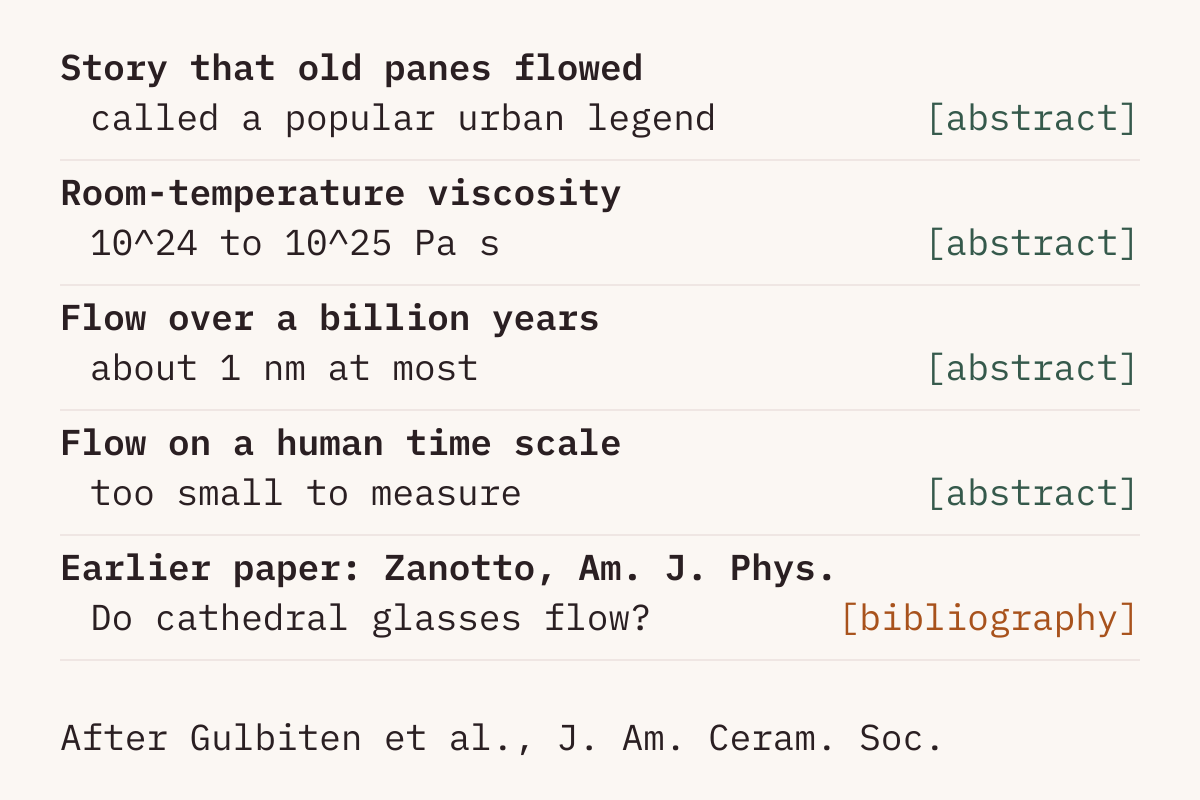
| Claim or measure | What the source says | Source and reading level |
|---|---|---|
| Story that old panes flowed, per the abstract | Called a popular urban legend | Gulbiten et al. 2018 abstract |
| Room-temperature viscosity, per the abstract | 1024 to 1025 Pa·s, depending on thermal history | Gulbiten et al. 2018 abstract |
| Flow over a billion years, per the abstract | About 1 nm at most | Gulbiten et al. 2018 abstract |
| Flow on a human time scale, per the abstract | Too small to measure | Gulbiten et al. 2018 abstract |
| Earlier paper, citation only | Titled Do cathedral glasses flow? | Zanotto 1998 bibliography |
"Old window panes and flowing glass: what each source says" by Kiln, Easel & Anvil, https://kilneaselandanvil.com/glass/is-glass-a-liquid/ — CC BY 4.0, https://creativecommons.org/licenses/by/4.0/
Data: Gulbiten, Mauro, Guo and Boratav, "Viscous flow of medieval cathedral glass", Journal of the American Ceramic Society, January 2018 (values from the abstract); Zanotto, "Do cathedral glasses flow?", American Journal of Physics, 1998 (title only)
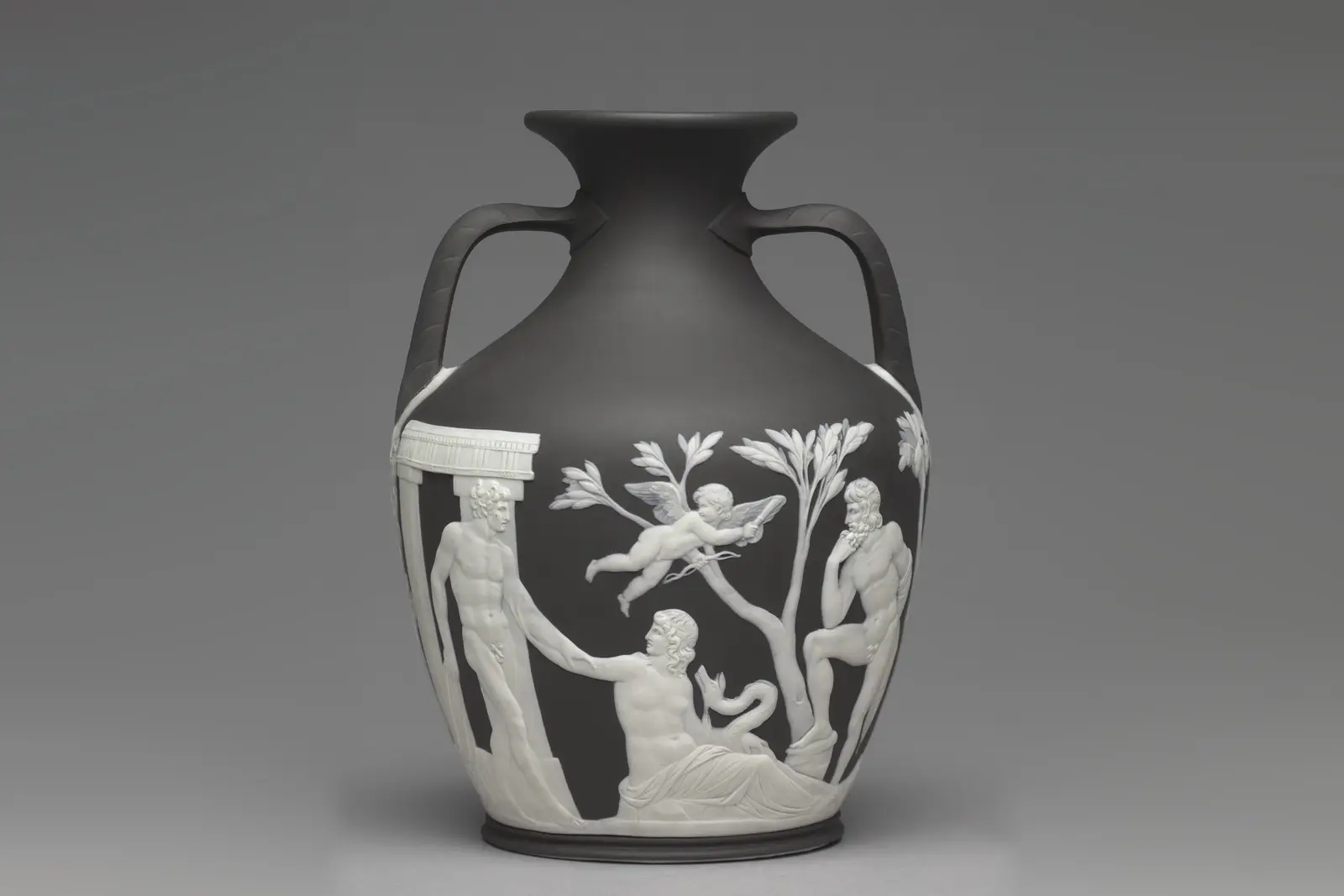
Elsewhere on this site, glass and glaze are read through how they were made: two layers of glass in the Portland Vase, and the white tin glaze over the clay of Delftware.
Under the loupe: go back to the point where the rod meets the centre of the disc in Fig. 2, the spot the explanation calls the noix, and then look at the mirror painted into the Arnolfini Portrait.
Pl. XV, Fig. 2, detail: the plat marked c, with the rod meeting it at the centre. The explanation calls it a plat ready to be laid on the pelote, a flattened heap of ash and fine embers.
Collection: Getty Research Institute copy, Encyclopédie, Recueil de planches vol. 10 (1772), Verrerie en bois, Pl. XV
Detail. The small picture marks where it sits in the whole object.
“Verrerie en bois, Pl. XV, Fig. 2, detail of the plat (Encyclopédie, Recueil de planches vol. 10)”, Robert Bénard after Radel / Radel (drawing) and Robert Bénard (engraving); public domain.
Complete credit
"Verrerie en bois, Pl. XV, Fig. 2, detail of the plat (Encyclopédie, Recueil de planches vol. 10)" by Radel (drawing) and Robert Bénard (engraving) — https://archive.org/details/gri_33125006581942 — Public domain (US: published in 1772, before 1931; DE/FR: drawn and engraved for a volume printed in Paris in 1772 (title page), so its makers died more than 70 years ago; engraver Robert Bénard born 1734 per the library record of the scan); modified: cropped to the detail of Fig. 2: the plat marked c and its centre, where the rod meets it
Sources and reading levels
- Ozgur Gulbiten, John C. Mauro, Xiaoju Guo and Olus N. Boratav, "Viscous flow of medieval cathedral glass", Journal of the American Ceramic Society 101 (1), 5–11 (January 2018; online 3 August 2017). DOI 10.1111/jace.15092 doi.org/10.1111/jace.15092Read: abstract
- Encyclopédie, Recueil de planches, sur les sciences, les arts libéraux, et les arts méchaniques, avec leur explication, Neuvieme livraison, ou dixieme volume (Paris: Briasson, 1772; the title page names no editor): Verrerie en bois, second section, explanation pp. 5 and 7 and Pl. XV (drawn by Radel, engraved by Robert Bénard). Getty Research Institute copy. Public domain (published 1772; Diderot died 1784, d'Alembert 1783) archive.org/details/gri_33125006581942Read: scanned page
- Edgar Dutra Zanotto, "Do cathedral glasses flow?", American Journal of Physics 66 (5), 392–395 (1998). DOI 10.1119/1.19026 doi.org/10.1119/1.19026Read: bibliography
More objects in Glass
Technique, diagrammed
Prince Rupert's Drop: Hooke's 1665 Account of a Snapped Stem
Catalogued
Picture credit
"Schem. IIII, glass drops (Hooke, Micrographia)" by Robert Hooke — https://archive.org/details/micrographiaorso00hook_4 — Public domain (US: published in 1665, before 1931; DE/FR: Robert Hooke died in 1703 per the library record of the scan (1635-1703), more than 70 years ago); modified: cropped to a 3:2 frame across the full width of the plate from the drop figures down
Object reading
Portland Vase: How the White Glass Was Cut, per Wedgwood
Catalogued
Picture credit
"Portland Vase, Wedgwood copy (Cleveland Museum of Art) (card)" by Cleveland Museum of Art — https://www.clevelandart.org/art/1918.823 — CC0 1.0 (https://creativecommons.org/publicdomain/zero/1.0/); modified: padded with the photograph's own background to a 3:2 frame, left and right, with a feathered seam
Cite this page
Kiln, Easel & Anvil. “Is Glass a Liquid? Old Window Panes Don't Prove It.” Published 28 November 2026. https://kilneaselandanvil.com/glass/is-glass-a-liquid/ (accessed on the day you read it).
How a record is checked Every correction, dated Report an error on this page (contact@kilneaselandanvil.com)