Portland Vase: How the White Glass Was Cut, per Wedgwood
Short answer
The Portland Vase is Roman dark-blue glass whose white reliefs, per Josiah Wedgwood’s description reprinted in 1845, were carved from one white coating, with the ground around them lowered beneath it almost everywhere scanned page. The photograph shows his Cleveland copy, so look at the section drawing under the first heading instead.
Object record
- Object
- Portland Vase (the Roman original, not the Cleveland copy)
- Maker
- Not named; a Roman antiquity, per the Cleveland Museum of Art record
- Date
- First century AD, per the Cleveland Museum of Art record
- Material
- Dark-blue glass, per the Cleveland record; figures cut in a white glass layer, per Wedgwood
- Dimensions
- No measurement in centimetres found in a readable source for the original
- Collection
- British Museum, per the Cleveland Museum of Art record
This record as CSV (portland-vase-record.csv) (notes on this file)
Data: Cleveland Museum of Art, 1918.823 collection record (CC0); Josiah Wedgwood, Description of the Portland Vase, reprinted London 1845, short phrases with page numbers
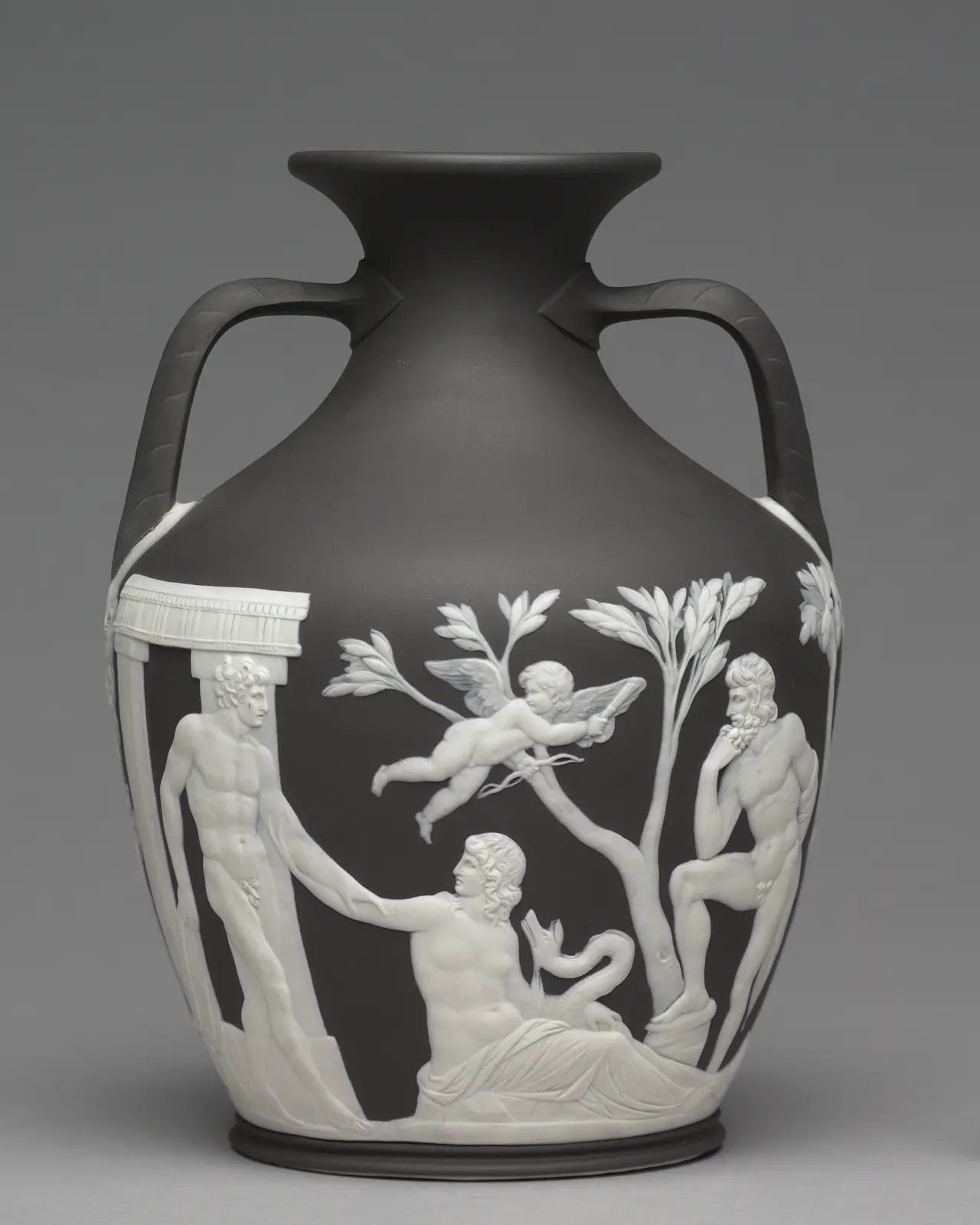
Wedgwood’s jasperware copy of the Portland Vase (Cleveland Museum of Art 1918.823), c. 1790, 26.4 x 17.8 cm overall as the record lists it; the Roman original is cameo glass.
Collection: Cleveland Museum of Art, 1918.823
"Portland Vase, Wedgwood copy (Cleveland Museum of Art)" by Cleveland Museum of Art — https://www.clevelandart.org/art/1918.823 — CC0 1.0 (https://creativecommons.org/publicdomain/zero/1.0/)
Card and share picture, a 3:2 copy of this object’s photograph: "Portland Vase, Wedgwood copy (Cleveland Museum of Art) (card)" by Cleveland Museum of Art — https://www.clevelandart.org/art/1918.823 — CC0 1.0 (https://creativecommons.org/publicdomain/zero/1.0/); modified: padded with the photograph's own background to a 3:2 frame, left and right, with a feathered seam
Around the white figures on the Portland Vase, the blue ground drops away almost everywhere. After what he called “a very careful examination of the original”, Josiah Wedgwood reported that the white had not been pressed down into the blue, as an earlier writer believed, but that “the ground is, almost in every part, cut down below the white” (p. 8) scanned page. In the section drawing under the first heading, that lowered blue is the strip between the two white figures.
The Cleveland Museum of Art describes the original as “a Roman antiquity, made of dark-blue glass, dating from the first century AD” full text. According to the same record, around 1790 the 3rd Duke of Portland lent the vase to the potter Josiah Wedgwood “to make exact replicas in ceramic”, and the 4th Duke eventually deposited the original in the British Museum.
The Cleveland vase is one of those early ceramic copies, catalogued as jasperware, and this page leaves the technique of its manufacture aside. Everything that follows concerns the Roman glass original, as Wedgwood described it.
How do the two layers sit?
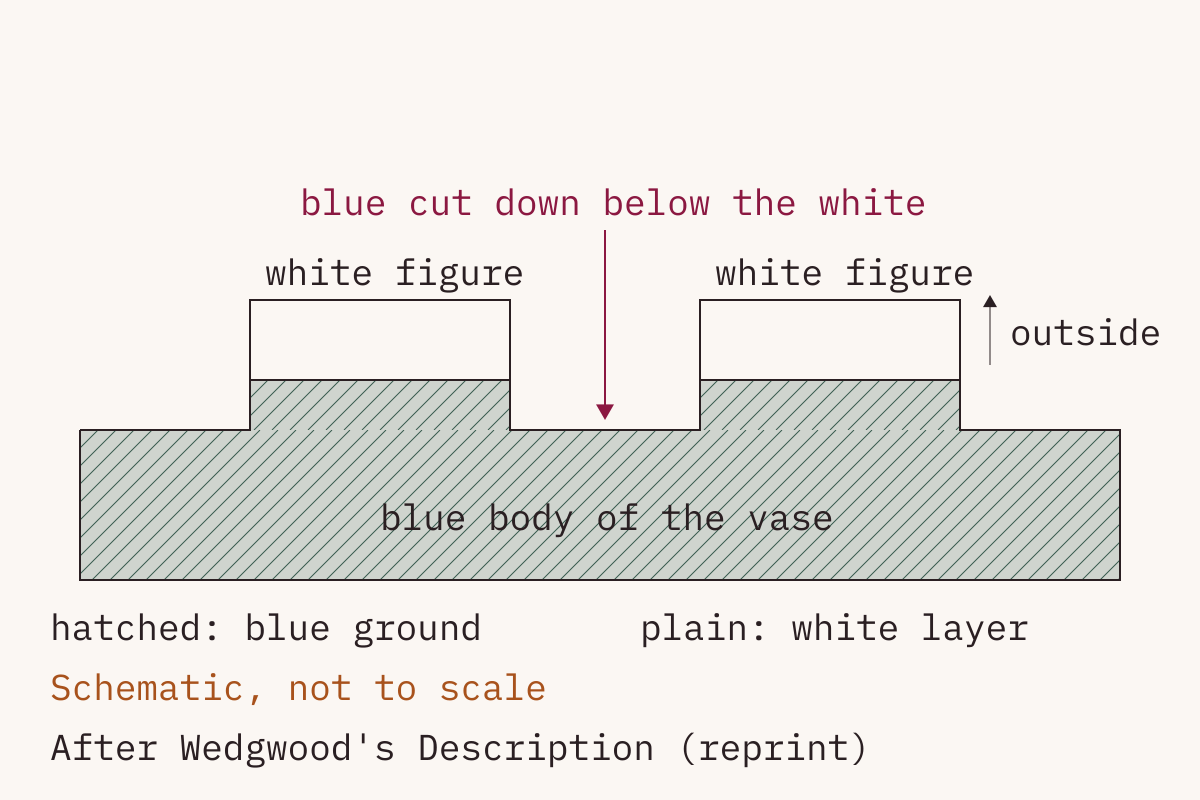 schematic, not to scale
The two layers in section: the white figures sit on flat steps of blue, and between them the blue surface lies lower than the underside of the white. The tints mark the layers only, not the colours of the glass.
Source: Wedgwood, Description of the Portland Vase, 1845 reprint, pp. 8–10
Read the figure as text
- Blue body: a transparent blue glass, drawn hatched (p. 9)
- White layer: the figures, drawn plain (p. 10)
- Under each figure: the blue stands up as a flat step (p. 8)
- Between the figures: the blue is cut down below the white (p. 8)
- No thicknesses are given in the source, so none are drawn
"Portland Vase in section: a white layer over a blue ground cut below it" by Kiln, Easel & Anvil, https://kilneaselandanvil.com/glass/portland-vase/ — CC BY 4.0, https://creativecommons.org/licenses/by/4.0/
Data: Josiah Wedgwood, Description of the Portland Vase, reprinted London 1845, pp. 8–10
Wedgwood distinguishes two glasses. The ground, or body of the vase, is “a transparent blue glass, so deep in colour” that it can appear black and opaque when viewed from above or by reflected light (pp. 9–10). The raised figures are “of a white glass”, which is translucent enough in places that “the blue colour of the ground is seen through the thin parts of it” (p. 10).
His conclusion is that the blue body was “coated all over, as far as the bas reliefs were intended to reach, with the white glass”, and that “the figures were afterwards produced in this coat by cutting it down to the blue ground in the manner of real cameos” (p. 10). That is the sense in which the vase is called cameo glass: a vessel whose outer layer of one colour has been carved back, so that the figures stand in relief on an underlying layer of another colour.
The blue below the white
The carving did not stop at the boundary between the two layers. Wedgwood found that the white glass is “in no one instance below the surface of the blue ground”, while the blue surrounding the figures was cut lower than the white almost everywhere (p. 8).
Because his text identifies both the location of this trace and its cause, the lowered blue counts as what this site calls the maker’s tell, a trace on an object that shows how it was made.
Wedgwood also explains how the carver controlled the appearance of the figures, giving them “the effect of light and shade, by cutting down the parts to greater or less thinness” (p. 11). Where the white was left thinner, more of the blue beneath showed through. Neither this page nor its source gives working details or measured thicknesses for that carving.
A glass object made by a quite different route is Prince Rupert’s drop, the glass drop Hooke described in 1665 full text.
What does Wedgwood’s description argue?
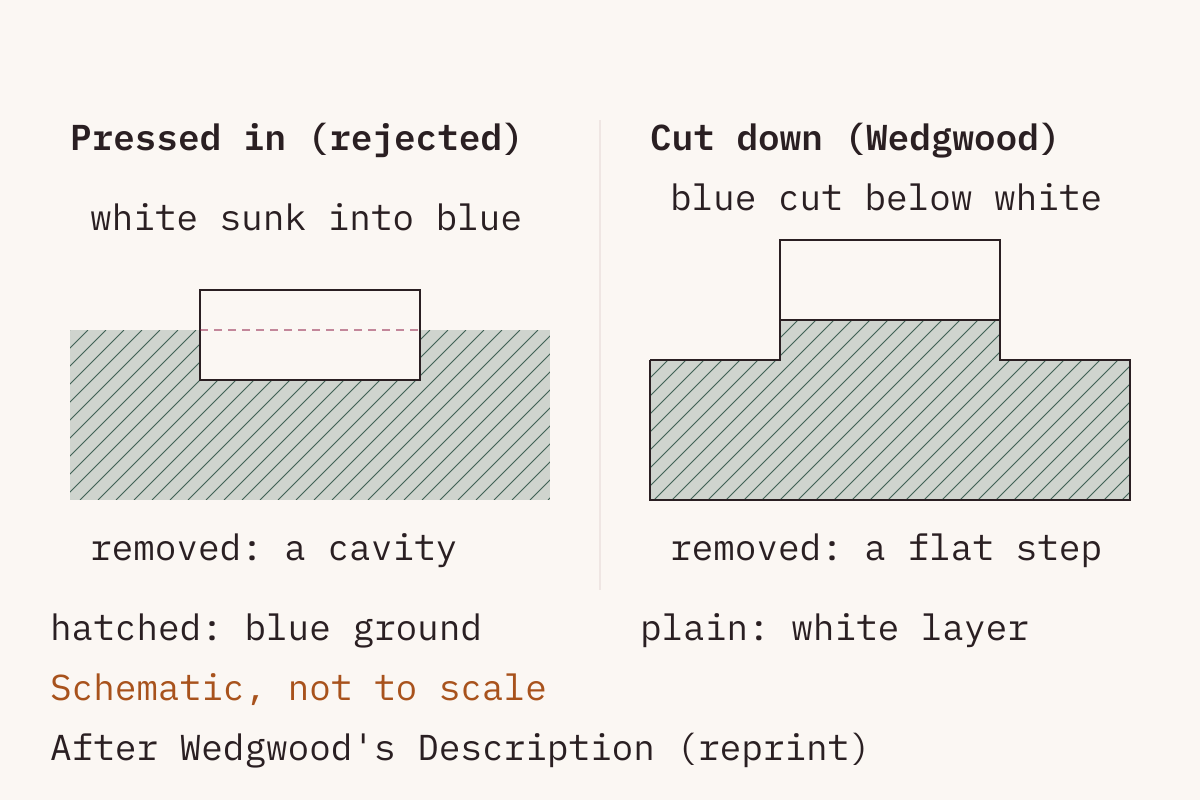 schematic, not to scale
Two accounts of the white figures. Left, the account Wedgwood rejects, with the white pressed into the blue. Right, the account he reports from the vase, with the blue cut below the white. The tints mark the layers only.
Source: Wedgwood, Description of the Portland Vase, 1845 reprint, p. 8
Read the figure as text
- Pressed in: the white lies below the surface of the blue around each figure; removing a figure would leave a cavity
- Cut down: the blue is cut below the white; removing a figure would leave a flat step of blue
"Portland Vase: the pressed-in account and the cut-down account" by Kiln, Easel & Anvil, https://kilneaselandanvil.com/glass/portland-vase/ — CC BY 4.0, https://creativecommons.org/licenses/by/4.0/
Data: Josiah Wedgwood, Description of the Portland Vase, reprinted London 1845, p. 8
The edition consulted for this page is a reprint published in London in 1845, with additional notes by Thomas Windus, digitised from the copy in the Frick Art Reference Library scanned page. Wedgwood himself died in 1795, so the description it reprints dates from several decades before that edition.
An earlier writer, quoted at length by Wedgwood, had proposed a different explanation of “the mode of forming the figures” (p. 7): separately formed figures of one colour, afterwards united to a ground of another. Wedgwood doubted that “such an operation would be practicable” on a vessel as large and hollow as this one, since a softened vessel would distort under the necessary pressure (p. 7).
The same writer offered visual evidence, which Wedgwood restates as meaning that “the white enamel has been pressed, and now lies, below the surface of the blue glass, about the edges of all the figures”. On that interpretation, removing the figures would leave “corresponding cavities in the blue ground” (p. 8).
Wedgwood rejected that interpretation. If the white figures were removed, he writes, “they would leave corresponding flat prominences of the blue” instead (p. 8). He nevertheless acknowledged that the two arrangements look so similar that “any person, on a hasty observation, might be liable to make the mistake” (p. 8).
The white under the handles
One further piece of evidence in Wedgwood’s account comes from the handles. Between the lower ends of the handles and the body, “there remains a stratum of white glass” roughly as thick as the most prominent parts of the figures, which he treats as “a strong presumption that it was originally a continuation of the same stratum” (p. 10). He interprets it as an unintended blemish produced by the method, not as deliberate decoration.
Windus disagreed in a footnote printed on the same page. “This certainly was left intentionally”, his note begins, and it interprets the white there as carved into fillets from which the masks on the handles hang (p. 10). The reprint therefore presents both opinions, one above the other, and this page does not choose between them.
The claims, page by page
| Claim | Page | Source |
|---|---|---|
| In Wedgwood’s account the white glass lies nowhere below the blue ground | 8 | Wedgwood |
| The blue ground is cut down below the white almost everywhere | 8 | Wedgwood |
| Removing the white figures would leave flat raised areas of blue | 8 | Wedgwood |
| In some places the white is cut away and the blue forms the relief | 8 | Wedgwood |
| The pillar behind the standing young man is cut from the blue ground | 8 | Wedgwood |
| The body is a transparent blue glass of a very deep colour | 9 | Wedgwood |
| The white glass lets the blue show through where it is thin | 10 | Wedgwood |
| The figures were cut in a white coat laid over the blue body | 10 | Wedgwood |
| A layer of white glass lies under the lower ends of the handles | 10 | Wedgwood |
| Windus held that the white under the handles was left on purpose | 10 | Windus’s note |
| The cutter varied the thickness of the white to give light and shade | 11 | Wedgwood |
| The original is a Roman antiquity of dark-blue glass from the first century AD | record | Cleveland Museum of Art |
Download the data (CSV, portland-vase-wedgwood-claims.csv) (notes on this file) Data: Josiah Wedgwood, Description of the Portland Vase, reprinted London 1845, with notes by Thomas Windus, pp. 8–11, short phrases with page numbers; Cleveland Museum of Art, 1918.823 collection record (CC0)
For how a museum glass might change over centuries, see the question of whether glass is a liquid.
Where is the white cut entirely away?
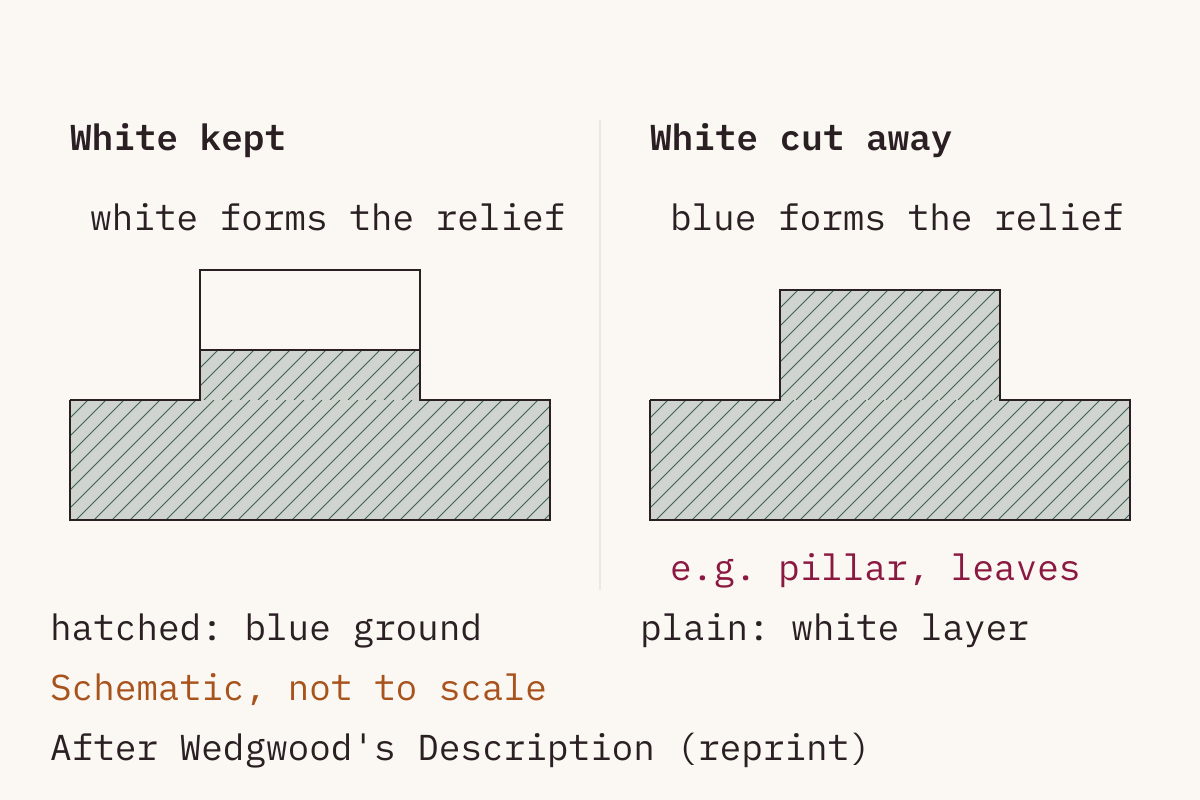 schematic, not to scale
Where the white stays, it forms the relief; where it is cut entirely away, the blue ground forms the relief, as Wedgwood reports for the pillar and the leaves. The tints mark the layers only.
Source: Wedgwood, Description of the Portland Vase, 1845 reprint, p. 8
Read the figure as text
- White kept: the white layer forms the figure, standing on a step of blue
- White cut away: the blue ground itself is raised to form the relief, for example the pillar and the leaves
"Portland Vase: white kept on a figure, white cut entirely away elsewhere" by Kiln, Easel & Anvil, https://kilneaselandanvil.com/glass/portland-vase/ — CC BY 4.0, https://creativecommons.org/licenses/by/4.0/
Data: Josiah Wedgwood, Description of the Portland Vase, reprinted London 1845, p. 8
Wedgwood identifies particular locations on the vase. “In some places the white is cut entirely away, and the ground itself, by that means, forms the bas relief” (p. 8). He says this is very visible “in the leaves of the trees which are intended to be kept back”, and most noticeably in the pillar standing behind the young man.
He also suggests a reason for the treatment of the pillar. In his interpretation, a white pillar would have interfered with the outline of the white figure in front of it, so the artist “cut the pillar entirely out of the blue ground” (p. 8). That is Wedgwood’s explanation of an artistic decision, not documentary evidence of the artist’s intention.
On other ancient glass, too, he reported the blue ground cut into, in fragments of the same kind of work in “Mr. Towneley’s collection”. On one of them, where the white had been accidentally chipped off, “it appears evidently that the blue ground had been cut into so as to form a part of the bas relief” (pp. 8–9).
These locations belong to the Roman glass original. The Cleveland copy in the photograph at the top of the page cannot serve as evidence for them, and no source consulted for this page identifies them on that copy. A different method of combining white with blue, involving no carving at all, appears on delftware, where an opaque white enamel covers a porous clay body.
Under the loupe: the right half of the drawing below stands for the pillar behind the standing young man, which Wedgwood says was cut entirely out of the blue ground; compare a join made in stone on the Venus de Milo, two marble elements joined at the hips, per the Louvre.
schematic, not to scaleWhere the white stays, it forms the relief; where it is cut entirely away, the blue ground forms the relief, as Wedgwood reports for the pillar and the leaves. The tints mark the layers only.
Source: Wedgwood, Description of the Portland Vase, 1845 reprint, p. 8
"Portland Vase: white kept on a figure, white cut entirely away elsewhere" by Kiln, Easel & Anvil, https://kilneaselandanvil.com/glass/portland-vase/ — CC BY 4.0, https://creativecommons.org/licenses/by/4.0/
Data: Josiah Wedgwood, Description of the Portland Vase, reprinted London 1845, p. 8
Sources and reading levels
- Josiah Wedgwood, Reprint of a Description of the Portland Vase, formerly the Barberini: the manner of its formation, and the various opinions hitherto advanced on the subjects of the bas reliefs, with the addition of notes by Thomas Windus (London: printed by J. B. Nichols and J. G. Nichols, 1845), pp. 7–11; public domain in the US and EU (Wedgwood died 1795; the 1845 notes by Windus are quoted briefly) archive.org/details/frick-31072003610328Read: scanned page
- Cleveland Museum of Art, Portland Vase, c. 1790, Josiah Wedgwood and Sons, jasperware, accession number 1918.823, collection online record (CC0), including the record's description of the Roman original www.clevelandart.org/art/1918.823Read: full textText licence: CC0 1.0 (terms)
- Hooke, Robert, Micrographia: or Some Physiological Descriptions of Minute Bodies Made by Magnifying Glasses (London: Jo. Martyn and Ja. Allestry, 1665), Observ. VII, "Of some Phænomena of Glass drops". Project Gutenberg eBook 15491. Public domain in the US and EU (Hooke died 1703) www.gutenberg.org/ebooks/15491Read: full text
- Musée du Louvre, collections notice 'Vénus de Milo', LL 299; N 527; Ma 399, Département des Antiquités grecques, étrusques et romaines (last updated 17 April 2026); quotations in French, with the English translated here collections.louvre.fr/ark:/53355/cl010277627Read: full textText licence: Licence Ouverte / Open Licence 2.0 (Etalab) (terms)
More objects in Glass
Pairs and lists
Is Glass a Liquid? Old Window Panes Don't Prove It
Catalogued
Picture credit
"Verrerie en bois, Pl. XV, Fig. 2 (Encyclopédie, Recueil de planches vol. 10)" by Radel (drawing) and Robert Bénard (engraving) — https://archive.org/details/gri_33125006581942 — Public domain (US: published in 1772, before 1931; DE/FR: drawn and engraved for a volume printed in Paris in 1772 (title page), so its makers died more than 70 years ago; engraver Robert Bénard born 1734 per the library record of the scan); modified: cropped to a 3:2 frame around Fig. 2
Technique, diagrammed
Prince Rupert's Drop: Hooke's 1665 Account of a Snapped Stem
Catalogued
Picture credit
"Schem. IIII, glass drops (Hooke, Micrographia)" by Robert Hooke — https://archive.org/details/micrographiaorso00hook_4 — Public domain (US: published in 1665, before 1931; DE/FR: Robert Hooke died in 1703 per the library record of the scan (1635-1703), more than 70 years ago); modified: cropped to a 3:2 frame across the full width of the plate from the drop figures down
Cite this page
Kiln, Easel & Anvil. “Portland Vase: How the White Glass Was Cut, per Wedgwood.” Published 28 November 2026. https://kilneaselandanvil.com/glass/portland-vase/ (accessed on the day you read it).
How a record is checked Every correction, dated Report an error on this page (contact@kilneaselandanvil.com)