Meissen Porcelain: Kaolin Clay in the Body, per Jonveaux
Short answer
Hard-paste porcelain, as made at Meissen, has more clay, a higher firing heat and a denser body than soft paste, per Joseph Marryat’s 1850 history scanned page, and its Saxon base was the white clay kaolin. In the figure below, compare the close hatching of hard paste with the open circles of soft paste.
Technique sheet
- Technique
- Hard-paste porcelain
- Kind of work
- Porcelain body; Marryat names two kinds, hard paste and soft paste
- Principle in one line
- More clay or alumine and less flint or silica than soft paste, fired at a higher furnace heat, which gives a greater density
- What to look for
- A denser body than soft paste; at Meissen its base was a white clay, the kaolin of Aue
- Usual period and place
- Meissen, Saxony: Meissen Porcelain Factory est. c. 1710 in the Cleveland record; director appointed in 1710 per Marryat
- Example in a collection
- Cleveland Museum of Art, 1952.452: beaker, before 1720, Meissen Porcelain Factory, porcelain, interior gilded, overall 9.1 x 6.9 cm
This record as CSV (meissen-hard-paste-porcelain-technique.csv) (notes on this file)
Data: Joseph Marryat, Collections towards a History of Pottery and Porcelain (1850), short phrases with page numbers; Cleveland Museum of Art, 1952.452 collection record (CC0)
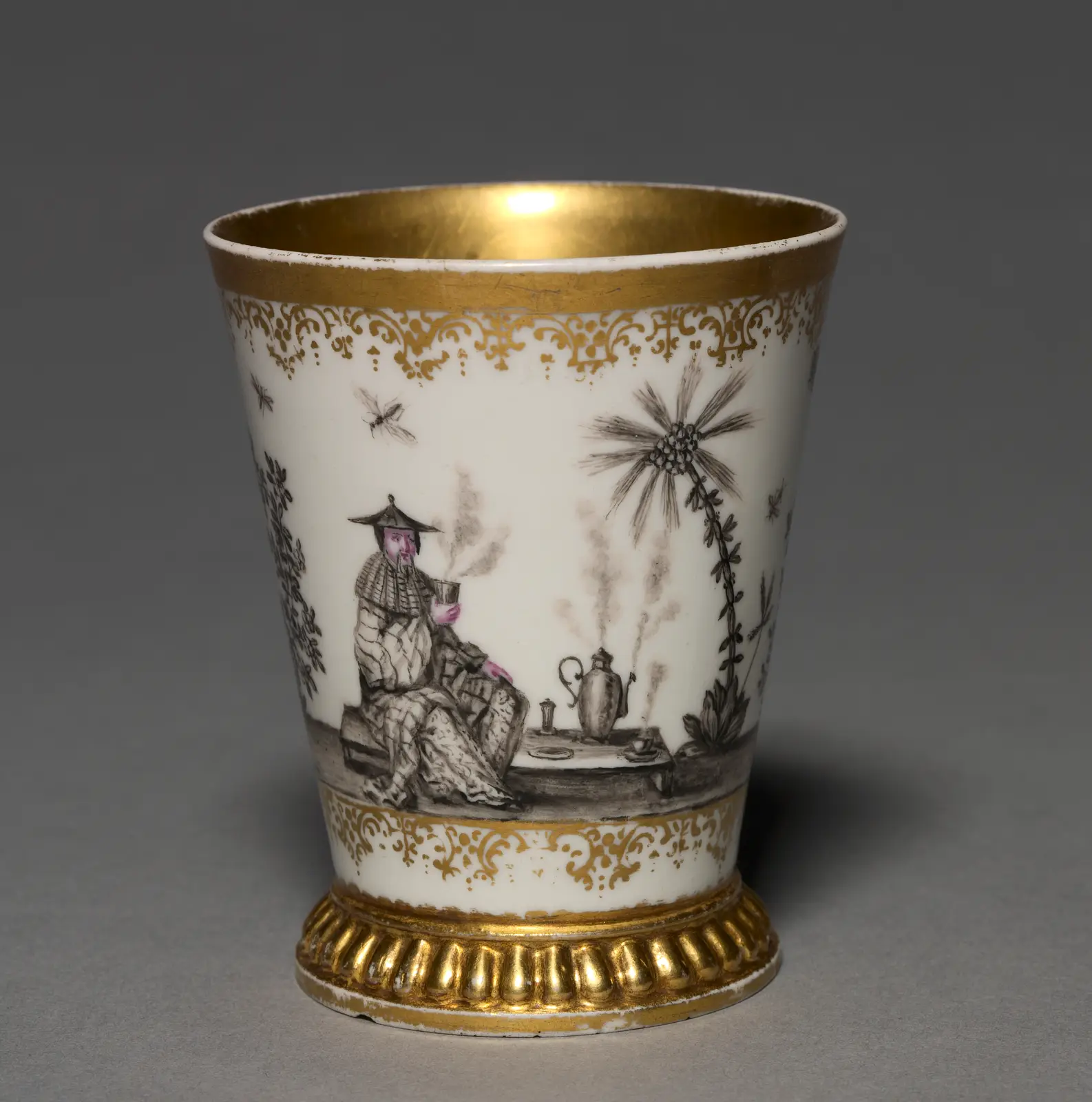
A beaker made before 1720 by the Meissen Porcelain Factory, which the Cleveland record lists as established c. 1710; the record gives porcelain with a gilded interior, 9.1 cm high and 6.9 cm wide overall.
Collection: Cleveland Museum of Art, 1952.452
"Beaker, Meissen Porcelain Factory" by Cleveland Museum of Art — https://www.clevelandart.org/art/1952.452 — CC0 1.0 (https://creativecommons.org/publicdomain/zero/1.0/)
Card and share picture, a 3:2 copy of this object’s photograph: "Beaker, Meissen Porcelain Factory (card)" by Cleveland Museum of Art — https://www.clevelandart.org/art/1952.452 — CC0 1.0 (https://creativecommons.org/publicdomain/zero/1.0/); modified: padded with the photograph's own background to a 3:2 frame, left and right, with a feathered seam
The Cleveland record gives this small Meissen beaker as porcelain, and on Marryat’s account Meissen’s porcelain was hard paste. The word hard describes the body itself rather than a coating, since Marryat wrote in 1850 that hard paste has “a greater density of substance than the Soft paste” (p. 93) scanned page. The photograph above shows the whole beaker, which the record describes as porcelain gilded on the inside.
This page does not judge whether any piece is genuine or what it is worth; it explains what hard-paste porcelain is and how the factory at Meissen came to make it.
Hard-paste or soft-paste: what differs?
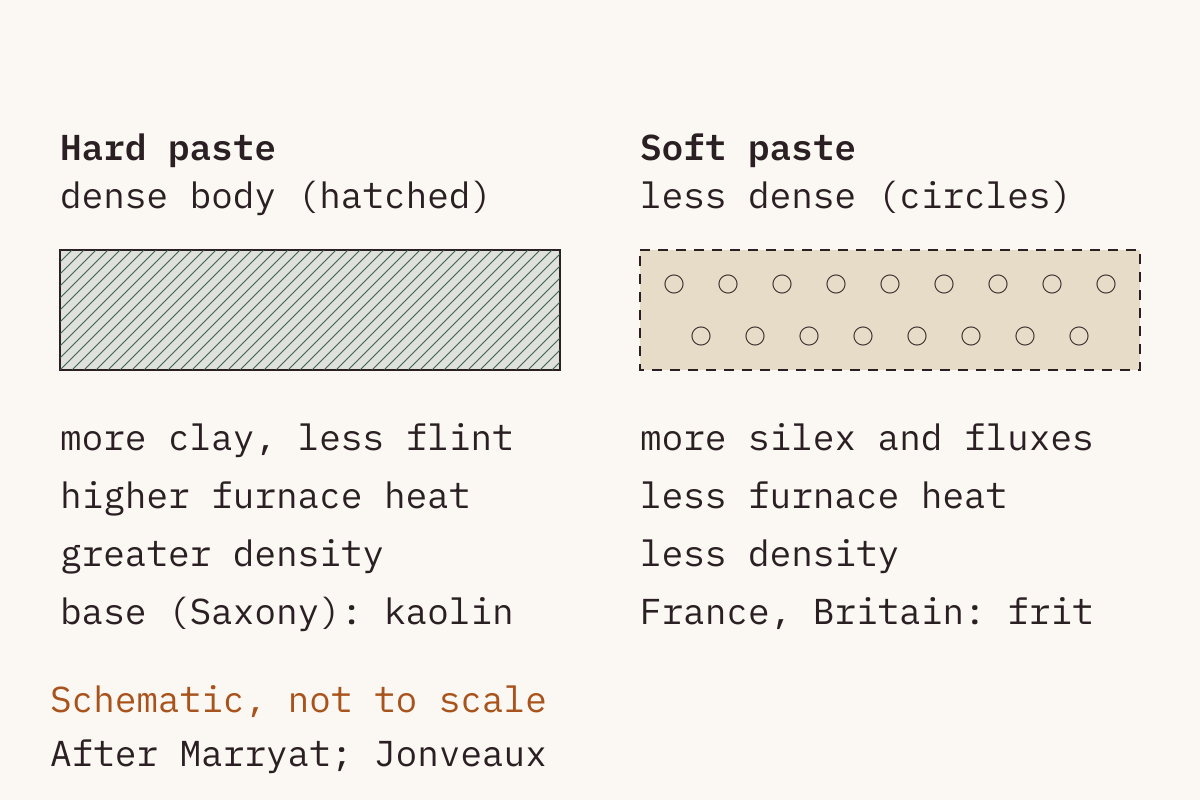 schematic, not to scale
Hard paste and soft paste side by side: more clay, a higher furnace heat and a greater density against more silex with fluxes, less heat and less density. The pages cited give the proportions in words only.
Source: Marryat, Collections towards a History of Pottery and Porcelain (1850), p. 93 and p. 131; Jonveaux, Histoire de trois potiers célèbres (1880), p. 30
"Hard paste or soft paste: clay, heat and density" by Kiln, Easel & Anvil, https://kilneaselandanvil.com/fired-clay/meissen-hard-paste-porcelain/ — CC BY 4.0, https://creativecommons.org/licenses/by/4.0/
Data: Joseph Marryat, Collections towards a History of Pottery and Porcelain (1850); Émile Jonveaux, Histoire de trois potiers célèbres (1880)
Marryat opened his sketch of the history of porcelain by dividing the material into two kinds, hard paste and soft paste, and he explained that “the Hard paste is composed of a greater proportion of clay or alumine, and less of flint or silica” (p. 93) scanned page. Fusing such a paste, he continued, “requires consequently a higher degree of furnace heat, which also gives it a greater density of substance than the Soft paste”.
Soft paste works the other way round. According to Marryat, the soft paste, “from the larger proportion of silex and the addition of alkaline fluxes, requires a less degree of furnace heat, and consequently acquires less density” (p. 93). Fluxes are substances added to help a mixture melt.
He also gives the word soft two separate meanings: soft paste is “less able to resist a high temperature”, and it is “easily scratched by the knife” (p. 93). This page reports that historical description and does not suggest scratching, heating or testing any object.
Kaolin against frit
The base of the paste differs as well. Émile Jonveaux, in an 1880 printing of his history of three potters, describes the soft or fritted porcelain of France and Britain as a porcelain whose base, “au lieu de kaolin, est un verre imparfait qu’on appelle fritte” (p. 30) scanned page, that is, instead of kaolin, is an imperfect glass called frit (translated here). Frit is a kind of glass, then, and glass is the material behind the question of whether glass is a liquid.
| Feature | Hard paste | Soft paste | Source |
|---|---|---|---|
| What goes into the paste | a greater proportion of clay or alumine, less of flint or silica | a larger proportion of silex, with alkaline fluxes added | Marryat 1850, p. 93 |
| Furnace heat | a higher degree of furnace heat | a less degree of furnace heat | Marryat 1850, p. 93 |
| Density of the body | a greater density of substance than the soft paste | acquires less density | Marryat 1850, p. 93 |
| Why soft paste is called soft | not stated in this source | less able to resist a high temperature, and easily scratched by the knife | Marryat 1850, p. 93 |
| What the base is | kaolin: at Meissen, the kaolin of Aue, the basis of the Saxon porcelain | not stated in this source | Marryat 1850, p. 131 |
| What the base is | not stated in this source | a frit, an imperfect glass, instead of kaolin (French and British soft or fritted porcelain) | Jonveaux 1880, p. 30 (translated here) |
Download the data (CSV, hard-paste-vs-soft-paste.csv) (notes on this file) Data: Joseph Marryat, Collections towards a History of Pottery and Porcelain (1850), short phrases with page numbers; Émile Jonveaux, Histoire de trois potiers célèbres (1880), short phrase with page number, translated from the French
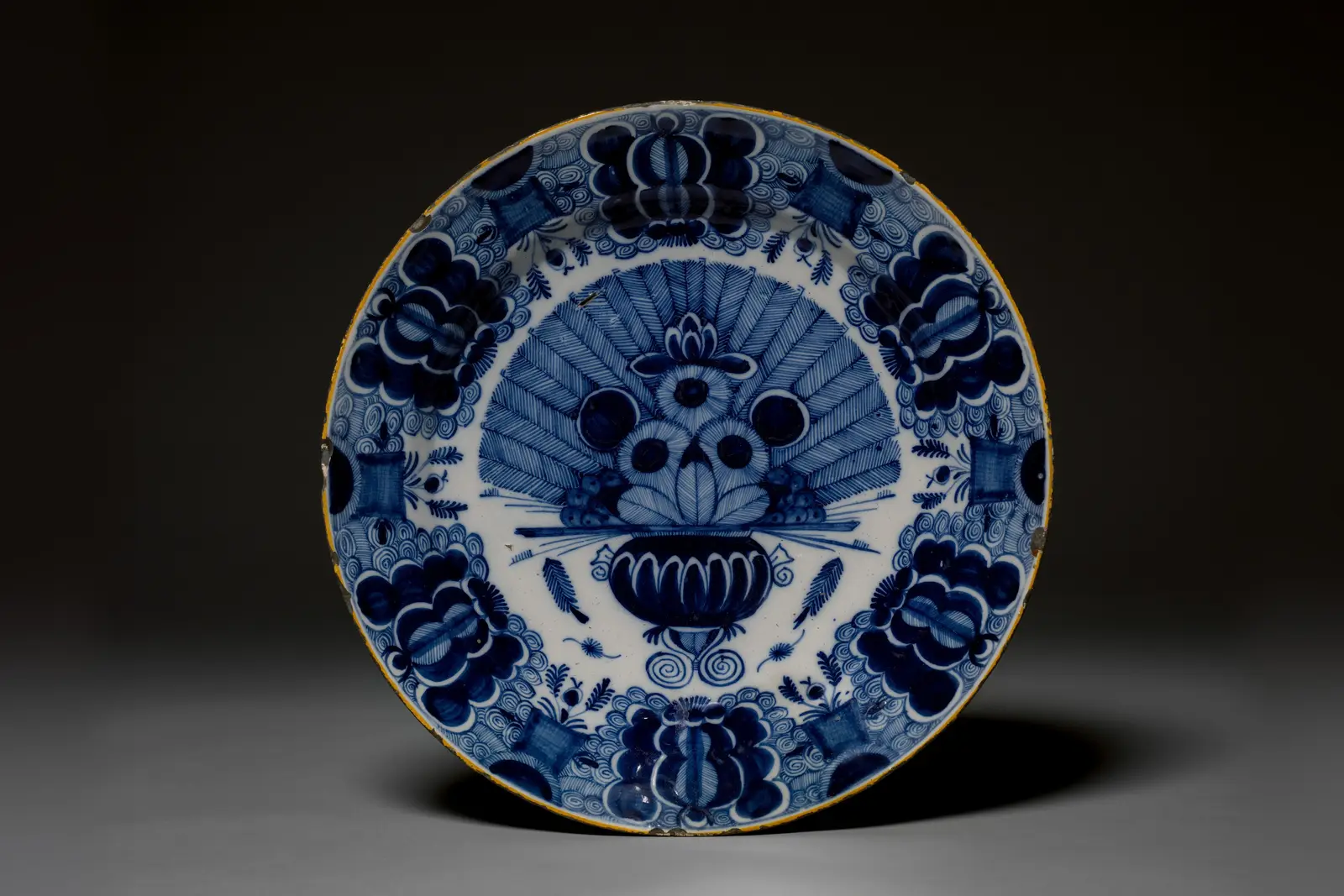
The pages cited here give the proportions in words only and no temperature for the kiln, so the table gives no figures. A white surface resembling porcelain could also be produced on an entirely different body, as in delftware, a Dutch ware that only looks like porcelain.
Where did the white clay come from?
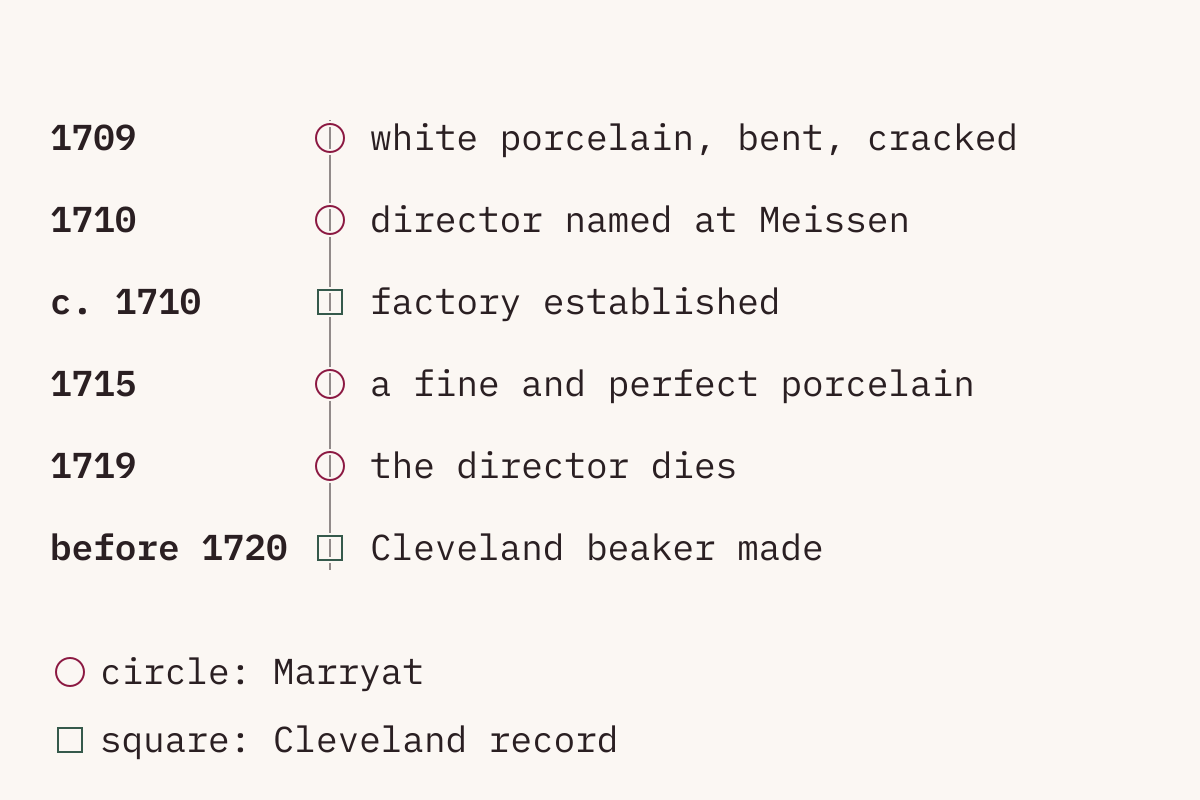 not to scale
Early Meissen in six dates: four from Marryat’s 1850 account, two from the Cleveland Museum of Art record, which gives its dates with c. and before.
Source: Marryat, Collections towards a History of Pottery and Porcelain (1850), p. 131; Cleveland Museum of Art record 1952.452
Read the figure as text
- 1709: Böttger produced a white porcelain that bent and cracked in the fire (Marryat, p. 131)
- 1710: he was appointed Director of the manufactory at Meissen (Marryat, p. 131)
- c. 1710: the Meissen Porcelain Factory was established (Cleveland record)
- 1715: he succeeded in making a fine and perfect porcelain (Marryat, p. 131)
- 1719: his death (Marryat, p. 131)
- before 1720: the Cleveland beaker was made (Cleveland record)
"Meissen from 1709 to 1720, after Marryat 1850 and the Cleveland record" by Kiln, Easel & Anvil, https://kilneaselandanvil.com/fired-clay/meissen-hard-paste-porcelain/ — CC BY 4.0, https://creativecommons.org/licenses/by/4.0/
Data: Joseph Marryat, Collections towards a History of Pottery and Porcelain (1850); Cleveland Museum of Art, Beaker, 1952.452, collection record (CC0)
Marryat credits one man with the Saxon porcelain: “We are indebted to the Saxon Böttcher for the second invention of porcelain” (p. 129) scanned page. He then states that “The first European porcelain was made at Dresden, and the first European manufactory was established at Meissen, on the Elbe, near Dresden” (p. 129).
Jonveaux spells the name Böttger, the spelling used on this page, while Marryat prints Böttcher. In his general sketch of porcelain, Marryat also names the kind that Böttger made: “Böttcher succeeded in making hard porcelain by softening pottery, and rendering it translucid” (p. 93), translucid meaning that light passes through it.
From red ware to white
According to Marryat, Böttger was an apothecary’s assistant at Berlin who fled into Saxony because he was suspected “of understanding the art of making gold” (p. 129). His first ware was red, made from a brown clay found near Meissen (p. 129), and “it was not until 1709 that Böttcher at last produced a white porcelain, which, however, bent and cracked in the fire” (p. 131).
The white clay arrived by accident. Marryat writes that “it appears certain that he discovered the kaolin of Aue, the basis of the Saxon porcelain, by a singular chance” (p. 131): an ironmaster, John Schnorr, riding near Aue, noticed that his horse’s feet stuck in “a soft, white earth”, at a time when hair powder was “a considerable object of commerce”.
In Jonveaux’s account, which also names Schnorr as the supplier of the clay, Böttger was certain that he held “le kaolin qui sert de base à la porcelaine blanche” (p. 258) scanned page, the kaolin that serves as the base of white porcelain (translated here). Jonveaux adds that the export of the clay was strictly forbidden and that it travelled to the factory in barrels sealed with the seal of Saxony, under the watch of sworn men.
How does a later Meissen teapot compare?
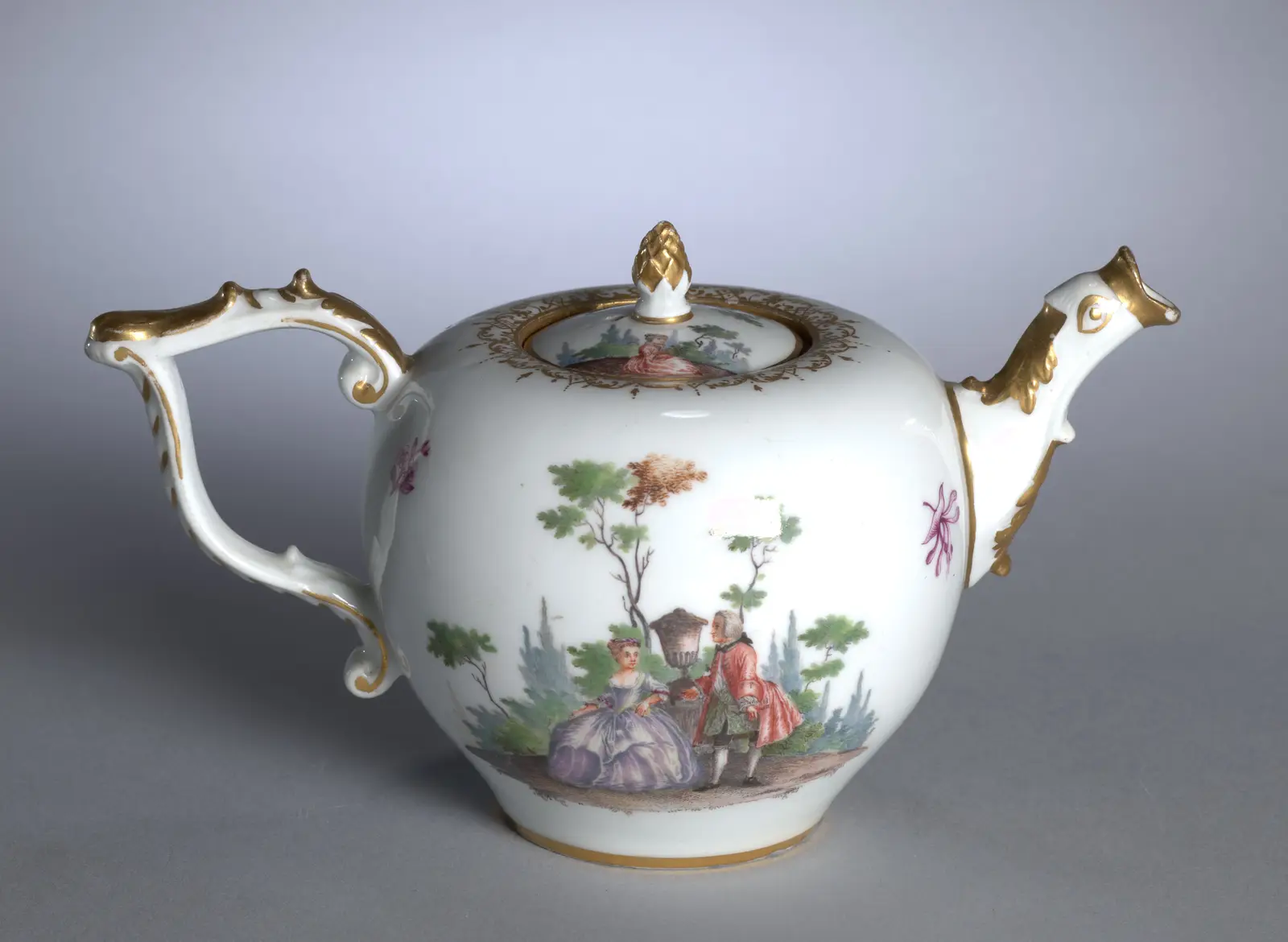
A teapot of c. 1750–70 from the Meissen Porcelain Factory; the Cleveland record gives porcelain and an overall size of 12.9 × 39.2 × 18.3 cm.
Collection: Cleveland Museum of Art, 2009.106
"Teapot, Meissen Porcelain Factory" by Cleveland Museum of Art — https://www.clevelandart.org/art/2009.106 — CC0 1.0 (https://creativecommons.org/publicdomain/zero/1.0/)
The teapot, dated c. 1750–70, was made decades after the beaker of before 1720, and the Cleveland records give both objects the same maker, the Meissen Porcelain Factory, and the same material, porcelain full text. Measured across, the teapot is 39.2 cm wide against the beaker’s 6.9 cm. Marryat’s account of the factory suggests that both belong to the hard-paste kind that he separated from soft paste by its density.
Factory marks belong to the same history. Marryat records that on Meissen porcelain “the well-known two electoral swords, crossed, were introduced” after earlier marks (p. 144) scanned page; this page reads the mark only as factory history and gives no table for dating a piece.
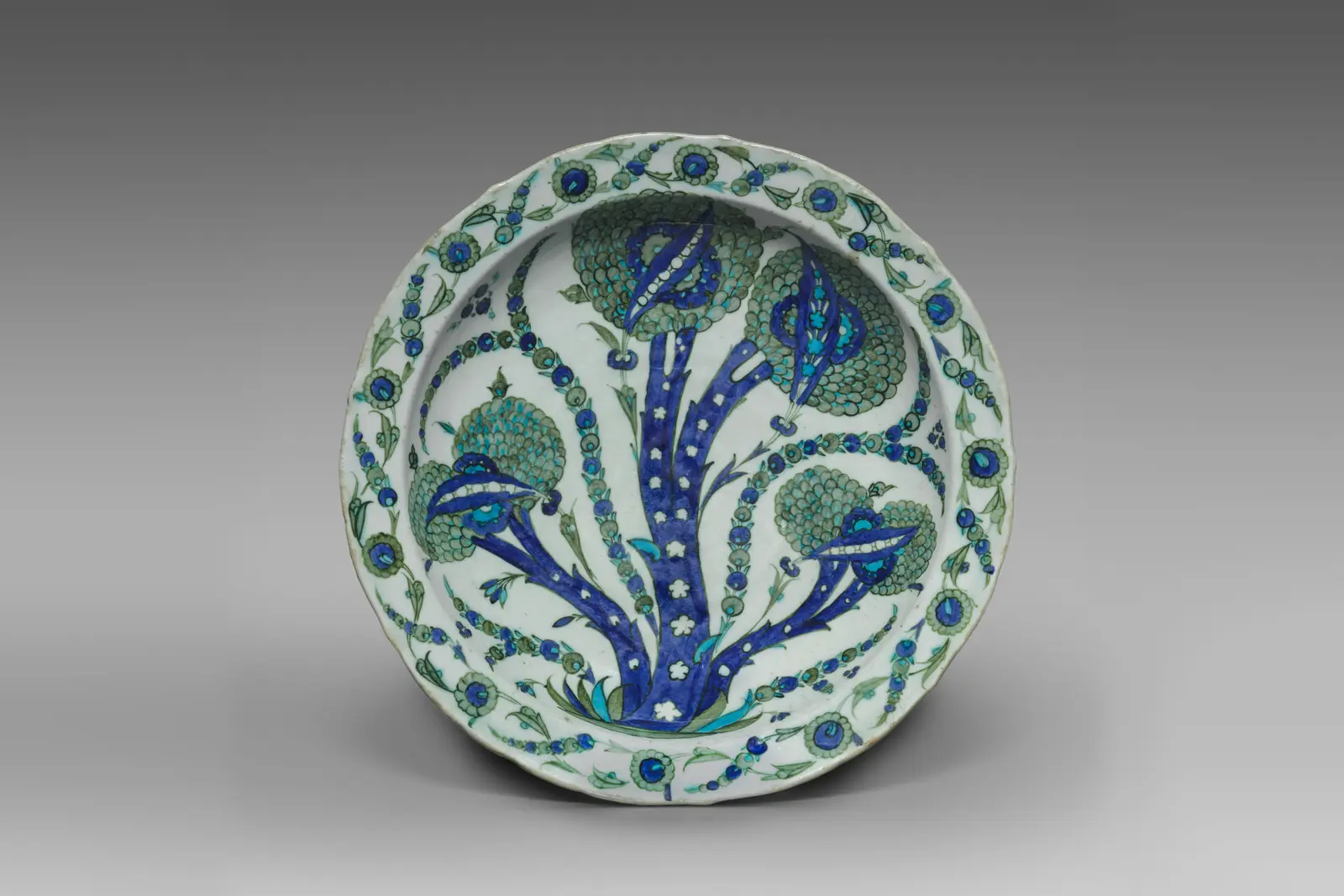
A fired-clay tradition from another place and an earlier century appears in Ottoman dishes from Iznik.
Under the loupe: look again at the gilded interior of the Cleveland beaker, porcelain on the museum record and, on Marryat’s account, of the hard-paste kind he set apart from soft paste by its density. Then compare it with a Roman vase in two layers of glass.
A beaker made before 1720 by the Meissen Porcelain Factory, which the Cleveland record lists as established c. 1710; the record gives porcelain with a gilded interior, 9.1 cm high and 6.9 cm wide overall.
Collection: Cleveland Museum of Art, 1952.452
"Beaker, Meissen Porcelain Factory" by Cleveland Museum of Art — https://www.clevelandart.org/art/1952.452 — CC0 1.0 (https://creativecommons.org/publicdomain/zero/1.0/)
Sources and reading levels
- Joseph Marryat, Collections towards a History of Pottery and Porcelain in the 15th, 16th, 17th, and 18th Centuries (London: J. Murray, 1850); public domain in the US and EU (published 1850 by an author already adult then, who cannot have died later than 1955; no readable record of his death year was found) archive.org/details/collectionstowar00marrRead: scanned page
- Cleveland Museum of Art, Beaker, before 1720, Meissen Porcelain Factory (German, est. c. 1710), porcelain, interior gilded, accession number 1952.452, collection online record (CC0) www.clevelandart.org/art/1952.452Read: full textText licence: CC0 1.0 (terms)
- Émile Jonveaux, Histoire de trois potiers célèbres: Bernard Palissy, Josiah Wedgwood, Frédéric Böttger (1880), pp. 30, 258; French, quoted with the English translated here; public domain in the US and EU (Jonveaux died 1871, per the creator field of the library record carried in the scan's metadata, 'Jonveaux, Émile, 1819-1871'; the 1880 printing appeared after his death) archive.org/details/frick-31072003683861Read: scanned page
- Cleveland Museum of Art, Teapot, c. 1750–70, Meissen Porcelain Factory (German, est. c. 1710), porcelain, accession number 2009.106, collection online record (CC0) www.clevelandart.org/art/2009.106Read: full textText licence: CC0 1.0 (terms)
More objects in Fired Clay
Telling them apart
Delftware: Opaque Tin White Over a Porous Clay Body
Catalogued
Picture credit
"Plate, probably De Porceleyne Claeuw Factory (card)" by Cleveland Museum of Art — https://www.clevelandart.org/art/1969.254 — CC0 1.0 (https://creativecommons.org/publicdomain/zero/1.0/); modified: padded with the photograph's own background to a 3:2 frame, left and right, with a feathered seam
Telling them apart
Iznik Pottery: An Artichoke Dish, per the Cleveland Record
Catalogued
Picture credit
"Large Dish with Artichokes (card)" by Cleveland Museum of Art — https://www.clevelandart.org/art/1995.17 — CC0 1.0 (https://creativecommons.org/publicdomain/zero/1.0/); modified: padded with the photograph's own background to a 3:2 frame, left and right, with a feathered seam
Cite this page
Kiln, Easel & Anvil. “Meissen Porcelain: Kaolin Clay in the Body, per Jonveaux.” Published 28 November 2026. https://kilneaselandanvil.com/fired-clay/meissen-hard-paste-porcelain/ (accessed on the day you read it).
How a record is checked Every correction, dated Report an error on this page (contact@kilneaselandanvil.com)