Chippendale Style: Thomas Chippendale's 1754 Director
Short answer
Chippendale style carries the name of Thomas Chippendale, a London cabinet-maker whose pattern book, the Director, came out in 1754 with 160 copper plates scanned page. On the Cleveland Museum of Art’s side chair, look at the splat in the middle of the back, which the record says “may be related” to his style full text.
Object record
- Object
- Side Chair
- Maker
- Not named in the record; America, Pennsylvania, Philadelphia
- Date
- c. 1770
- Material
- mahogany
- Dimensions
- Overall: 97 x 60 x 56.9 cm (height x width x depth, as published)
- Collection
- Cleveland Museum of Art, 1985.58
This record as CSV (chippendale-style-record.csv) (notes on this file)
Data: Cleveland Museum of Art, Side Chair, 1985.58, collection record (CC0)
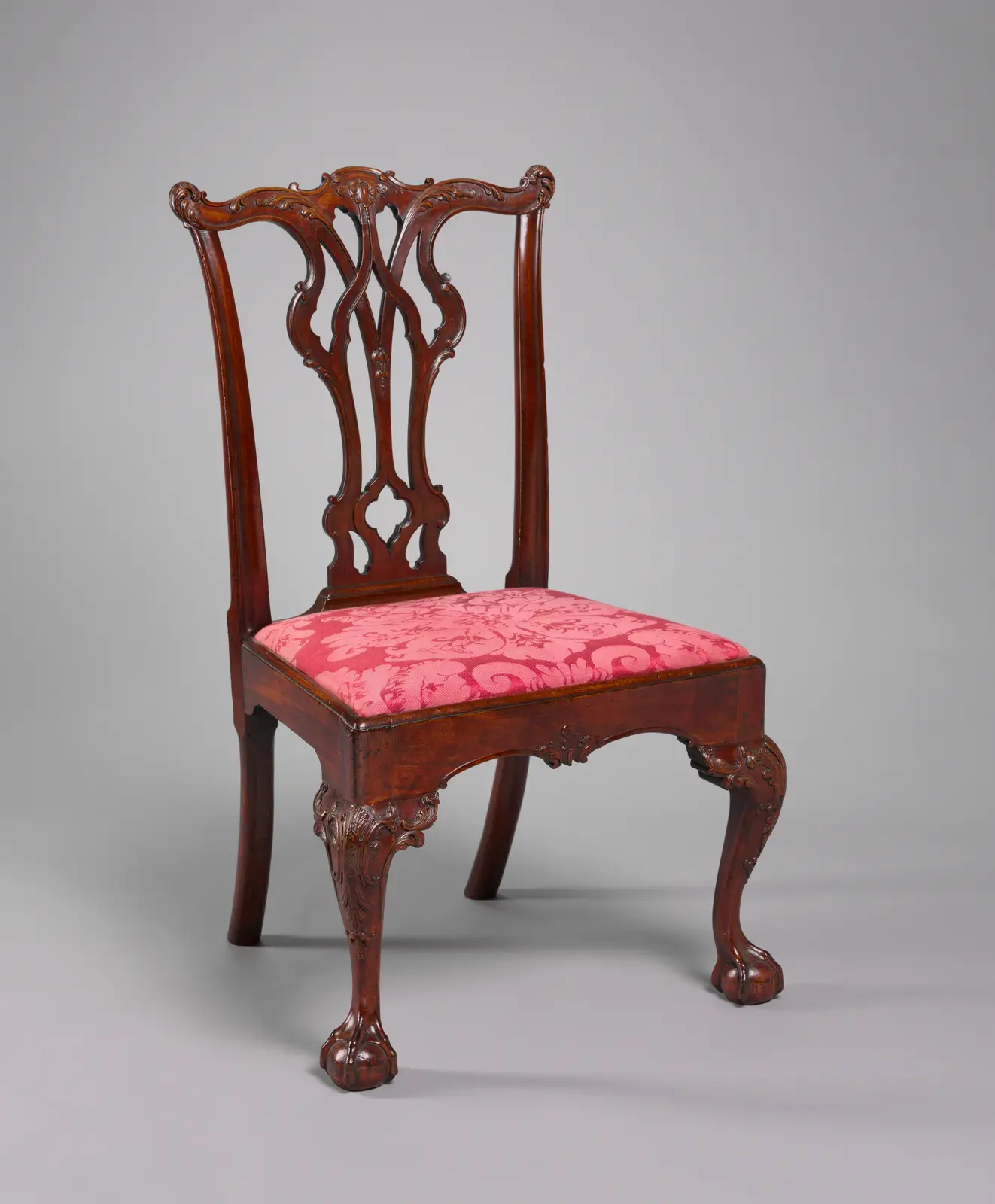
A mahogany side chair of c. 1770 from Philadelphia, one of a set made for Thomas and Elizabeth Edwards; the Cleveland record gives its overall size as 97 x 60 x 56.9 cm.
Collection: Cleveland Museum of Art, 1985.58
"Side Chair, Philadelphia" by Cleveland Museum of Art — https://www.clevelandart.org/art/1985.58 — CC0 1.0 (https://creativecommons.org/publicdomain/zero/1.0/)
Card and share picture, a 3:2 copy of this object’s photograph: "Side Chair, Philadelphia (card)" by Cleveland Museum of Art — https://www.clevelandart.org/art/1985.58 — CC0 1.0 (https://creativecommons.org/publicdomain/zero/1.0/); modified: padded with the photograph's own background to a 3:2 frame, left and right, with a feathered seam
Pointed arches, Gothic ones in the museum’s word, run down the centre of this mahogany chair’s back. The Cleveland Museum of Art, which owns the chair, connects those arches with Thomas Chippendale’s style, yet its record names no maker for the chair, no plate and no book. The record calls this part “The middle section, or splat,” of the chair back, so in the photograph above it is the centre of the back, above the seat.
The name on the style and the name on a 1754 pattern book are the same, since the title page of the Director, printed in London that year, reads “BY THOMAS CHIPPENDALE, Of St. MARTIN’s-LANE, CABINET-MAKER” scanned page. The rest of this page draws on two sources, read in full or on the scanned page: the museum’s record of one chair, and the book of designs that the chair is compared with.
This page does not judge whether any piece is genuine or what it is worth, and it gives no buying advice; it explains what the label refers to and what the record and the book each say.
What does a Chippendale-style chair look like?
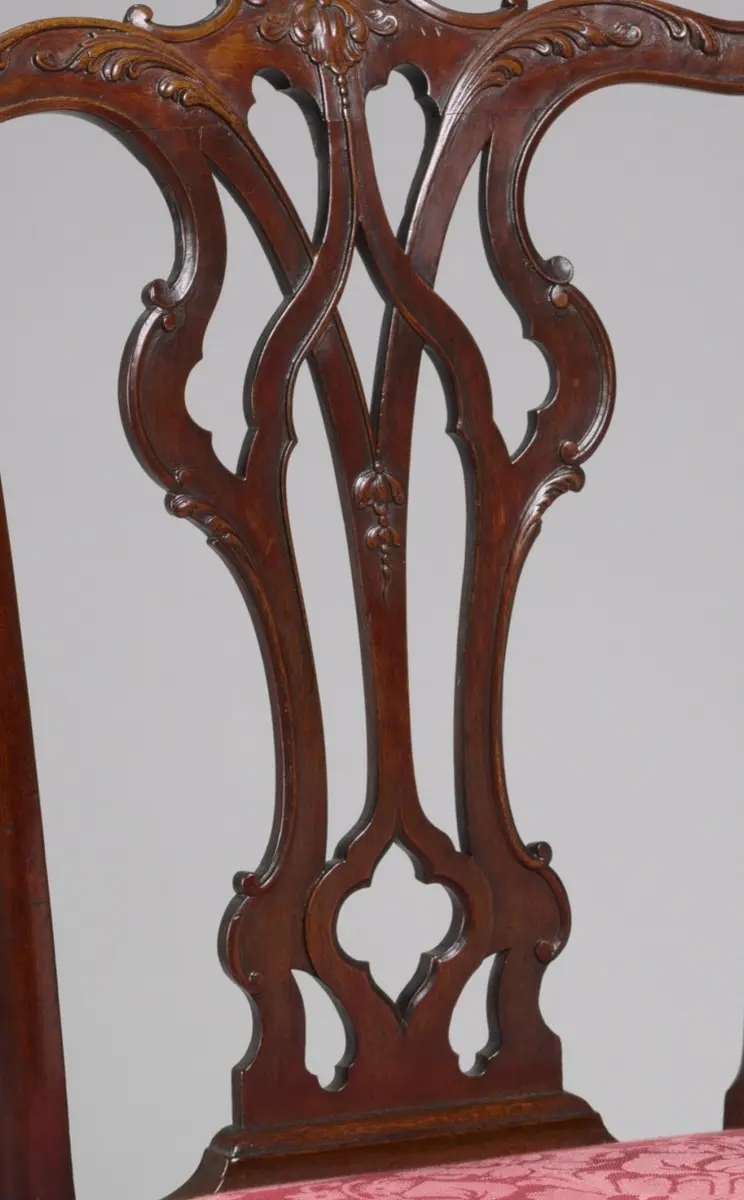
The splat, the middle section of the chair back, whose Gothic pointed arches the Cleveland record says may be related to Thomas Chippendale’s style.
Collection: Cleveland Museum of Art, 1985.58
Detail. The small picture marks where it sits in the whole object.
"Side Chair, Philadelphia (detail of the splat)" by Cleveland Museum of Art — https://www.clevelandart.org/art/1985.58 — CC0 1.0 (https://creativecommons.org/publicdomain/zero/1.0/); modified: cropped to the detail of the splat, the middle section of the chair back, and resized to 1200 pixels high
There is no single answer, and the Director itself suggests why. Its title page offers designs “IN THE GOTHIC, CHINESE and MODERN TASTE” scanned page, three manners in one book rather than one look.
The preface goes further, explaining that the designs “are so contrived, that if no one drawing should singly answer the Gentleman’s taste, there will yet be found a variety of hints sufficient to construct a new one” (p. iii). On that account, the gentleman reading the book could mix and adapt rather than pick one fixed model.
The notes on the individual chair plates point in the same direction. Of Plates XII to XV, a group of “new-pattern Chairs”, Chippendale wrote that “The fore feet are all different for your better choice”, and that if a reader thought them “too much ornamented, that can be omitted at pleasure” (p. 7). Of the Gothic chairs on Plates XXI and XXII he wrote that “Most of the ornaments may be left out if required” (p. 8).
On the book’s own terms, then, a chair made from it could lose its carving, change a foot or combine parts of several plates. That is a reading of the preface and the plate notes, not a rule stated in them, and on that reading no list of features can settle whether a chair belongs to the style.
What the Cleveland record picks out
The museum’s record, short and specific, gives the material as mahogany and the date as c. 1770, and it describes the splat’s “Gothic pointed arches” full text. It adds that “This chair features several finely and naturalistically carved details” without identifying them, so this page does not point to any.
The record gives no maker’s name; the place it records is “America, Pennsylvania, Philadelphia”, and the overall size is 97 by 60 by 56.9 centimetres, which the record’s own fields identify as height, width and depth.
What is in the 1754 Director?
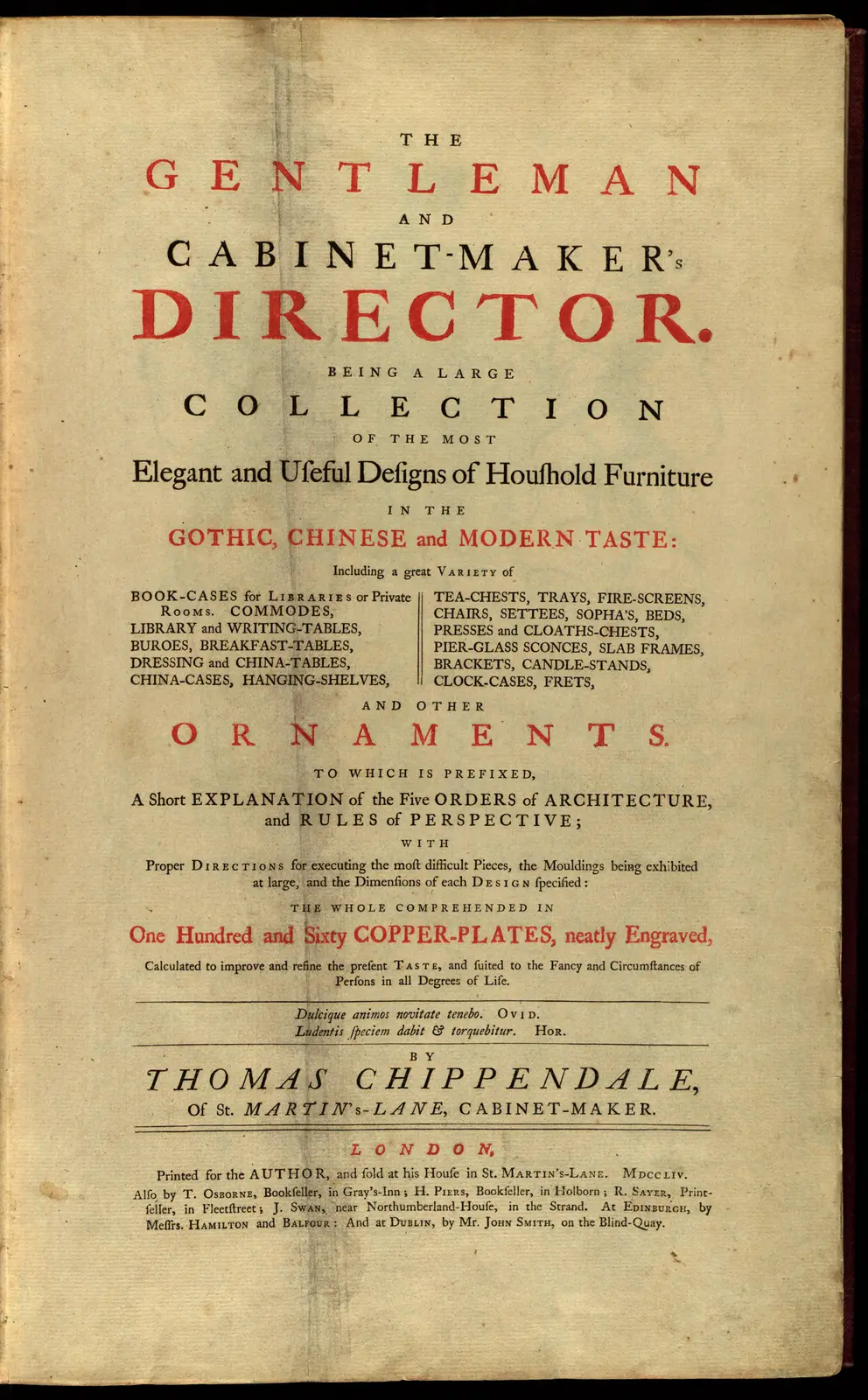
The title page of the 1754 Director, printed in red and black: designs in the Gothic, Chinese and Modern taste, in 160 copper plates, by Thomas Chippendale of St. Martin’s Lane, cabinet-maker.
Collection: Smithsonian Libraries copy, The Gentleman and Cabinet-Maker’s Director (1754), title page, scanned for the Internet Archive
"Title page of The Gentleman and Cabinet-Maker's Director (Chippendale)" by Thomas Chippendale — https://archive.org/details/gentlemancabine00Chip — Public domain (US: published in 1754, before 1931; DE/FR: Thomas Chippendale died in 1779 per the Smithsonian Libraries catalogue record (Chippendale, Thomas, 1718-1779), more than 70 years ago)
The title page sets out the whole book, promising “Elegant and Useful Designs of Houshold Furniture” in three tastes and listing the categories of furniture, from “BOOK-CASES” and “COMMODES” to “CHAIRS, SETTEES, SOPHA’S, BEDS” scanned page. Then it gives the size of the project: “THE WHOLE COMPREHENDED IN One Hundred and Sixty COPPER-PLATES, neatly Engraved”.
The imprint at the foot says the book was “Printed for the AUTHOR, and sold at his House in St. MARTIN’s-LANE”, dated MDCCLIV, the Roman numerals for 1754. A copper plate is an engraved metal plate from which pictures were printed.
The preface names two intended readers, explaining that the title page had called the work “The Gentleman and Cabinet-Maker’s Director, as being calculated to assist the one in the choice, and the other in the execution of the designs” (p. iii). The gentleman chooses, and the cabinet-maker builds.
Who was Chippendale, on the page?
The Director says little about its author beyond what a reader needs to find him. The title page gives his name, his street and his trade, Thomas Chippendale of St. Martin’s Lane, cabinet-maker, and adds that the book was sold at his house there. The preface closes with the same name and the same address, and nothing in the pages read for this article goes further into his life, so this page does not either.
A promise about the Gothic designs
In the same preface, Chippendale also answered a complaint about his designs: “I have here given no design but what may be executed with advantage by the hands of a skillful workman” (p. vi). He added that some in the trade had called his designs, “especially those after the Gothic and Chinese manner”, “specious drawings, impossible to be work’d off by any mechanic whatsoever” (p. vi). The preface is signed from St. Martin’s Lane on 23 March 1754.
The chair plates, as the book lists them
The explanations of the plates, printed before the plates themselves, describe the chairs in groups. Pages 7 and 8 list them as follows:
- Plates XII to XV: “a variety of new-pattern Chairs” (p. 7)
- Plate XVI: “three Ribband-back Chairs”, of which “The Chair on the left hand has been executed from this Design” (p. 8)
- Plates XVII to XX: “eight different designs of French Elbow Chairs” (p. 8)
- Plates XXI and XXII: “six new designs of Gothic Chairs” (p. 8)
- Plates XXIII to XXV: “nine Chairs in the present Chinese manner” (p. 8)
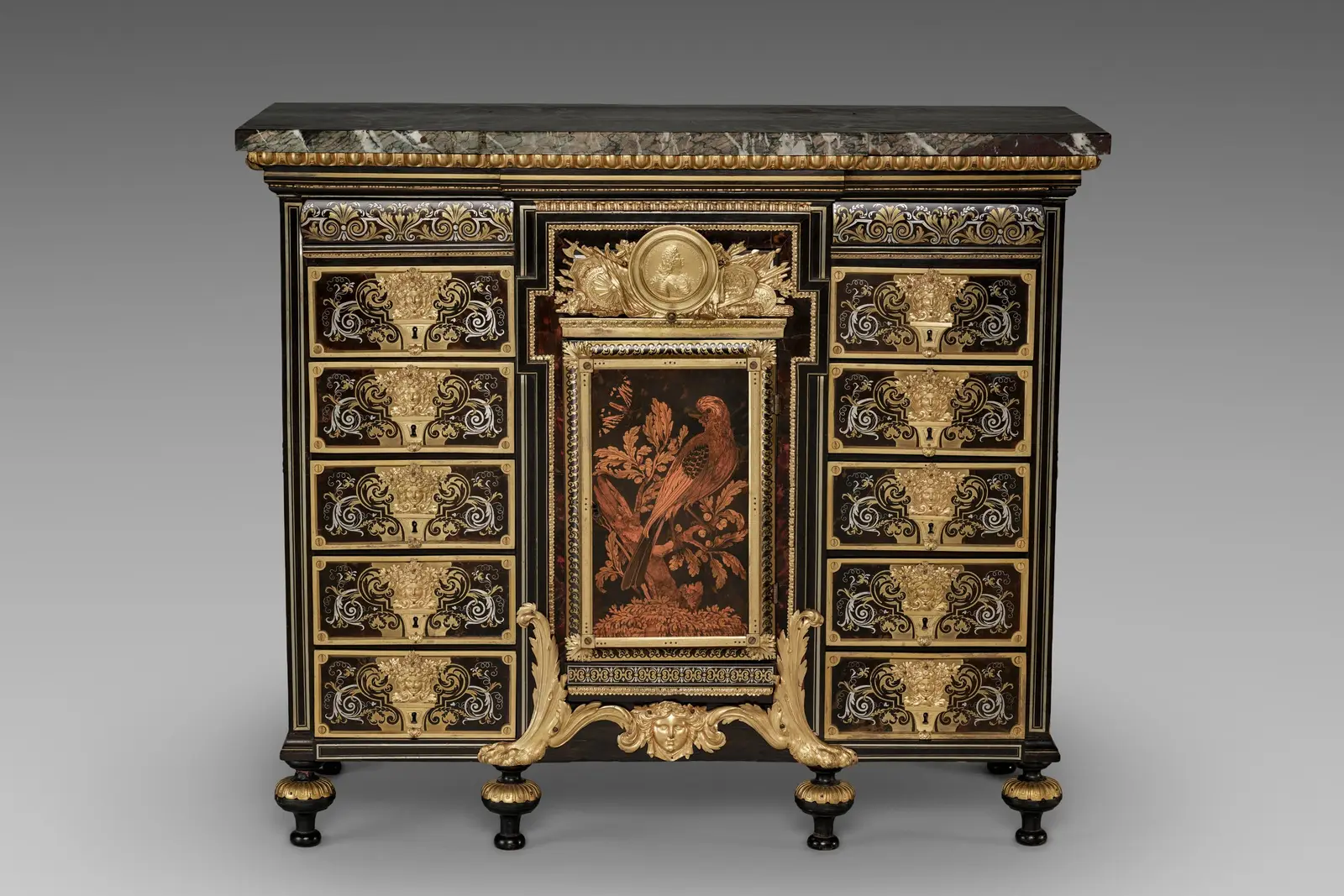
The note on Plate XVI is the author’s own claim that at least one design had been built. The Director is a book of designs on paper; for a piece whose evidence sits in the veneer itself, see Boulle marquetry, where, per Roubo, one cut makes two panels of shell and brass.
Where does the chair match the book?
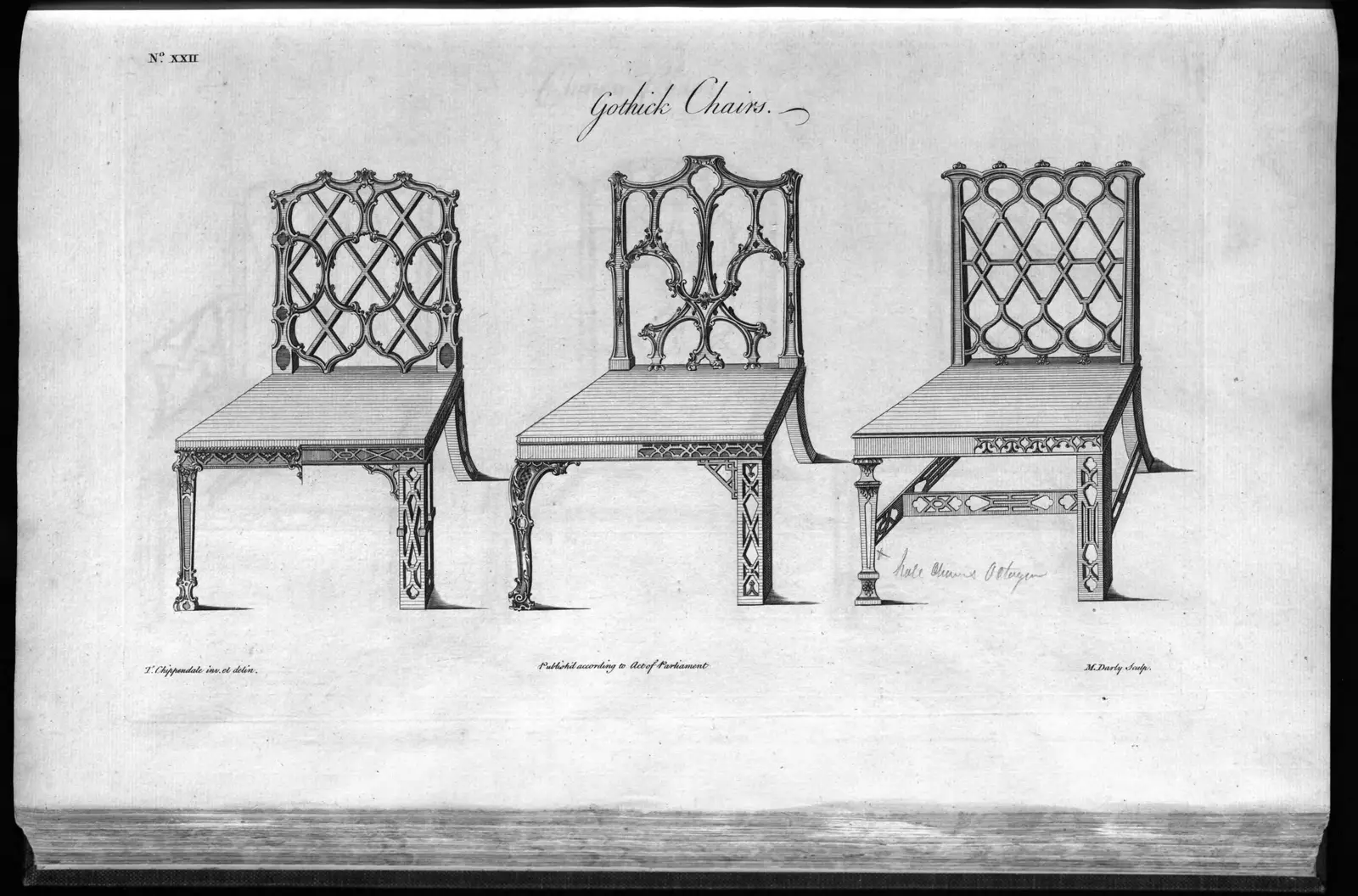
Plate XXII of the Director, engraved with the title Gothick Chairs and the names T. Chippendale and M. Darly: three chair designs on one of the two Gothic chair plates. The scan is turned upright here; the handwritten note beside the right-hand chair is not part of the engraving.
Collection: Smithsonian Libraries copy, The Gentleman and Cabinet-Maker’s Director (1754), Plate XXII, scanned for the Internet Archive
“Gothick Chairs, Plate XXII of The Gentleman and Cabinet-Maker's Director (Chippendale)”, Thomas Chippendale (design and drawing) and M. Darly (engraving) / Thomas Chippendale and M. Darly; public domain.
Complete credit
"Gothick Chairs, Plate XXII of The Gentleman and Cabinet-Maker's Director (Chippendale)" by Thomas Chippendale and M. Darly — https://archive.org/details/gentlemancabine00Chip — Public domain (US: published in 1754, before 1931; DE/FR: Thomas Chippendale, who designed and drew the plate, died in 1779 per the Smithsonian Libraries catalogue record; the engraver M. Darly's death year was not found in a readable library record, but the plate bears his name and was published in 1754, so an engraver already at work then cannot have died later than 1955, more than 70 years ago); modified: rotated a quarter turn clockwise so that the chairs stand upright
The chair and the book meet at one place only, and only as a possibility: the Cleveland record says that the splat, “with its Gothic pointed arches, may be related to the style invented by the English cabinetmaker Thomas Chippendale” full text. The Director has Gothic chairs to set beside it: page 8 calls Plates XXI and XXII “six new designs of Gothic Chairs”, and Plate XXII carries the engraved title Gothick Chairs scanned page.
The museum’s record does not name a plate, and it does not say that the Philadelphia chair was copied from the book. Its next sentence points somewhere else: “English chairs of this pattern are known” full text. The comparison the museum makes is between a pattern and a style.
This page goes no further than that comparison, and it does not match the chair’s legs, seat or top rail to any plate, because no source read here makes those identifications.
Why one shared feature is not a verdict
A shared feature is a clue, and the Director itself builds in the exceptions. Its plate notes allow ornament to be left out and feet to vary, and its preface invites new designs built from hints. With that much allowed, a chair can depart from all of the plates and still descend from the book, while a feature shared with a plate may have arrived through another chair.
The same caution applies to construction details: the spacing of a dovetail joint or a tool mark can suggest how a piece was made, but each such trace has exceptions, and the verdict on maker and date belongs to the museum record or the literature.
The record and the book, one claim per row
| Item | Date | Place | Claim | Qualifier |
|---|---|---|---|---|
| Director, title page | 1754 | London | designs of household furniture in the Gothic, Chinese and Modern Taste | as printed; the date is given in Roman numerals |
| Director, title page | 1754 | London | the whole comprehended in one hundred and sixty copper plates | as printed |
| Director, title page | 1754 | London | by Thomas Chippendale, of St. Martin's Lane, cabinet-maker | the name and trade as the title page gives them |
| Director, preface | 1754-03-23 | St. Martin's Lane, London | no design given but what may be executed by a skilful workman | the author's own claim, dated 23 March 1754 |
| Director, Plates XII to XV | 1754 | London | a variety of new-pattern chairs, the fore feet all different | the number of designs is not stated |
| Director, Plates XXI and XXII | 1754 | London | six new designs of Gothic chairs | most of the ornaments may be left out, per the same text |
| Director, Plates XXIII to XXV | 1754 | London | nine chairs in the present Chinese manner | as printed |
| Side Chair, 1985.58 | c. 1770 | America, Pennsylvania, Philadelphia | a mahogany side chair | date as the record gives it, with c. |
| Side Chair, 1985.58 | c. 1770 | America, Pennsylvania, Philadelphia | the splat, with its Gothic pointed arches, may be related to the style invented by Thomas Chippendale | may be related, in the record's words |
| English chairs of this pattern | not stated | England | English chairs of this pattern are known | the record names no particular chair |
| Side Chair, 1985.58 | not stated | England to Philadelphia | the design originated in England and was transmitted, perhaps by means of an imported example | probably, in the record's words; the imported example is a perhaps |
| Side Chair, 1985.58 | c. 1770 | Philadelphia | one of a set made for Thomas and Elizabeth Edwards of Philadelphia | as the record states |
Download the data (CSV, chippendale-style-sources.csv) (notes on this file) Data: Thomas Chippendale, The Gentleman and Cabinet-Maker's Director (London, 1754), short phrases with page numbers (public domain); Cleveland Museum of Art, Side Chair, 1985.58, collection record (CC0)
How did an English design reach Philadelphia?
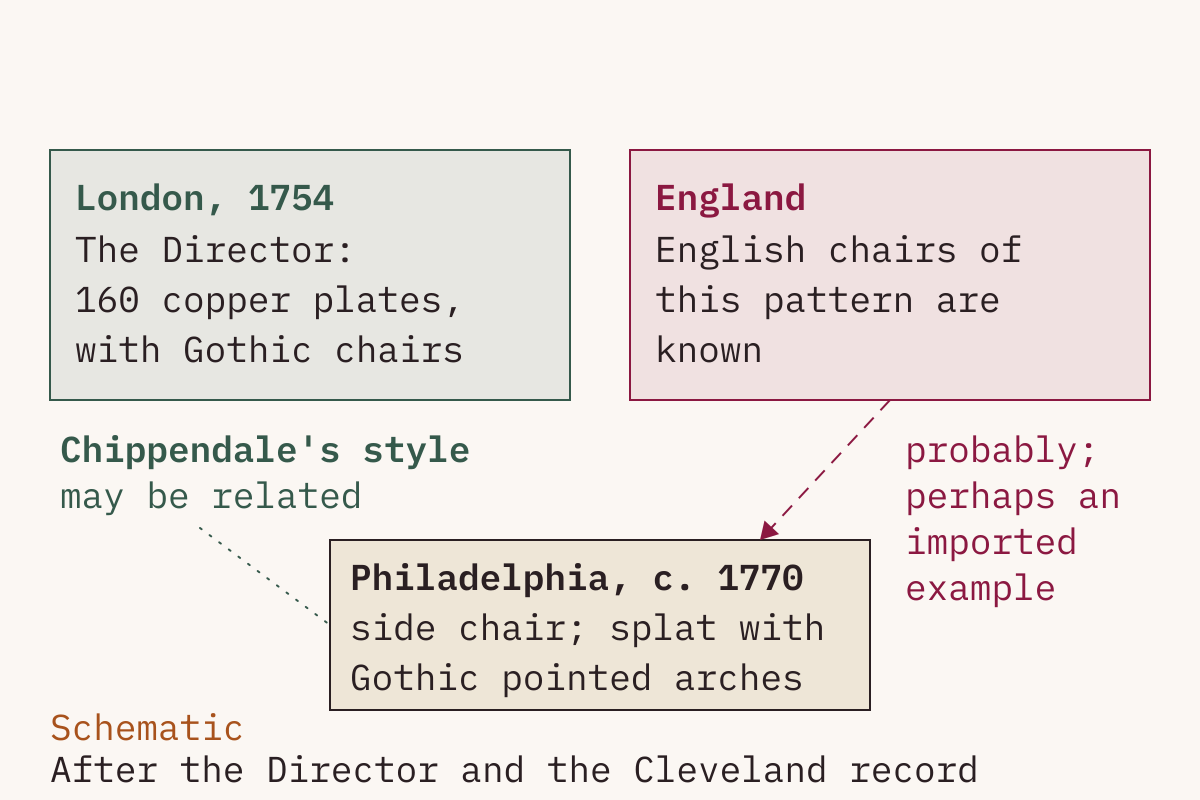 schematic
The two links the Cleveland record makes, drawn apart: the splat may be related to Chippendale’s style, shown by the dotted line from the words for that style, since the record names no book, while the design probably came from English chairs of the pattern, perhaps through an imported example, shown by the dashed arrow.
Source: Thomas Chippendale, The Gentleman and Cabinet-Maker’s Director (London, 1754), title page and p. 8; Cleveland Museum of Art, record for Side Chair 1985.58
Read the figure as text
- London, 1754: the Director, 160 copper plates, with Gothic chairs among the designs (title page; p. 8)
- England: English chairs of this pattern are known (Cleveland record)
- From the English chairs to Philadelphia: the design probably originated in England and was transmitted, perhaps by means of an imported example (Cleveland record)
- From Chippendale’s style to the chair: the splat may be related to that style; the record names neither the Director nor a plate (Cleveland record)
- Philadelphia, c. 1770: a side chair whose splat has Gothic pointed arches (Cleveland record)
"From an English design to a Philadelphia chair, as the Cleveland record puts it" by Kiln, Easel & Anvil, https://kilneaselandanvil.com/furniture/chippendale-style/ — CC BY 4.0, https://creativecommons.org/licenses/by/4.0/
Data: Thomas Chippendale, The Gentleman and Cabinet-Maker's Director (London, 1754), title page and p. 8 (public domain); Cleveland Museum of Art, Side Chair, 1985.58, collection record (CC0)
The museum’s answer points to an individual chair rather than to the book, as the record’s complete sentence shows: “English chairs of this pattern are known, so the design probably originated there and was transmitted to this side of the Atlantic, perhaps by means of an imported example” full text.
That sentence holds two qualifiers: the English origin is a probably, and the imported example is a perhaps. Neither part of the museum’s sentence mentions the Director, and no source read for this page says that a copy of the book reached Philadelphia, so the diagram does not draw the book onto the route.
What the record adds, and what it leaves open
The record leaves several questions open, since it does not say when the English chairs of this pattern were made, how many are known, or which collection holds them, and it does not name the imported example it has in mind. Those gaps are why the dashed arrow in the diagram starts from a box of English chairs rather than from any single object.
The record places the chair in a particular household and town, stating that the chair “comes from a set made for Thomas and Elizabeth Edwards of Philadelphia, a furniture making center famous for its carved ornament” full text. The place the record gives for the chair itself is Philadelphia; the pattern behind it, in the museum’s account, probably came from England.
The dates on this page stay as each source gives them: 1754 from the book’s title page, and c. 1770 from the record, with its “c.” kept. Elsewhere on the site, dates for an Ottoman Iznik dish in the same museum are kept the same way.
Under the loupe: look again at the pointed arches in the splat, the one part of this chair that the Cleveland record ties to Chippendale’s style, then compare the Thonet No. 14, a chair of bent wood.
The splat, the middle section of the chair back, whose Gothic pointed arches the Cleveland record says may be related to Thomas Chippendale’s style.
Collection: Cleveland Museum of Art, 1985.58
Detail. The small picture marks where it sits in the whole object.
"Side Chair, Philadelphia (detail of the splat)" by Cleveland Museum of Art — https://www.clevelandart.org/art/1985.58 — CC0 1.0 (https://creativecommons.org/publicdomain/zero/1.0/); modified: cropped to the detail of the splat, the middle section of the chair back, and resized to 1200 pixels high
Sources and reading levels
- Cleveland Museum of Art, Side Chair, c. 1770, America, Pennsylvania, Philadelphia, mahogany, accession number 1985.58, collection online record (CC0) www.clevelandart.org/art/1985.58Read: full textText licence: CC0 1.0 (terms)
- Thomas Chippendale, The Gentleman and Cabinet-Maker's Director (London: printed for the author, 1754); Smithsonian Libraries copy, scanned for the Internet Archive; public domain in the US and EU (Chippendale died 1779) archive.org/details/gentlemancabine00ChipRead: scanned page
More objects in Furniture
Technique, diagrammed
Dovetail Joint: How Roubo Placed the Tails in a Drawer
Catalogued
Picture credit
"Assemblages doubles et à queues d'aronde, Pl. 9 of L'Art du menuisier (Roubo), detail" by André-Jacob Roubo and Berthault — https://archive.org/details/gri_33125009321916 — Public domain (US: published in 1769, before 1931; DE/FR: Roubo, who drew the plate, died in 1791 per the Getty Research Institute library record of the scan, more than 70 years ago; the engraving, published in 1769, is signed 'Berthault Sculp.' with no first name: the Internet Archive's library records name two engravers of that name working then, Nicolas Berthault, d. 1785, and Pierre Gabriel Berthault, 1748-1819 (archive.org search of creator Berthault, read 2026-11-27, rights-research/evidence/ia/search-berthault.json), so whichever of them engraved it died more than 70 years ago); modified: cropped to a 3:2 frame around Fig. 7 to 12 and the lower halves of Fig. 5 and 6
Technique, diagrammed
Thonet No. 14: Bent, Not Carved, per Heller
Catalogued
Picture credit
"Sessel Nr. 14, plate in Michael Thonet (Heller, ed.), detail" by Unknown author — https://archive.org/details/michaelthonetder00hell — Public domain (US: published in [1920] (year from the library record; the title page gives Brünn and no year), before 1931; DE/FR: unsigned catalogue cut, an anonymous work published in [1920] (Brünn, per the title page), so 70 years from publication have passed); modified: cropped to a 3:2 frame around the chair Sessel Nr. 14, caption excluded
Technique, diagrammed
Boulle Marquetry: Two Panels From One Cut, per Roubo
Catalogued
Picture credit
"Cabinet, André-Charles Boulle (card)" by Cleveland Museum of Art — https://www.clevelandart.org/art/1949.539 — CC0 1.0 (https://creativecommons.org/publicdomain/zero/1.0/); modified: cropped to a 3:2 frame from the centre (full width, 216 px removed at the top and at the bottom) and resized to 2400 x 1600
Cite this page
Kiln, Easel & Anvil. “Chippendale Style: Thomas Chippendale's 1754 Director.” Published 28 November 2026. https://kilneaselandanvil.com/furniture/chippendale-style/ (accessed on the day you read it).
How a record is checked Every correction, dated Report an error on this page (contact@kilneaselandanvil.com)