Thonet No. 14: Bent, Not Carved, per Heller
Short answer
According to Heller's [1920] account of the Thonet firm, the curved parts of its bentwood chairs were made by bending solid beech around a form with the help of steam or boiling liquid, instead of cutting each curve out of solid wood scanned page. Look at the round seat of the chair at the top right of Heller's plate.
Technique sheet
- Technique
- Bentwood (Möbel aus gebogenem Holze, furniture of bent wood)
- Kind of work
- chair parts bent from solid wood instead of cut to shape
- Principle in one line
- the wood is bent by the action of steam or boiling liquids, in place of curves cut out of solid wood (per Heller)
- What to look for
- parts held by iron screws without glued joints, so a chair can be taken apart; a circular bent seat frame on Sessel Nr. 14 (per Heller)
- Usual period and place
- Gebrüder Thonet, Vienna and Koritschan in Moravia, 19th century (per Heller)
- Example in a collection
- Sessel Nr. 14, a type created at the Koritschan factory in 1859 (per Heller), shown on a plate in Michael Thonet (Brünn, [1920])
This record as CSV (thonet-no-14-technique.csv) (notes on this file)
Data: Hermann Heller (ed.), Michael Thonet (Brünn, [1920]), pp. 8, 9, 24, 28 and 29 (public domain in the US)
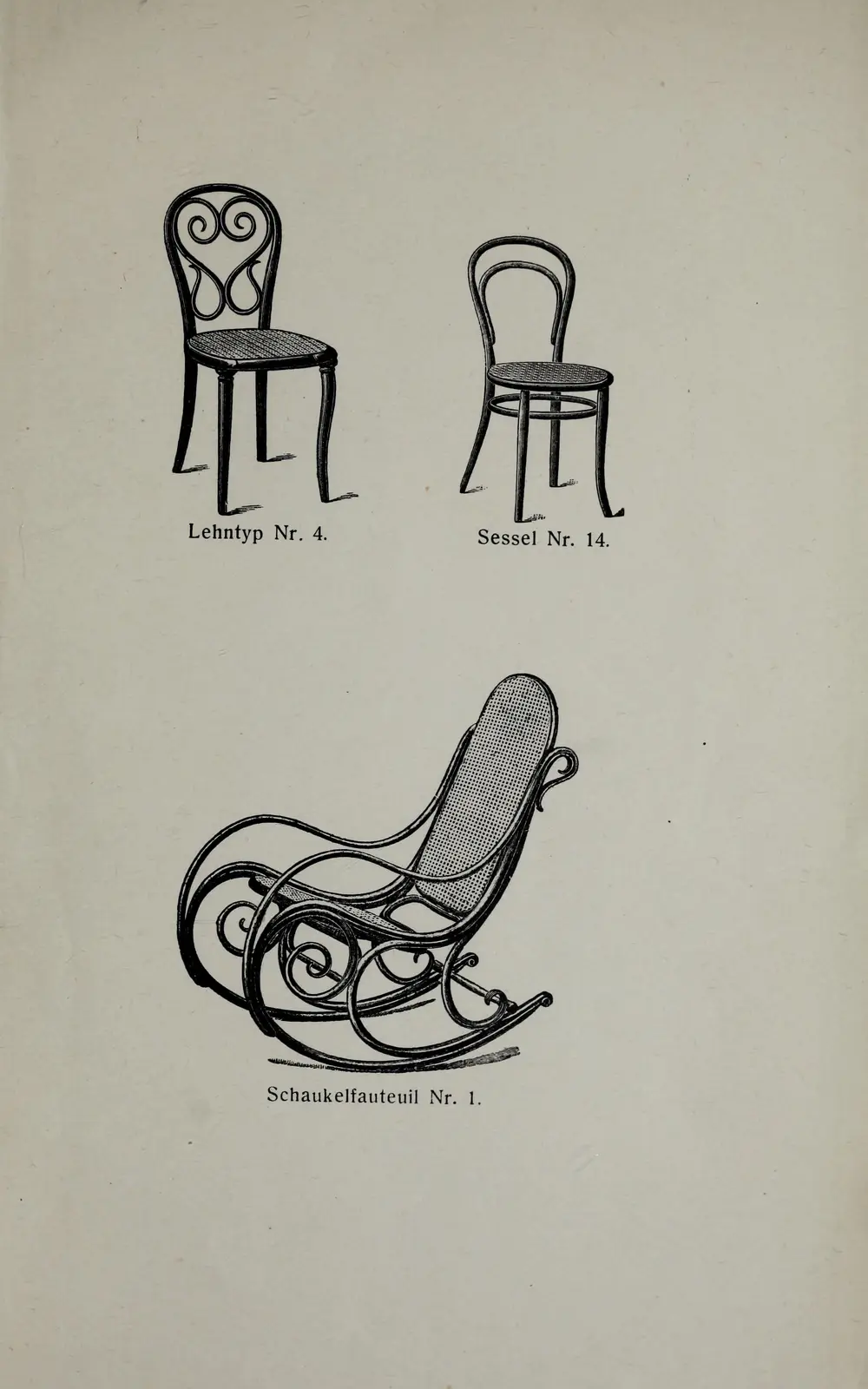
A plate from Heller's [1920] book on Michael Thonet, with three printed captions: Lehntyp Nr. 4 at the top left, Sessel Nr. 14 at the top right and Schaukelfauteuil Nr. 1, a rocking chair, below. The pictures are line cuts, not photographs.
Collection: Getty Research Institute copy, Michael Thonet (Brünn, [1920]), plate with Sessel Nr. 14, scanned for the Internet Archive
“Lehntyp Nr. 4, Sessel Nr. 14, Schaukelfauteuil Nr. 1, plate in Michael Thonet (Heller, ed.)”, Unknown author; public domain.
Complete credit
"Lehntyp Nr. 4, Sessel Nr. 14, Schaukelfauteuil Nr. 1, plate in Michael Thonet (Heller, ed.)" by Unknown author — https://archive.org/details/michaelthonetder00hell — Public domain (US: published in [1920] (year from the library record; the title page gives Brünn and no year), before 1931; DE/FR: unsigned catalogue cut, an anonymous work published in [1920] (Brünn, per the title page), so 70 years from publication have passed)
Card and share picture, a 3:2 copy of this object’s photograph: "Sessel Nr. 14, plate in Michael Thonet (Heller, ed.), detail" by Unknown author — https://archive.org/details/michaelthonetder00hell — Public domain (US: published in [1920] (year from the library record; the title page gives Brünn and no year), before 1931; DE/FR: unsigned catalogue cut, an anonymous work published in [1920] (Brünn, per the title page), so 70 years from publication have passed); modified: cropped to a 3:2 frame around the chair Sessel Nr. 14, caption excluded
Trace the arch of the chair back at the top right of the plate. Before Thonet's experiments, Heller explains, a curved rail like that one was usually cut out of solid wood, worked into shape, and finally covered with a thin sheet of finer veneer.
This page does not judge the authenticity, price or value of any chair. It describes how the type was manufactured, using one account printed in [1920], and it explains the principle only, not a working method that a reader could follow.
The book, Michael Thonet, is a history of Michael Thonet and his family firm, Gebrüder Thonet, edited by Heller and written in German. Quotations below are deliberately short, given in the original German with the English translated here, and page numbers refer to the printed pages of the [1920] edition. scanned page
How do you bend solid wood?
Heller's explanation begins with an official document. On 10 July 1856, he writes, the firm Gebrüder Thonet received a privilege (Privilegium) for chairs and table legs “aus gebogenem Holze, dessen Biegung durch Einwirkung von Wasserdämpfen oder siedenden Flüssigkeiten geschieht”: of bent wood, whose bending takes place through the action of steam or boiling liquids (translated here; p. 24).
The material was beech. On the same page, Heller explains why the company moved its production away from Vienna. It needed ever larger quantities of beech of suitable quality, and a location where “frisch geschlagenes Buchenholz”, freshly felled beech, could be delivered straight from the forest (translated here; p. 24). The firm settled on Koritschan, a market town in Moravia, where, according to Heller, the firm's first larger factory for bent furniture was built in 1856.
 schematic
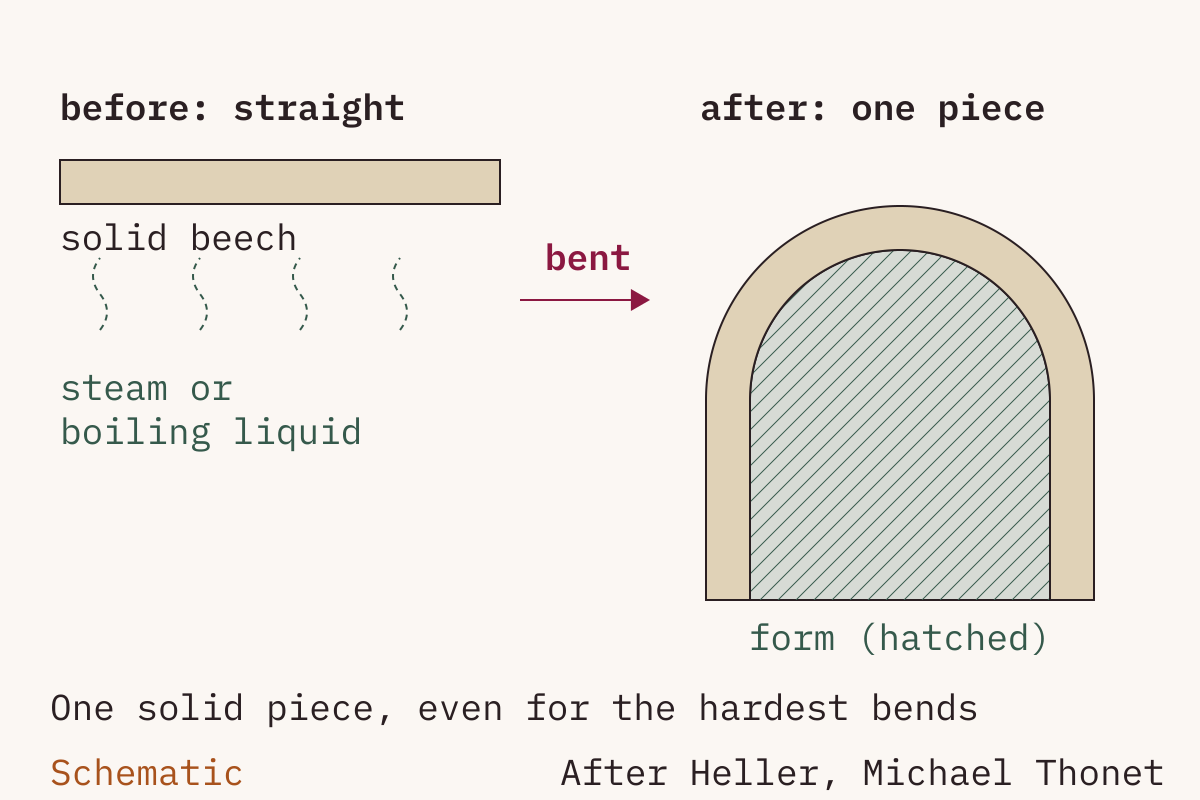
The principle in two stages: a straight piece of solid beech is bent with the help of steam or boiling liquid over a form into a curve, and it stays one piece. No steps, temperatures or times are shown.
Source: Heller (ed.), Michael Thonet (Brünn, [1920]), p. 24 (steam or boiling liquids; beech) and p. 28 (bending forms; one solid piece)
Read the figure as text
- Before: a straight piece of solid beech (Heller, p. 24, on beech).
- Bending: it takes place through the action of steam or boiling liquids (Heller, p. 24, the 1856 privilege; translated here).
- After: the piece is bent over a form and remains a single solid piece, even for the hardest bends (Heller, p. 28).
- Proportions in the drawing: illustrative.
"Bending a solid piece of beech around a form" by Kiln, Easel & Anvil, https://kilneaselandanvil.com/furniture/thonet-no-14/ — CC BY 4.0, https://creativecommons.org/licenses/by/4.0/
Data: Hermann Heller (ed.), Michael Thonet (Brünn, [1920]), pp. 24 and 28 (public domain in the US)
Next to the method, Heller names the forms. He attributes the decisive progress to “Verbesserungen im Biegeverfahren”, improvements in the bending method, and to better construction of the “Biegeformen”, the bending forms (translated here; p. 28). The drawing above is an independent schematic of that general principle, not a copy of any illustration in Heller's book.
Bent or carved: what changes in the chair?
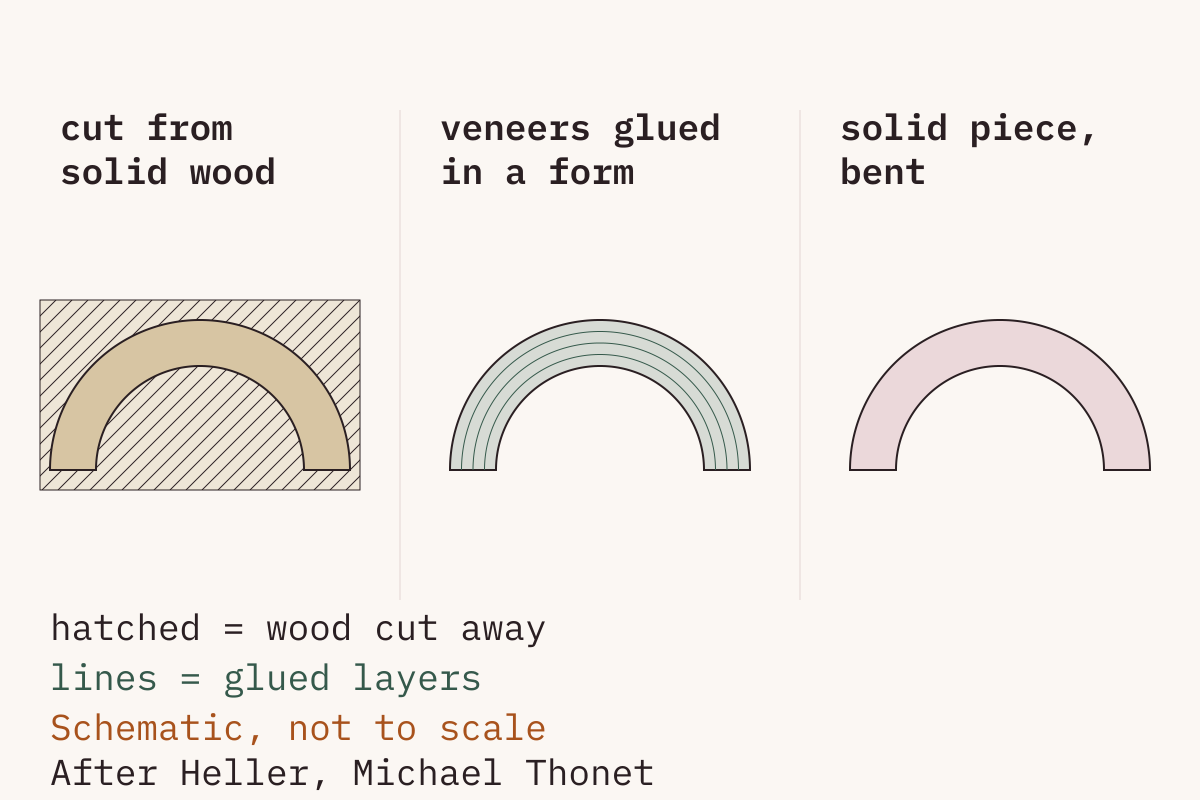
Heller describes three successive ways of making the same curved part. The first is the traditional method: the curved top rail of a chair back was, “wie es früher immer geschah, aus massivem Holze herauszuschneiden”, as was always done before, cut out of solid wood (translated here), and was then shaped and veneered (p. 8).
The second method is the one Michael Thonet tried first. He glued thick veneers together inside a wooden form and pressed them into the required curve (pp. 8 and 9). According to Heller, these pressed rails used less wood, were lighter, and were nevertheless considerably more durable. Decorative rods on the finer chairs were also glued in metal forms, “statt dieselben von Holzschnitzern aus massivem Holze ausarbeiten zu lassen”: instead of having woodcarvers work them out of solid wood (translated here; p. 9). scanned page
 schematic, not to scale
The same curved part three ways, in the order Heller describes them: cut from a solid block, with the waste hatched; glued from thick veneers in a form, with lines for the layers; and bent from one solid piece.
Source: Heller (ed.), Michael Thonet (Brünn, [1920]), p. 8 (cut from solid wood; veneers glued in a form), p. 9 (less wood, lighter; not by woodcarvers) and p. 28 (glued strips came apart; one solid piece)
Read the figure as text
- Cut from solid wood: the curve is cut out of a solid block, shaped, then veneered; the usual method before Thonet's trials (Heller, p. 8).
- Veneers glued in a form: thick veneers are glued and pressed in a wooden form; less wood, lighter and much more durable (Heller, pp. 8 and 9).
- One solid piece, bent: a solid piece is bent over a form; all parts, even the hardest bends, made from one solid piece (Heller, p. 28).
- Proportions in the drawing: illustrative.
"A curved chair part cut from solid wood, glued from veneers, or bent in one piece" by Kiln, Easel & Anvil, https://kilneaselandanvil.com/furniture/thonet-no-14/ — CC BY 4.0, https://creativecommons.org/licenses/by/4.0/
Data: Hermann Heller (ed.), Michael Thonet (Brünn, [1920]), pp. 8, 9 and 28 (public domain in the US)
Why did the glued parts give way?
A weakness in the second method pushed the change to the third. Heller writes that the bentwood chairs soon became a popular export. But shipments to tropical regions revealed a defect. Chair parts that were in part still bent from several strips and glued together “öfters aus dem Leime gingen” in the burning sun and humid heat: they frequently came unglued (translated here; p. 28).
The remedy was to abandon the glue. Some parts were already being bent from solid wood instead of several strips, Heller says, and gradually better bending methods and improved forms made it possible to produce all the parts, “selbst die schwierigsten Biegungen, ausschließlich aus einem massiven Stücke”: even the most difficult bends, entirely from one solid piece (translated here; p. 28). He describes this as the change that gave the chairs their resistance to heat and humidity. scanned page
How is the chair held together?
There was a second reason, Heller says, why these chairs travelled well. They were constructed so that the individual parts, “ohne Leimverbindung bloß mittels eiserner Schrauben”, without glued joints and only with iron screws, could be assembled and dismantled (translated here; p. 28). Dismantled, they were packed into crates and occupied very little space.
On these pages Heller gives no count of parts or screws for any chair, and none is given here.
What did Heller show in [1920]?
Heller dates the No. 14 itself in a single sentence. In 1859, he writes, the factory at Koritschan created the type that, as “Sessel Nr. 14”, became and remained the principal mass-market product of the Thonet industry (p. 29). On that page the type is credited to the factory, and no individual designer is named.
He then singles out one feature as even more significant than the chair: the “kreisrund gebogenen Sitzrahmens”, the seat frame bent into a complete circle, which was introduced with it (translated here; p. 29). In his own day, Heller believed, that circular seat frame was probably being used with about a hundred different chair types from the various bentwood factories.
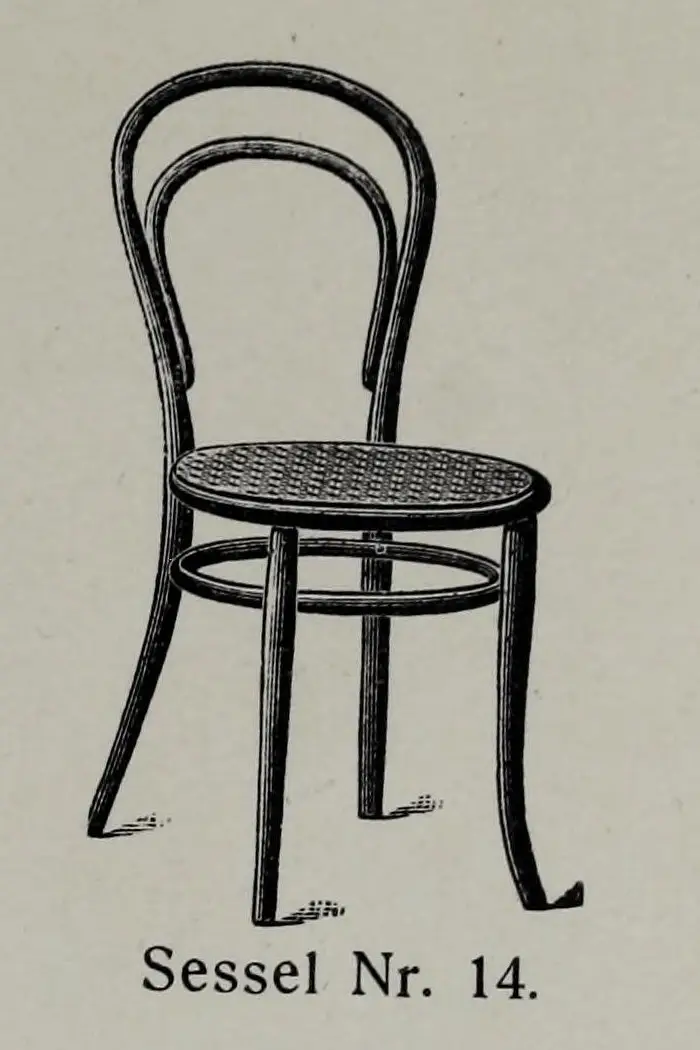
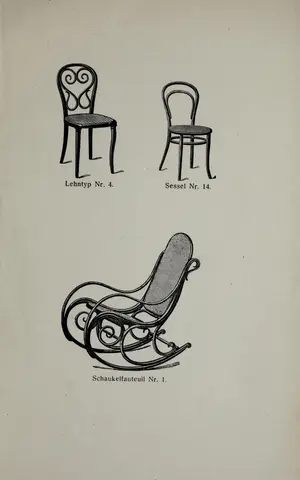
The chair printed above the caption Sessel Nr. 14 on Heller's plate, with its curved back and round seat. Heller's text on p. 29 names the circular bent seat frame as the feature that came with this type.
Collection: Getty Research Institute copy, Michael Thonet (Brünn, [1920]), plate with Sessel Nr. 14, scanned for the Internet Archive
Detail. The small picture marks where it sits in the whole object.
“Sessel Nr. 14, plate in Michael Thonet (Heller, ed.), detail with caption”, Unknown author; public domain.
Complete credit
"Sessel Nr. 14, plate in Michael Thonet (Heller, ed.), detail with caption" by Unknown author — https://archive.org/details/michaelthonetder00hell — Public domain (US: published in [1920] (year from the library record; the title page gives Brünn and no year), before 1931; DE/FR: unsigned catalogue cut, an anonymous work published in [1920] (Brünn, per the title page), so 70 years from publication have passed); modified: cropped to the detail of the chair printed above the caption Sessel Nr. 14, caption included, at the scan's own resolution
The plate is a catalogue illustration, not a technical drawing. It shows the finished chair, but it does not reveal how the pieces were cut, bent or joined; for that, this page relies on Heller's text. A style label such as Chippendale style, tied to Thomas Chippendale's 1754 Director, a pattern book, describes how furniture looks, whereas Heller's pages describe how a chair was manufactured.
Bending is only one way a workshop could shape its material. In veneer, the workshop technique of Boulle marquetry makes two panels from one cut, per Roubo; in bronze, a sculpture can be cast more than once, as with The Thinker.
Under the loupe: look again at the round seat on Heller's plate, the circular bent frame he singles out on p. 29, then compare the cut corner of a dovetail joint, held by the shape of its tails rather than by screws.
The chair printed above the caption Sessel Nr. 14 on Heller's plate, with its curved back and round seat. Heller's text on p. 29 names the circular bent seat frame as the feature that came with this type.
Collection: Getty Research Institute copy, Michael Thonet (Brünn, [1920]), plate with Sessel Nr. 14, scanned for the Internet Archive
Detail. The small picture marks where it sits in the whole object.
“Sessel Nr. 14, plate in Michael Thonet (Heller, ed.), detail with caption”, Unknown author; public domain.
Complete credit
"Sessel Nr. 14, plate in Michael Thonet (Heller, ed.), detail with caption" by Unknown author — https://archive.org/details/michaelthonetder00hell — Public domain (US: published in [1920] (year from the library record; the title page gives Brünn and no year), before 1931; DE/FR: unsigned catalogue cut, an anonymous work published in [1920] (Brünn, per the title page), so 70 years from publication have passed); modified: cropped to the detail of the chair printed above the caption Sessel Nr. 14, caption included, at the scan's own resolution
Sources and reading levels
- Hermann Heller (ed.), Michael Thonet: der Erfinder und Begründer der Bugholzmöbel-Industrie (Brünn, [1920]), pp. 8, 9, 24, 28 and 29 and the plate with Sessel Nr. 14; Getty Research Institute copy; in German, quoted with the English translated here; public domain in the US (published [1920]), EU status not traced, so quoted briefly archive.org/details/michaelthonetder00hellRead: scanned page
More objects in Furniture
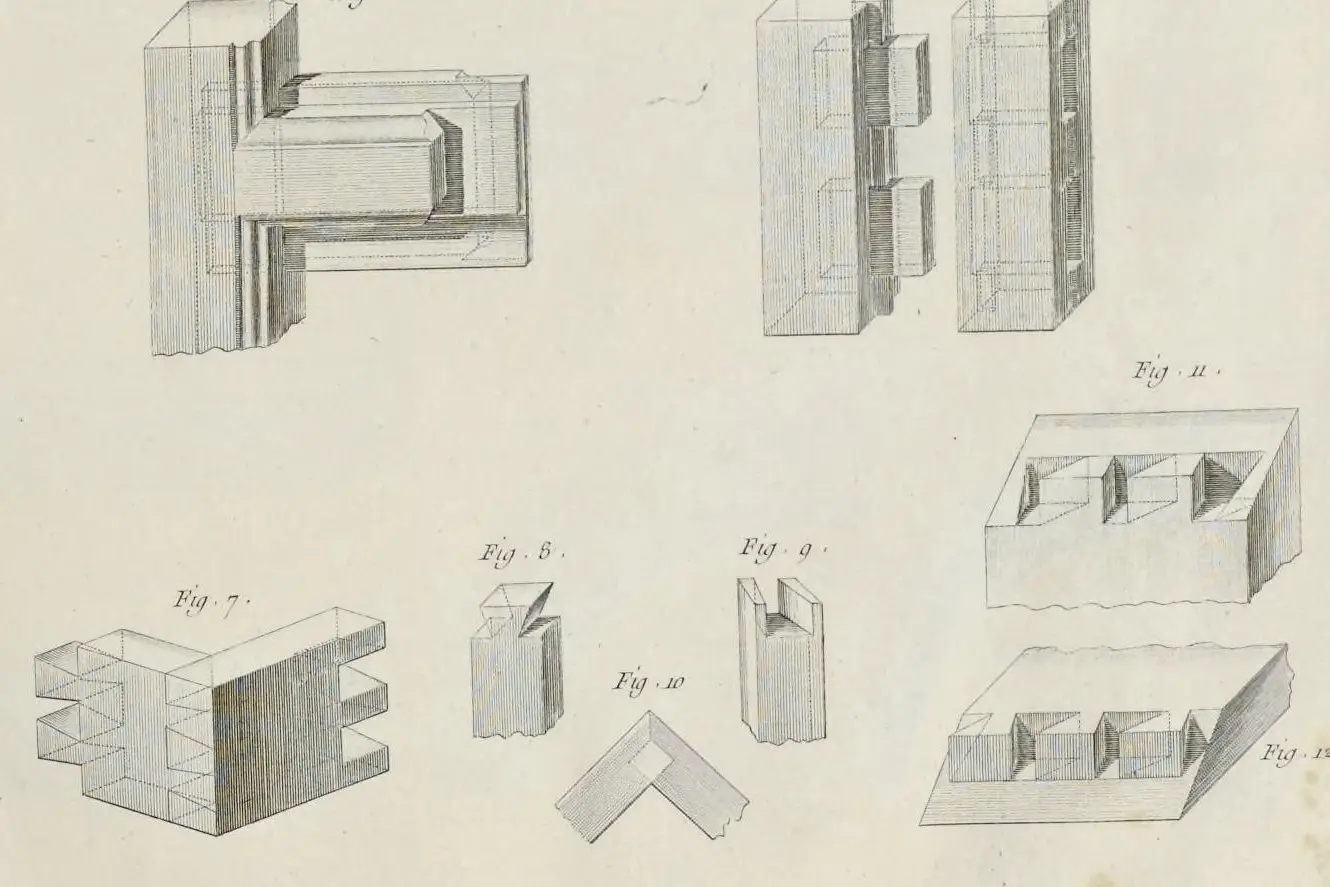
Technique, diagrammed
Dovetail Joint: How Roubo Placed the Tails in a Drawer
Catalogued
Picture credit
"Assemblages doubles et à queues d'aronde, Pl. 9 of L'Art du menuisier (Roubo), detail" by André-Jacob Roubo and Berthault — https://archive.org/details/gri_33125009321916 — Public domain (US: published in 1769, before 1931; DE/FR: Roubo, who drew the plate, died in 1791 per the Getty Research Institute library record of the scan, more than 70 years ago; the engraving, published in 1769, is signed 'Berthault Sculp.' with no first name: the Internet Archive's library records name two engravers of that name working then, Nicolas Berthault, d. 1785, and Pierre Gabriel Berthault, 1748-1819 (archive.org search of creator Berthault, read 2026-11-27, rights-research/evidence/ia/search-berthault.json), so whichever of them engraved it died more than 70 years ago); modified: cropped to a 3:2 frame around Fig. 7 to 12 and the lower halves of Fig. 5 and 6
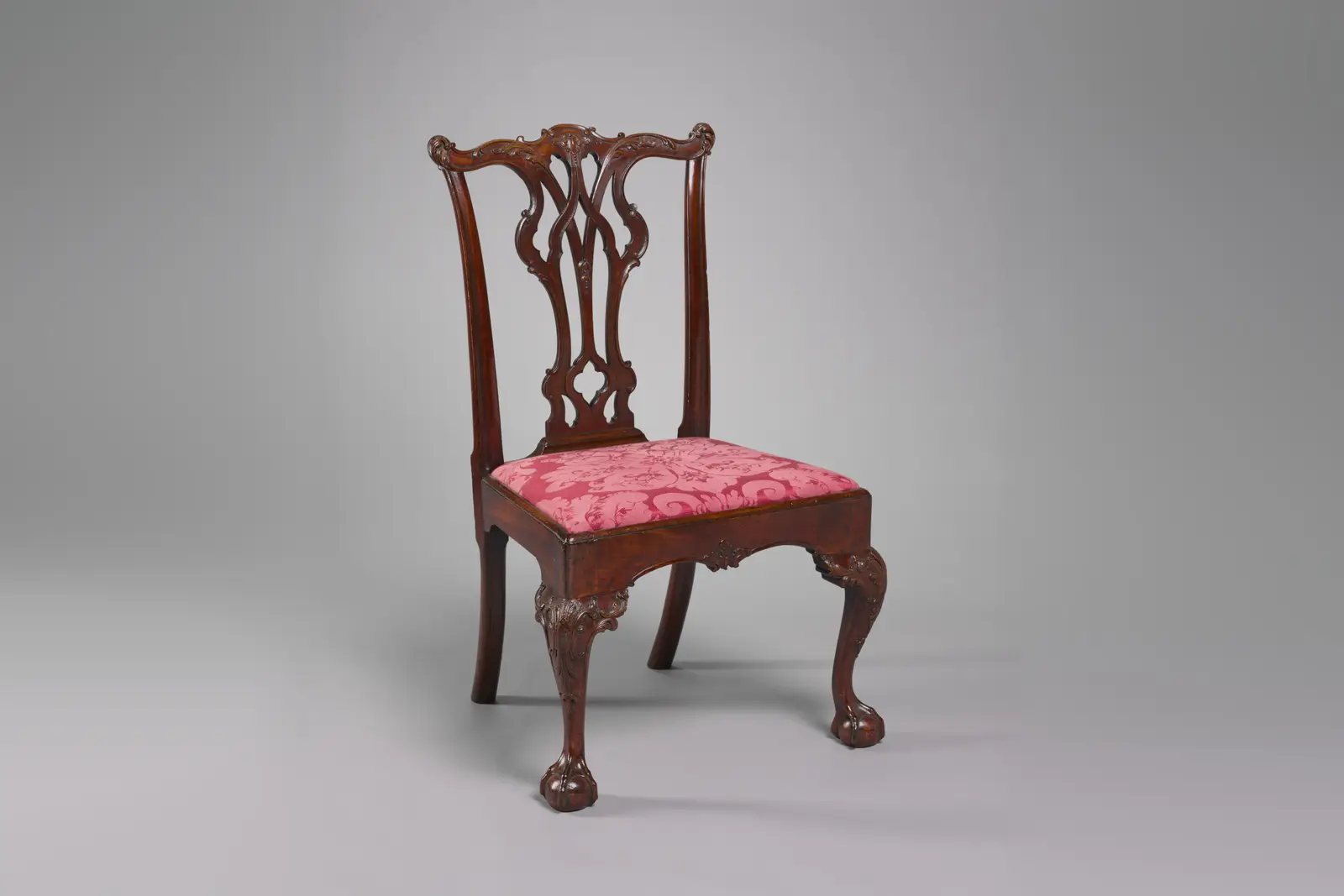
Telling them apart
Chippendale Style: Thomas Chippendale's 1754 Director
Catalogued
Picture credit
"Side Chair, Philadelphia (card)" by Cleveland Museum of Art — https://www.clevelandart.org/art/1985.58 — CC0 1.0 (https://creativecommons.org/publicdomain/zero/1.0/); modified: padded with the photograph's own background to a 3:2 frame, left and right, with a feathered seam
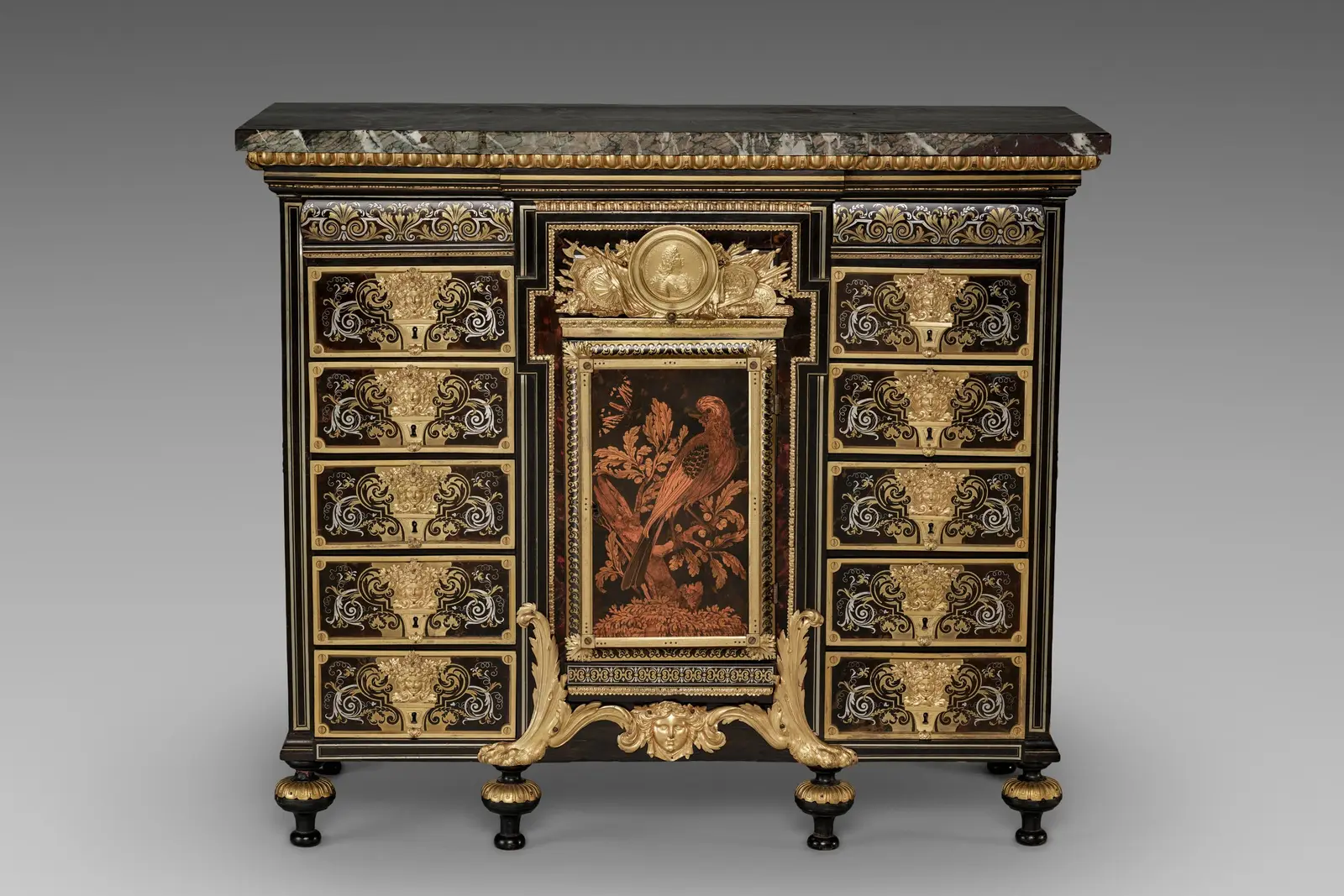
Technique, diagrammed
Boulle Marquetry: Two Panels From One Cut, per Roubo
Catalogued
Picture credit
"Cabinet, André-Charles Boulle (card)" by Cleveland Museum of Art — https://www.clevelandart.org/art/1949.539 — CC0 1.0 (https://creativecommons.org/publicdomain/zero/1.0/); modified: cropped to a 3:2 frame from the centre (full width, 216 px removed at the top and at the bottom) and resized to 2400 x 1600
Cite this page
Kiln, Easel & Anvil. “Thonet No. 14: Bent, Not Carved, per Heller.” Published 28 November 2026. https://kilneaselandanvil.com/furniture/thonet-no-14/ (accessed on the day you read it).
How a record is checked Every correction, dated Report an error on this page (contact@kilneaselandanvil.com)