Dovetail Joint: How Roubo Placed the Tails in a Drawer
Short answer
A dovetail joint locks because its flared tails can slide out of their sockets in one direction only, and according to André-Jacob Roubo's 18th-century joinery manual, the tails go in the drawer sides so that opening a drawer does not pull it apart. On his Pl. 9, look at Fig. 8 and 9, a tail and its socket drawn apart.
Technique sheet
- Technique
- Dovetail joint (queue d’aronde)
- Kind of work
- joint between two boards meeting at a corner
- Principle in one line
- flared tails sit in matching sockets, so the boards can part only by sliding one way (site description of the shape)
- What to look for
- on drawers, tails in the sides and pins in the front, two or three over the height of the side (per Roubo)
- Usual period and place
- France, 18th century, as described in Roubo’s L’Art du menuisier
- Example in a collection
- Roubo, L’Art du menuisier, plates to part I, Pl. 9, Fig. 7 to 12
This record as CSV (dovetail-joint-technique.csv) (notes on this file)
Data: André-Jacob Roubo, L'Art du menuisier, part I, p. 47, and part III, p. 722 (public domain)
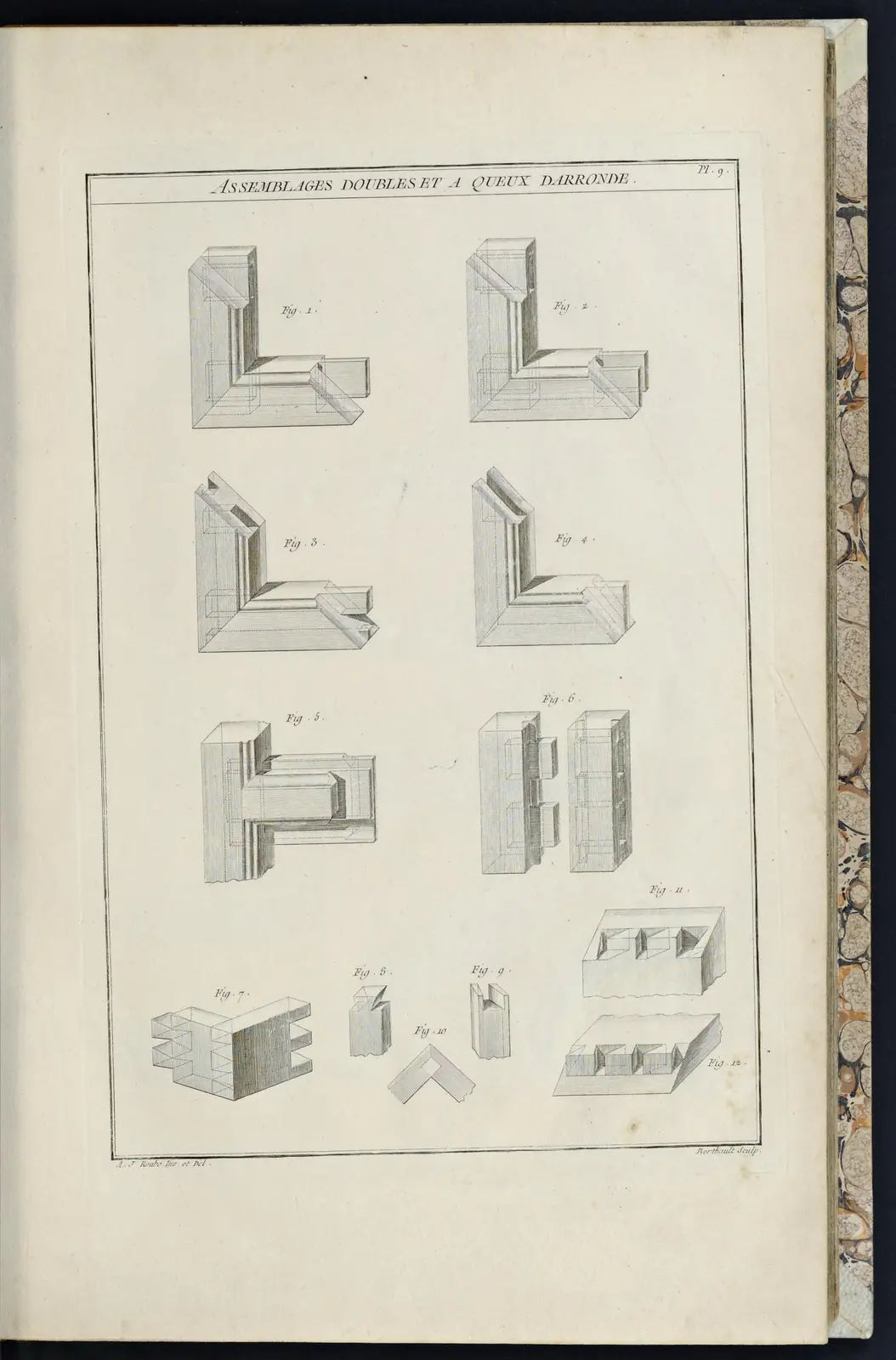
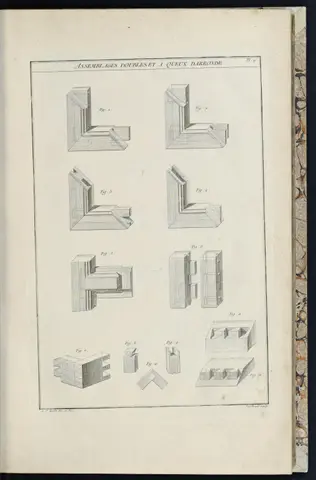
Pl. 9 from the plates to Part I of Roubo's L’Art du menuisier, engraved with the title ASSEMBLAGES DOUBLES ET A QUEUX DARRONDE. Roubo's text on p. 47 explains the bottom row: Fig. 7 is a dovetail, Fig. 8 and 9 show a tail and its socket apart, and Fig. 10 to 12 show covered tails, assembled and apart.
Collection: Getty Research Institute copy, L'Art du menuisier (1769), plates to Part I, Pl. 9, scanned for the Internet Archive
“Assemblages doubles et à queues d'aronde, Pl. 9 of L'Art du menuisier (Roubo)”, André-Jacob Roubo (drawing) and Berthault (engraving) / André-Jacob Roubo and Berthault; public domain.
Complete credit
"Assemblages doubles et à queues d'aronde, Pl. 9 of L'Art du menuisier (Roubo)" by André-Jacob Roubo and Berthault — https://archive.org/details/gri_33125009321916 — Public domain (US: published in 1769, before 1931; DE/FR: Roubo, who drew the plate, died in 1791 per the Getty Research Institute library record of the scan, more than 70 years ago; the engraving, published in 1769, is signed 'Berthault Sculp.' with no first name: the Internet Archive's library records name two engravers of that name working then, Nicolas Berthault, d. 1785, and Pierre Gabriel Berthault, 1748-1819 (archive.org search of creator Berthault, read 2026-11-27, rights-research/evidence/ia/search-berthault.json), so whichever of them engraved it died more than 70 years ago)
Card and share picture, a 3:2 copy of this object’s photograph: "Assemblages doubles et à queues d'aronde, Pl. 9 of L'Art du menuisier (Roubo), detail" by André-Jacob Roubo and Berthault — https://archive.org/details/gri_33125009321916 — Public domain (US: published in 1769, before 1931; DE/FR: Roubo, who drew the plate, died in 1791 per the Getty Research Institute library record of the scan, more than 70 years ago; the engraving, published in 1769, is signed 'Berthault Sculp.' with no first name: the Internet Archive's library records name two engravers of that name working then, Nicolas Berthault, d. 1785, and Pierre Gabriel Berthault, 1748-1819 (archive.org search of creator Berthault, read 2026-11-27, rights-research/evidence/ia/search-berthault.json), so whichever of them engraved it died more than 70 years ago); modified: cropped to a 3:2 frame around Fig. 7 to 12 and the lower halves of Fig. 5 and 6
In the bottom row of Roubo's ninth plate, two boards meet at a corner, locked by flared tails. Because the flared shape means the boards can part in one direction only, where the tails go matters for how a piece of furniture behaves in daily use. The plain dovetail in that bottom row is Fig. 7. In a drawer, Roubo puts the tails in the sides rather than in the front, and the diagrams below explain why that arrangement keeps a drawer in one piece.
Roubo's French name for the joint is queue d’aronde, literally a swallow's tail (translated here), and the German equivalent is Schwalbenschwanzverbindung. In English usage, the board with the flared projections carries the tails, while the other board carries the pins, the narrower pieces of wood left standing between its sockets. Roubo's own terms for the two separated parts in Fig. 8 and 9 are queue and entaille, tail and socket.
A joint hidden at the corner of a drawer can contain as much deliberate making as a famous painting such as the Mona Lisa, and it is read here in the same order: first how the parts were cut and assembled, then what they are called. Style labels such as Chippendale style come last.
How do tails and pins lock?
Roubo's explanation, printed on p. 47 of Part I, is brief. Fig. 7, he writes, “représente un assemblage qui se nomme à queue d'aronde”, that is, shows a joint called a dovetail (translated here). The parts are “des entailles d'une forme évasée”, sockets of a flared shape (translated here), which, when cut with precision, “retiennent deux pieces de bois ensemble d'une maniere très-solide”: they hold two pieces of wood together very firmly (translated here). scanned page
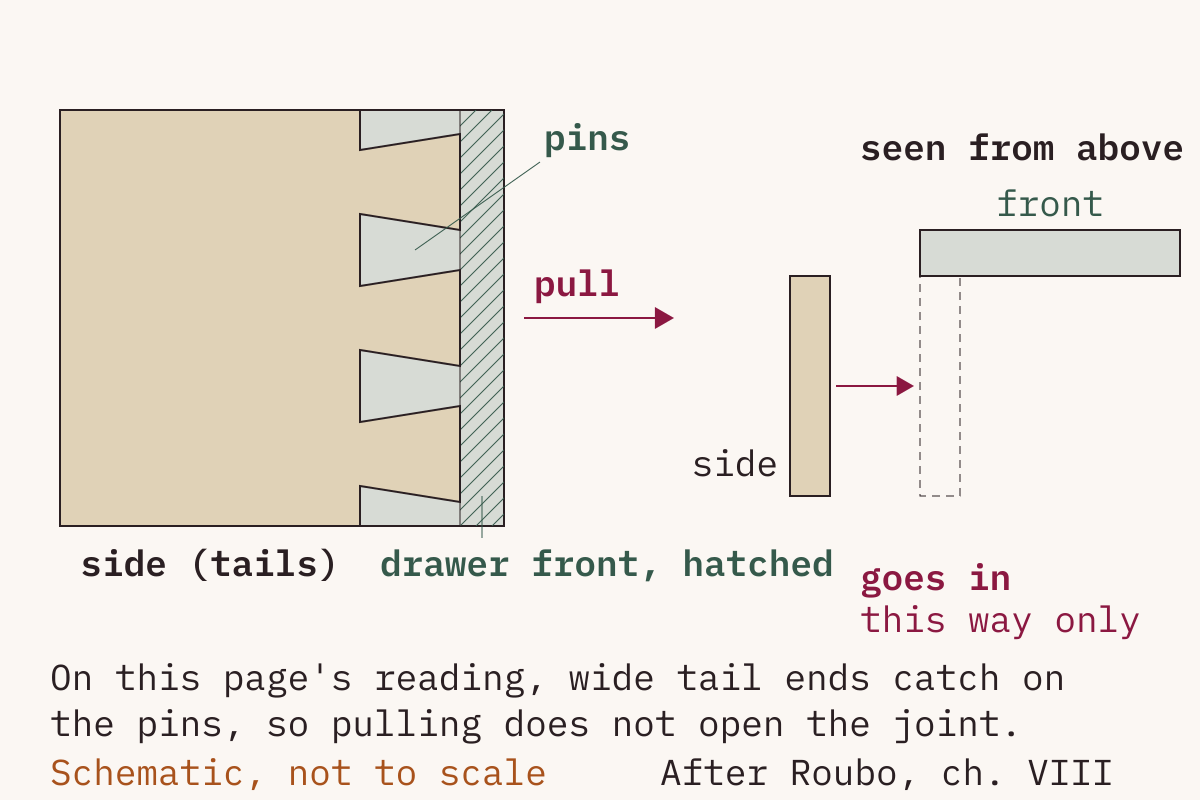
The geometry accounts for that firmness, though this is the page's reading of the shape, not a sentence from Roubo. Each tail is wider at its end than at its root, and each socket is cut to the same flare, so the tail board can slide into its sockets along one line only, at right angles to its own face. Pulled in any other direction, the wide end of a tail meets the narrower mouth of its socket and stops.
 schematic, not to scale
A drawer corner with the tails cut on the side, as Roubo directs; on this page's reading of the shape, a pull on the front is caught by the wide tail ends. Seen from above, the side goes onto the front from one direction only.
Source: Roubo, L’Art du menuisier, part III (Paris, 1769–1774), section II, chapter VIII, p. 722 (drawers joined with two or three dovetails, tails in the sides)
Read the figure as text
- Side board: ends in three flared tails; Roubo asks for two or three over the height of the side (part III, p. 722).
- Drawer front: holds the pins between the tails; its hatched strip lies beyond the tail ends.
- Pull on the front: on this page's reading of Roubo's placement rule, the wide tail ends catch on the pins, so the joint does not open.
- Assembly: the side goes onto the front from one direction only, at right angles to its face.
- Angles and proportions: illustrative, not from the source.
"Drawer dovetail: tails on the side, pins on the front" by Kiln, Easel & Anvil, https://kilneaselandanvil.com/furniture/dovetail-joint/ — CC BY 4.0, https://creativecommons.org/licenses/by/4.0/
Data: André-Jacob Roubo, L'Art du menuisier, part III, section II, chapter VIII, p. 722 (public domain)
No angle for the flare appears on these pages of Roubo, and none is given here; the slope in the drawing is illustrative and only makes the flared shape easier to recognise.
Why put the tails in the sides?
The drawer rule appears much later in the manual, in Part III, within the chapter on tables (chapter VIII, according to the running head printed on the page), where Roubo describes writing desks and their drawers. On p. 722 he specifies that the drawer frames should be joined “à queues d'aronde, au nombre de deux ou trois sur la hauteur, & jamais une seule, ce qui n'est pas assez solide”. scanned page
That means with dovetails, two or three over the height, and never a single one, which is not strong enough (translated here). The placement rule follows immediately: “il faut aussi observer de placer les queues dans les côtés des tiroirs, afin qu'en les faisant ouvrir, on ne les fasse pas désassembler”. So the tails belong in the sides of the drawers, so that opening the drawers does not take them apart (translated here).
Roubo also names the arrangement to avoid: tails placed “dans les têtes au devant des tiroirs & dans les derrieres”, in the ends at the front and back of the drawer (translated here), where opening could separate the joint.
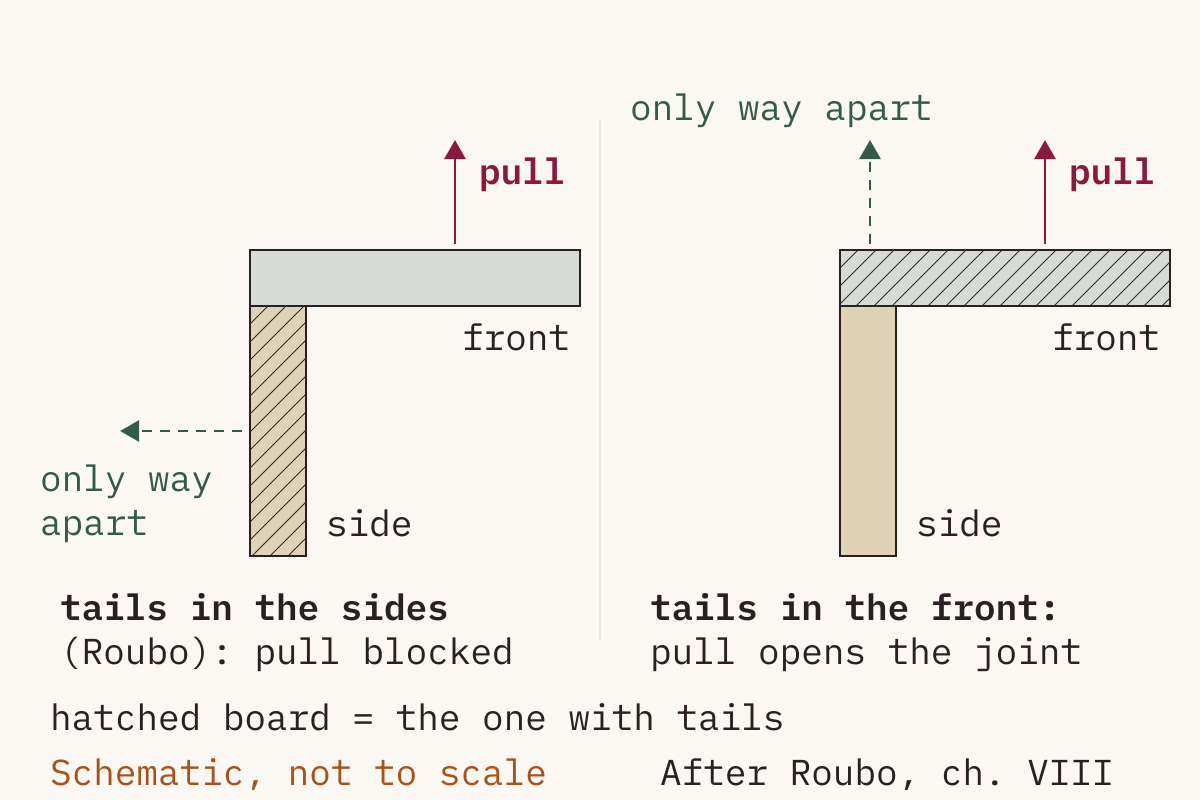
The reason follows from the one-way slide; this is the page's interpretation, not Roubo's wording. With the tails in the side, the side can leave the front only by moving sideways, across the drawer. A pull on the handle runs along the length of the side, so the flared faces press against each other and do not slide. Reverse the arrangement, with the tails on the front, and the front's only way out is straight forward, exactly the direction in which the handle pulls.
 schematic, not to scale
Two drawer corners seen from above. With the tails in the side, as Roubo directs, the side can leave only sideways and a pull on the front is blocked. With the tails in the front, the only way apart is the direction of the pull.
Source: Roubo, L’Art du menuisier, part III (Paris, 1769–1774), section II, chapter VIII, p. 722 (tails in the sides, so that opening the drawer does not take it apart)
Read the figure as text
- Tails in the sides, as Roubo directs: the joint opens only sideways, across the drawer, so a pull on the handle is blocked.
- Tails in the front, the placement Roubo warns against: the joint opens straight forward, the same way the handle pulls.
- Hatched board in each corner: the board that carries the tails.
"Where the tails go decides which way a drawer corner can open" by Kiln, Easel & Anvil, https://kilneaselandanvil.com/furniture/dovetail-joint/ — CC BY 4.0, https://creativecommons.org/licenses/by/4.0/
Data: André-Jacob Roubo, L'Art du menuisier, part III, section II, chapter VIII, p. 722 (public domain)
Does the spacing show hand or machine work?
Spacing, layout lines and the number of tails on a surviving drawer are sometimes interpreted as evidence of how it was cut. Each of these traces is treated here as a clue with known exceptions rather than a verdict, and the reasoning is set out on Provenance check. Roubo's count of two or three, and never one, is a recommendation from a single 18th-century manual, not a test that dates a drawer or separates hand work from machine work.
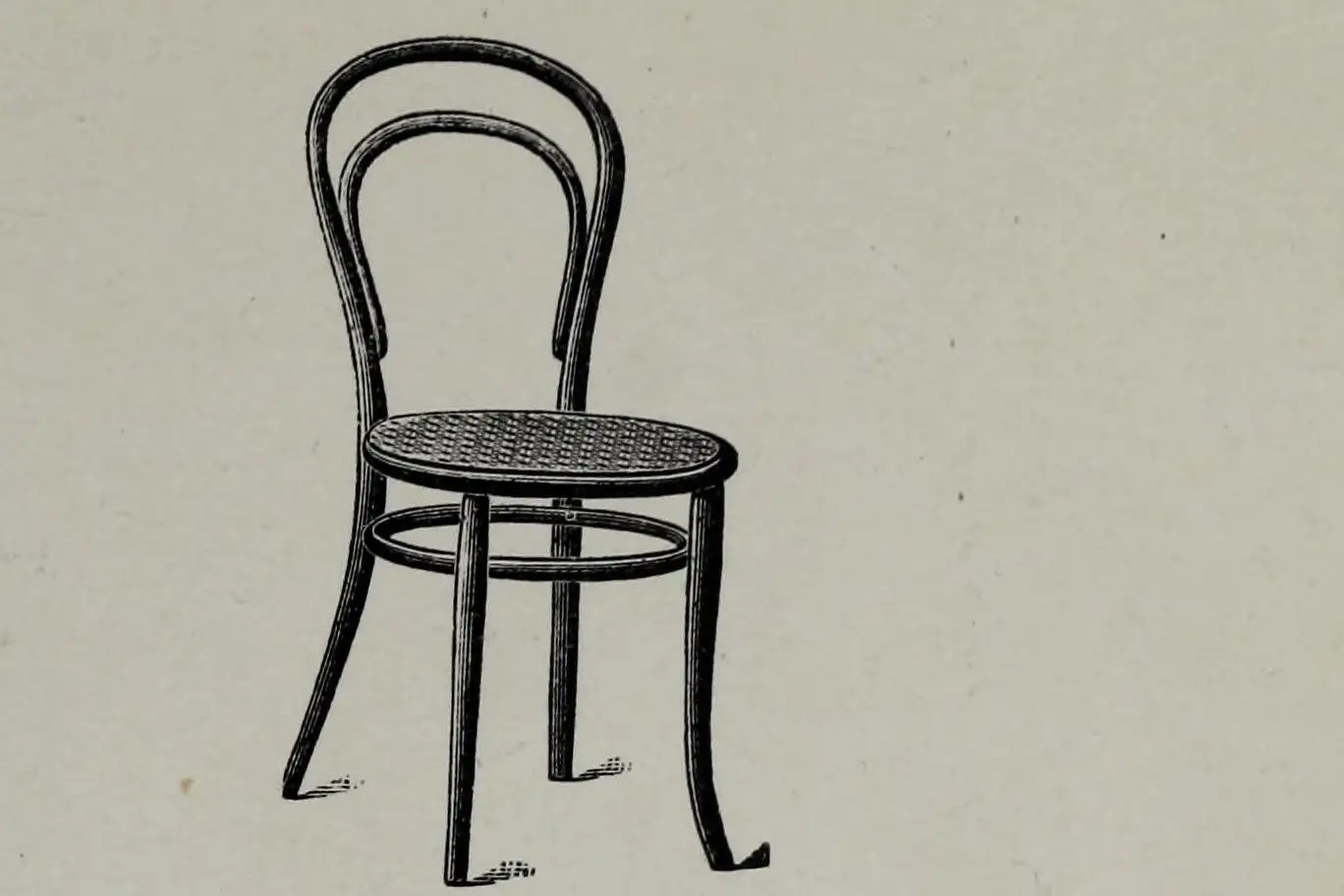
Not every piece of furniture depends on cut joints in the same way: a chair constructed around bent wood, the Thonet No. 14, addresses the problem of holding parts together with a different method.
Open or covered tails: what changes?
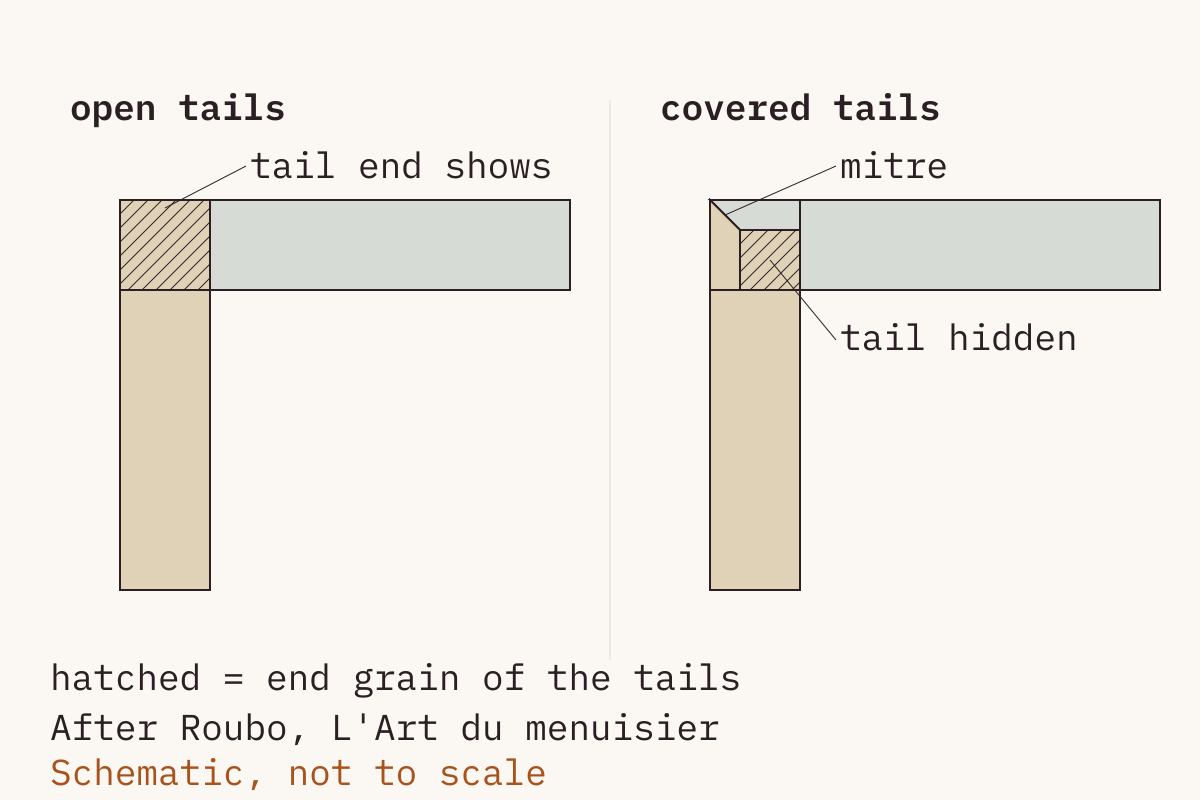
English trade names are not Roubo's vocabulary. On p. 47 he contrasts the plain dovetail of Fig. 7, whose tail ends are visible on the outside of the corner, with “queues recouvertes, ou queues perdues”, covered or lost tails (translated here). This page uses through for the first kind. Half-blind, the English trade name often searched for a hidden dovetail, is not Roubo's term, so the description below keeps to what his text says his covered tails actually are.
According to Roubo, covered tails are made “pour plus de propreté”, for a neater finish (translated here), and they take “les deux tiers ou les trois quarts de l'épaisseur du bois”, two thirds or three quarters of the thickness of the wood (translated here), “& le restant est coupé d'onglet”: the remainder is cut to a mitre (translated here). Fig. 10 shows such a joint assembled, and Fig. 11 and 12 show the same tails separated “pour en faire voir les dedans”, to reveal the inside (translated here). scanned page
 schematic, not to scale
A corner seen from above. On the left, open tails: the end grain of the tail shows on the outside. On the right, covered tails as Roubo describes them: the tail takes part of the thickness, and the rest of both boards meets on a mitre, so the outside shows only a diagonal line.
Source: Roubo, L’Art du menuisier, part I (Paris, 1769), p. 47 (Fig. 7 to 12: the dovetail, a tail and its socket, covered tails)
Read the figure as text
- Open tails (Fig. 7): the tails pass through the other board, and their end grain shows on the outside of the corner.
- Covered tails (Fig. 10 to 12): the tails take two thirds or three quarters of the thickness of the wood (Roubo, p. 47).
- Covered tails, outside: the remaining thickness is cut to a mitre, so the corner shows a diagonal line and no tail.
- Proportions in the drawing: illustrative.
"Open and covered dovetails, a corner seen from above" by Kiln, Easel & Anvil, https://kilneaselandanvil.com/furniture/dovetail-joint/ — CC BY 4.0, https://creativecommons.org/licenses/by/4.0/
Data: André-Jacob Roubo, L'Art du menuisier, part I, p. 47 (public domain)
What changes, in Roubo's account, is what the outside of the corner reveals, and the reason he states is neatness rather than strength. In both kinds the tail board still enters from one direction only, so on this page's reading of the geometry the rule about which board carries the tails applies to both.
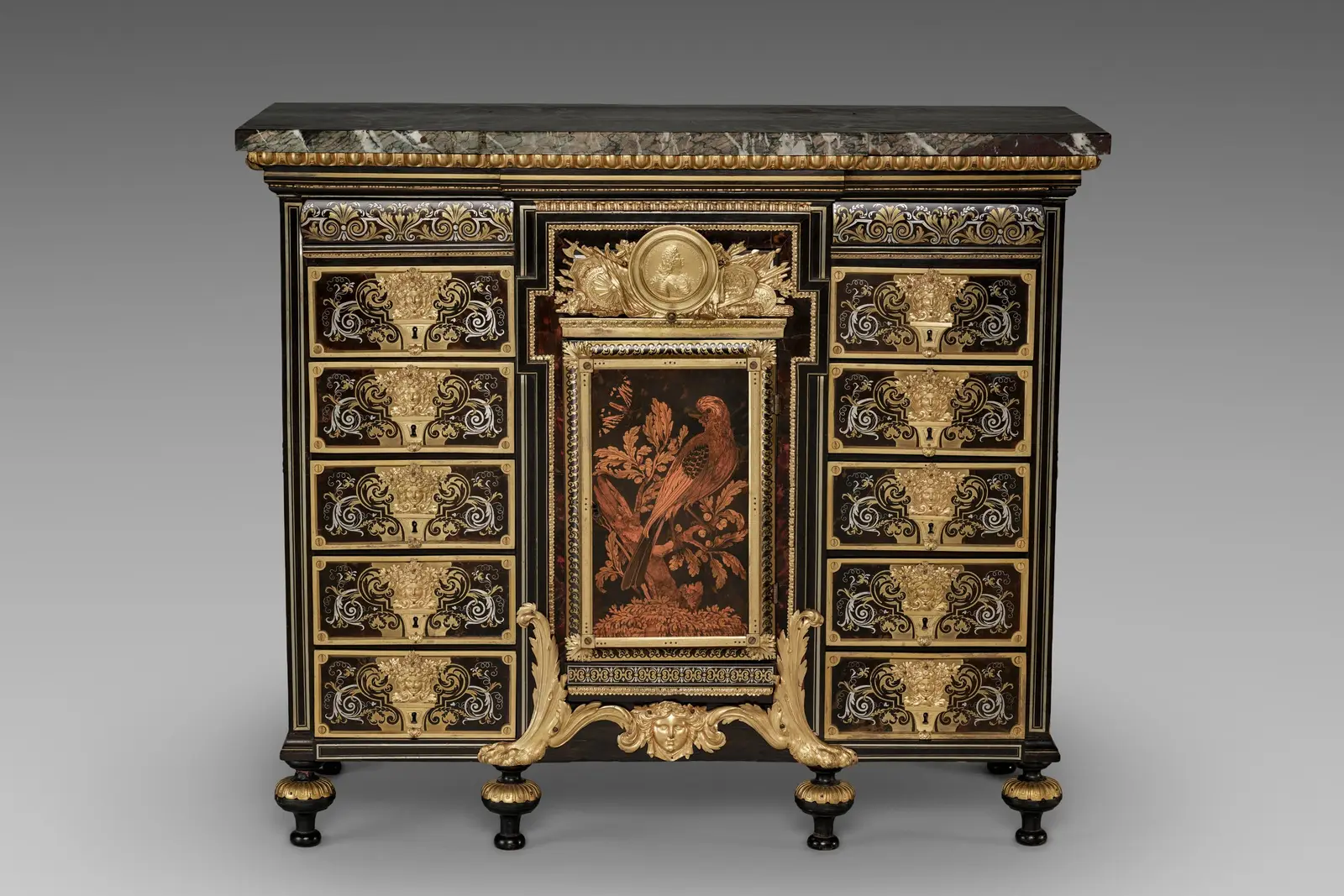
Under the loupe: look again at Fig. 10 on Roubo's plate, the small corner that shows nothing but a mitre, then turn to Boulle marquetry, a different workshop technique, cut in veneer.
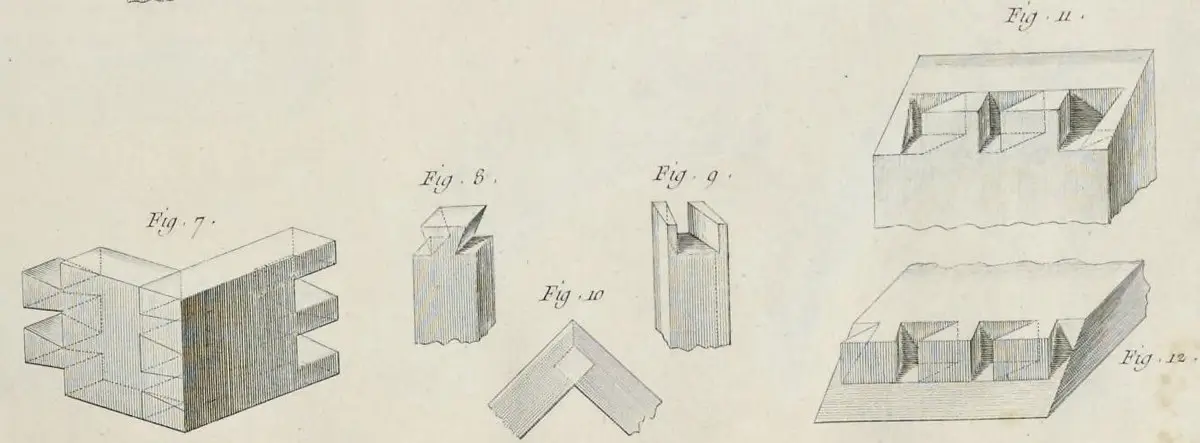
The bottom row of Pl. 9, Fig. 7 to 12, as described on p. 47 of Part I: the dovetail, a tail and its socket apart, and covered tails assembled and apart.
Collection: Getty Research Institute copy, L'Art du menuisier (1769), plates to Part I, Pl. 9, scanned for the Internet Archive
Detail. The small picture marks where it sits in the whole object.
“Assemblages doubles et à queues d'aronde, Pl. 9 of L'Art du menuisier (Roubo), Fig. 7 to 12”, André-Jacob Roubo (drawing) and Berthault (engraving) / André-Jacob Roubo and Berthault; public domain.
Complete credit
"Assemblages doubles et à queues d'aronde, Pl. 9 of L'Art du menuisier (Roubo), Fig. 7 to 12" by André-Jacob Roubo and Berthault — https://archive.org/details/gri_33125009321916 — Public domain (US: published in 1769, before 1931; DE/FR: Roubo, who drew the plate, died in 1791 per the Getty Research Institute library record of the scan, more than 70 years ago; the engraving, published in 1769, is signed 'Berthault Sculp.' with no first name: the Internet Archive's library records name two engravers of that name working then, Nicolas Berthault, d. 1785, and Pierre Gabriel Berthault, 1748-1819 (archive.org search of creator Berthault, read 2026-11-27, rights-research/evidence/ia/search-berthault.json), so whichever of them engraved it died more than 70 years ago); modified: cropped to the detail of Fig. 7 to 12 in the bottom row of the plate, resized to 1200 pixels wide
Sources and reading levels
- André-Jacob Roubo, L'Art du menuisier, plates to part I (Paris, 1769), Pl. 9, engraved title ASSEMBLAGES DOUBLES ET A QUEUX DARRONDE, signed A. J. Roubo Inv. et Del. and Berthault Sculp.; Getty Research Institute copy; public domain in the US and EU (Roubo died 1791) archive.org/details/gri_33125009321916Read: scanned page
- André-Jacob Roubo, L'Art du menuisier, part I (Paris, 1769), p. 47, on Pl. 9, Fig. 7 to 12; Getty Research Institute copy; public domain in the US and EU (Roubo died 1791) archive.org/details/gri_33125009321551Read: scanned page
- André-Jacob Roubo, L'Art du menuisier, part III: section II (chapter VIII, on tables) and section III, L'Art du menuisier ébéniste (Paris, 1769–1774: the library record dates the work 1769; section III was approved by the Académie royale des sciences on 5 March 1774 and printed by L. F. Delatour in 1774; no year for section II appears on the pages read); Getty Research Institute copy, one bound volume; public domain in the US and EU (Roubo died 1791) archive.org/details/gri_33125009321973Read: scanned page
More objects in Furniture
Telling them apart
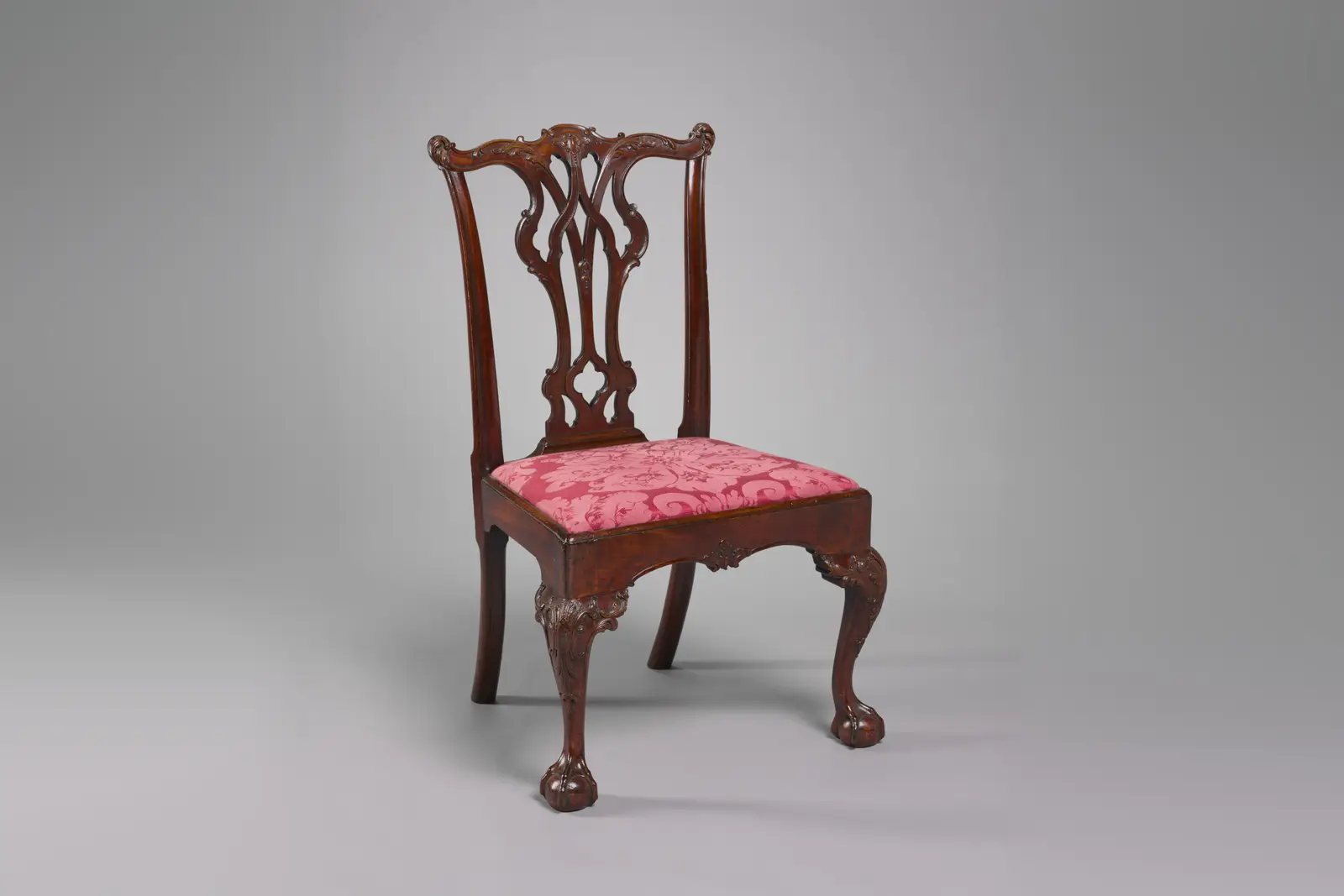
Chippendale Style: Thomas Chippendale's 1754 Director
Catalogued
Picture credit
"Side Chair, Philadelphia (card)" by Cleveland Museum of Art — https://www.clevelandart.org/art/1985.58 — CC0 1.0 (https://creativecommons.org/publicdomain/zero/1.0/); modified: padded with the photograph's own background to a 3:2 frame, left and right, with a feathered seam
Technique, diagrammed
Thonet No. 14: Bent, Not Carved, per Heller
Catalogued
Picture credit
"Sessel Nr. 14, plate in Michael Thonet (Heller, ed.), detail" by Unknown author — https://archive.org/details/michaelthonetder00hell — Public domain (US: published in [1920] (year from the library record; the title page gives Brünn and no year), before 1931; DE/FR: unsigned catalogue cut, an anonymous work published in [1920] (Brünn, per the title page), so 70 years from publication have passed); modified: cropped to a 3:2 frame around the chair Sessel Nr. 14, caption excluded
Technique, diagrammed
Boulle Marquetry: Two Panels From One Cut, per Roubo
Catalogued
Picture credit
"Cabinet, André-Charles Boulle (card)" by Cleveland Museum of Art — https://www.clevelandart.org/art/1949.539 — CC0 1.0 (https://creativecommons.org/publicdomain/zero/1.0/); modified: cropped to a 3:2 frame from the centre (full width, 216 px removed at the top and at the bottom) and resized to 2400 x 1600
Cite this page
Kiln, Easel & Anvil. “Dovetail Joint: How Roubo Placed the Tails in a Drawer.” Published 28 November 2026. https://kilneaselandanvil.com/furniture/dovetail-joint/ (accessed on the day you read it).
How a record is checked Every correction, dated Report an error on this page (contact@kilneaselandanvil.com)