Mona Lisa: Painted on Poplar, Not Canvas, per the Louvre
Short answer
The Mona Lisa is painted in oil on a thin board of poplar wood, not on canvas, according to the Louvre's collection record, and the board is 79.4 cm high by 53.4 cm wide. Compare the board with a canvas in the first diagram below, then look at its size in centimetres in the second.
Object record
- Object
- Mona Lisa (La Joconde); full title in the record: Portrait de Lisa Gherardini, épouse de Francesco del Giocondo, dit La Joconde ou Monna Lisa
- Maker
- Léonard de Vinci (Leonardo da Vinci), Vinci 1452 to Amboise 1519, as named in the record
- Date
- 1503 / 1519 (first quarter of the 16th century), as published
- Material
- huile sur bois (peuplier), as published: oil on wood (poplar), translated here
- Dimensions
- 79.4 × 53.4 cm, height by width, as published in metres (0,794 × 0,534 m)101 × 77 cm with accessory, as published in metres (1,01 × 0,77 m); accessory not described
- Collection
- Musée du Louvre, Département des Peintures, Paris; INV 779 (other number MR 316)
This record as CSV (mona-lisa-record.csv) (notes on this file)
Data: Musée du Louvre, collection record INV 779 (Licence Ouverte, Etalab)
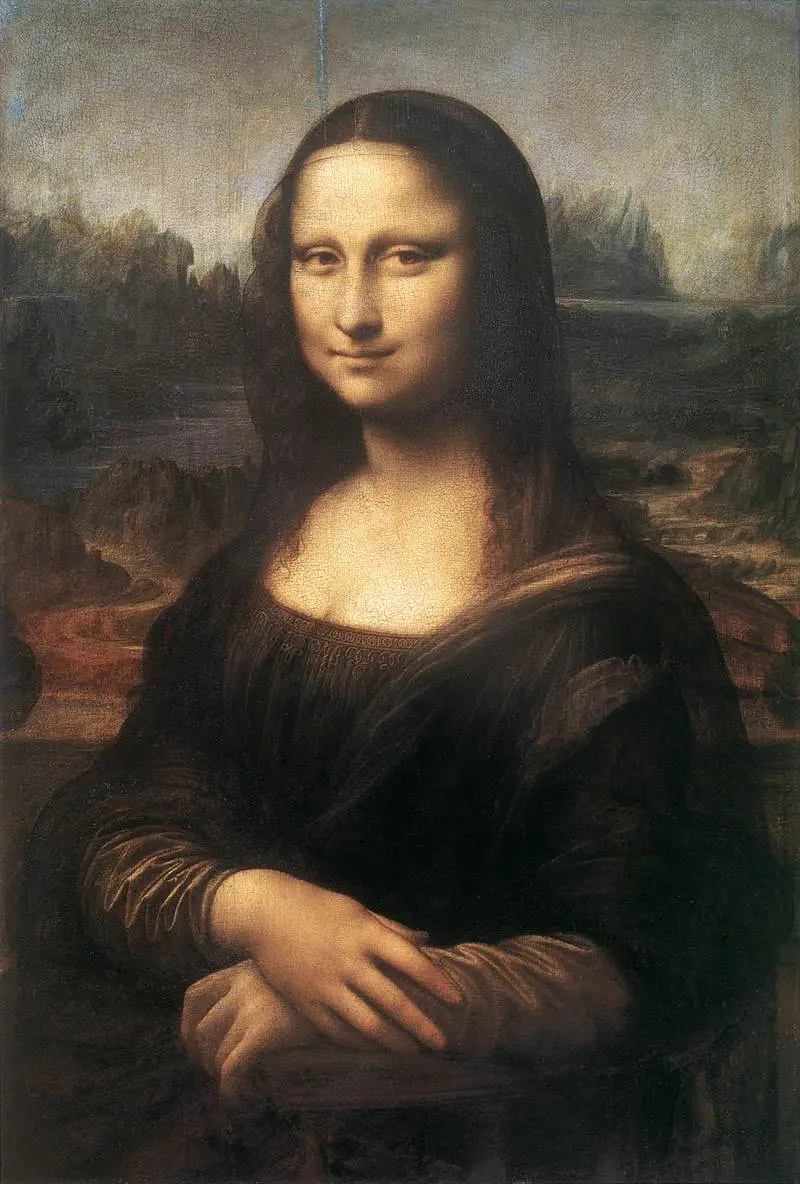
The Mona Lisa, dated 1503 to 1519 in the Louvre's record, which lists it as oil on wood (poplar).
Collection: Musée du Louvre, Paris, INV 779
"Mona Lisa (Leonardo da Vinci)" by Leonardo da Vinci — https://commons.wikimedia.org/wiki/File:Leonardo_da_Vinci_-_Mona_Lisa_(La_Gioconda)_-_WGA12712.jpg — Public domain (US: published before 1931; DE/FR: Leonardo da Vinci died in 1519 per the Louvre collection record, more than 70 years ago; faithful reproduction of a two-dimensional work)
Card and share picture, a 3:2 copy of this object’s photograph: "Mona Lisa (Leonardo da Vinci)" by Leonardo da Vinci — https://commons.wikimedia.org/wiki/File:Leonardo_da_Vinci_-_Mona_Lisa_(La_Gioconda)_-_WGA12712.jpg — Public domain (US: published before 1931; DE/FR: Leonardo da Vinci died in 1519 per the Louvre collection record, more than 70 years ago; faithful reproduction of a two-dimensional work); modified: cropped to a 3:2 frame from 120 px below the top edge (face), enlarged from 800 to 1,200 px wide
Behind the paint of the Mona Lisa lies a thin plank of poplar wood, not canvas. The Louvre's record gives the medium as “huile sur bois (peuplier)”, that is, oil on wood, poplar (translated here), for a painting that its own commentary calls “l’œuvre la plus célèbre au monde”, the most famous work in the world (translated here). Look at the lower right of the landscape, where the same record says the ground was left only roughly laid in.
That record is the Louvre's online entry for the painting. Its commentary, written by Vincent Delieuvin and dated July 2021, adds that Leonardo painted the portrait “sur une fine planche de bois de peuplier”, on a thin plank of poplar wood (translated here). Vasari's life of Leonardo describes the eyes, the eyebrows and the mouth in detail (in Gaetano Milanesi's edition of the Italian text, pp. 39–40), yet says nothing about what the picture is painted on.
Panel or canvas: what is the difference?
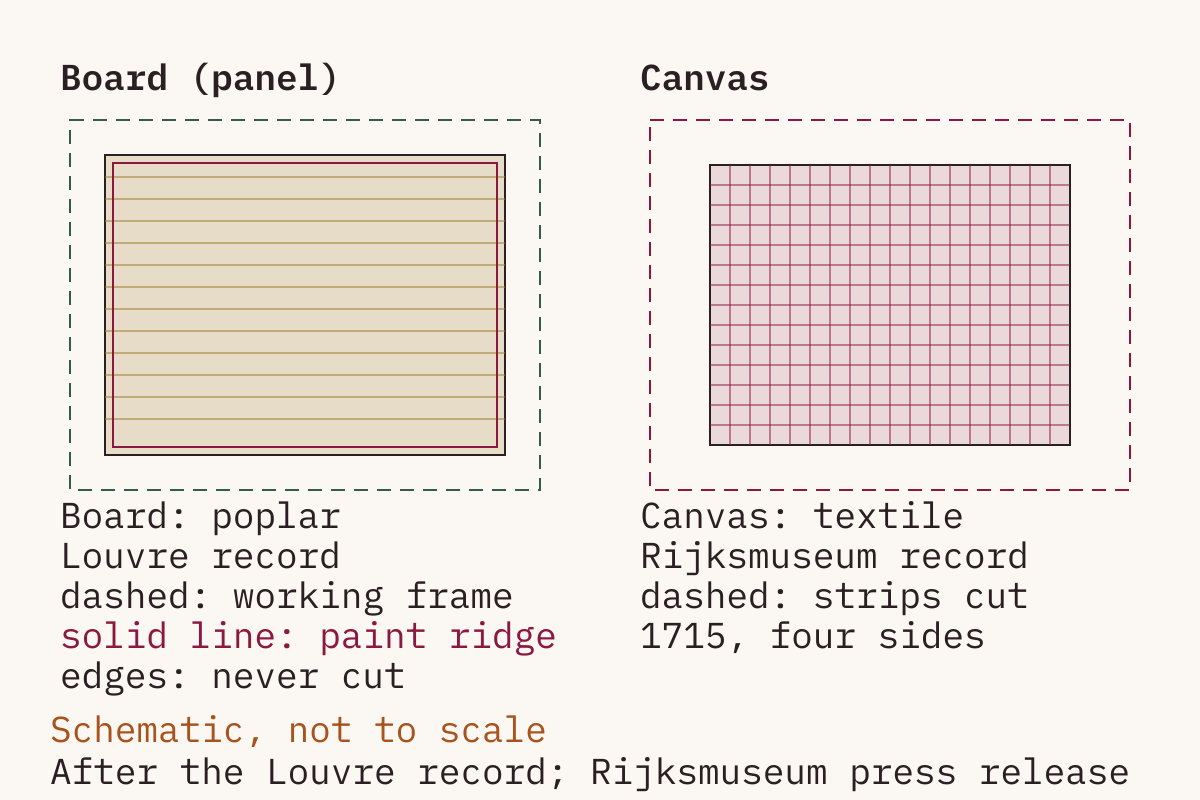 schematic, not to scale
Two supports for oil paint, side by side. On the left, the Mona Lisa's poplar board inside the working frame that the Louvre's record describes; on the right, the canvas of The Night Watch, cut on all four sides in 1715, per the Rijksmuseum's 2021 press release.
Source: Musée du Louvre, collection record INV 779 (last updated 25 September 2025); Rijksmuseum, record SK-C-5 and press release of 23 June 2021
Read the figure as text
- Mona Lisa: oil on wood (poplar), a thin plank, per the Louvre's record.
- While it was painted, a working frame surrounded the board, and paint built up against that frame into a ridge the record calls a barbe.
- The board has never been cut down, per the same record.
- The Night Watch: oil on canvas, which the Rijksmuseum's record files under textile materials.
- In 1715, strips were cut from all four sides of that canvas, per the Rijksmuseum's 2021 press release.
"Two supports for oil paint: a poplar board and a canvas" by Kiln, Easel & Anvil, https://kilneaselandanvil.com/paintings/mona-lisa/ — CC BY 4.0, https://creativecommons.org/licenses/by/4.0/
Data: Musée du Louvre, collection record INV 779, Mona Lisa (last updated 25 September 2025; Licence Ouverte, Etalab); Rijksmuseum, collection record SK-C-5, The Night Watch; Rijksmuseum press release, 'For the first time in 300 years The Night Watch is complete again' (published 23 June 2021)
A painting's support is the material underneath the paint. The Louvre's record lists the Mona Lisa as oil on wood, while the Rijksmuseum's record for The Night Watch lists oil on canvas and files canvas under “textile materials”. One is a plank of wood; the other is cloth.
What do the edges of the board show?
The difference shows at the edges. In 1715, according to the Rijksmuseum's press release of 23 June 2021, The Night Watch was moved to what was then Amsterdam's City Hall and “Strips were cut from all four sides”. For the Mona Lisa, the Louvre's record says the reverse: “le support n’a jamais été coupé”, the support has never been cut (translated here).
The record names two pieces of evidence for this. The first is the bare edges of the panel. The second is a barbe (French for beard), which it defines as “la crête de matière picturale formée contre le châssis de travail qui entourait le bois”: the ridge of paint formed against the working frame that surrounded the wood (translated here). Per the record, that frame was there to make the board easier to handle while it was being painted.
Because the record names both the place (the edges of the panel) and the cause (the frame used during painting), the ridge is what this site calls the maker's tell, a trace on an object that shows how it was made. The trimmed edges of The Night Watch are the opposite case, since they record a change made long after the painting.
Why poplar?
Neither source gives Leonardo's reason for choosing wood. The Louvre's commentary says only that poplar is “une essence assez courante en Italie et notamment à Florence”, a species fairly common in Italy and especially in Florence (translated here). Vasari's account of the portrait, quoted below, does not mention the support at all.
The same commentary calls the work “intrinsèquement très fragile”, inherently very fragile (translated here), while judging it to be in a good state of preservation. Wooden boards are also the raw material of furniture, and the dovetail joint is one way of locking two of them at a corner. The Arnolfini Portrait is another portrait read one detail at a time.
How big is it?
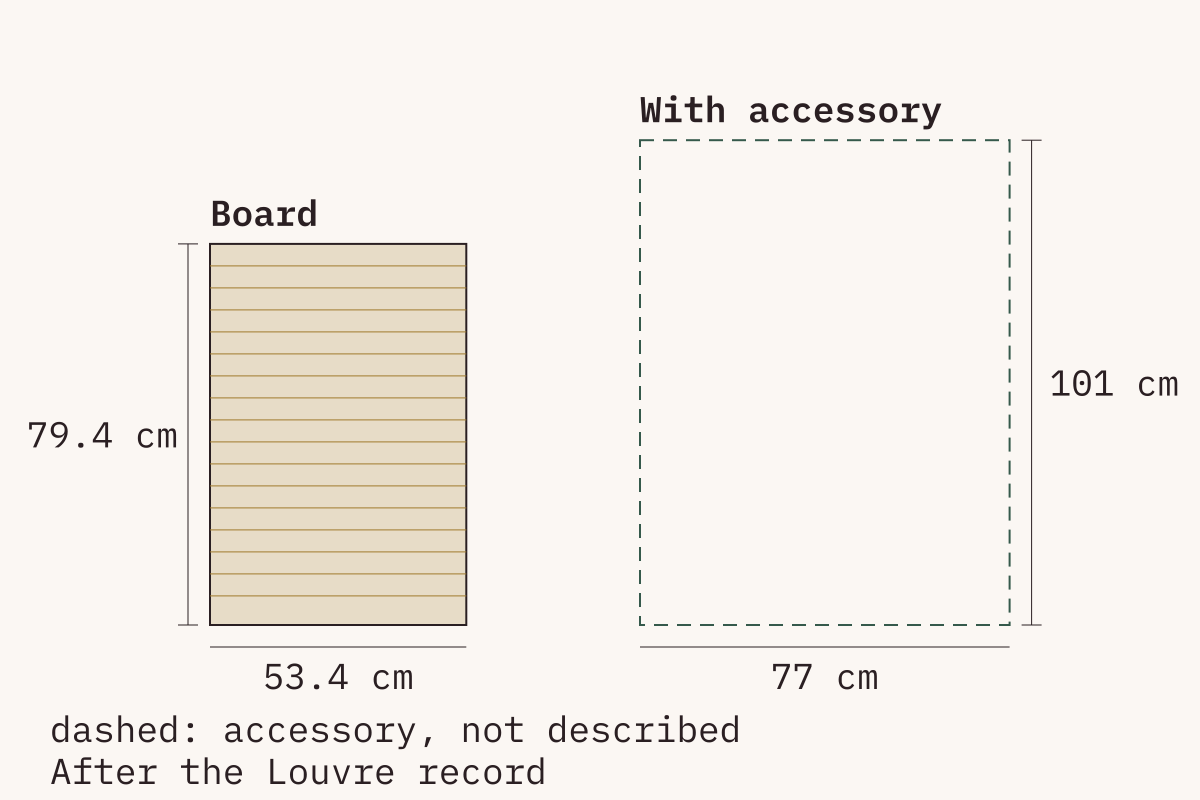
The board and the record's second pair of measurements, drawn to the same scale in centimetres. The record does not say what the accessory is.
Source: Musée du Louvre, collection record INV 779 (last updated 25 September 2025)
"The Mona Lisa's board and its size with accessory, to scale in centimetres" by Kiln, Easel & Anvil, https://kilneaselandanvil.com/paintings/mona-lisa/ — CC BY 4.0, https://creativecommons.org/licenses/by/4.0/
Data: Musée du Louvre, collection record INV 779, Mona Lisa (last updated 25 September 2025; Licence Ouverte, Etalab)
The Louvre's record gives the board as “Hauteur : 0,794 m” and “Largeur : 0,534 m”. With the decimal comma changed to a point and the metres turned into centimetres, that is 79.4 cm high by 53.4 cm wide. The same field lists a second pair, “avec accessoire” (with accessory): “1,01 m” by “0,77 m”, or 101 cm high by 77 cm wide. The record does not say what the accessory is, so this page does not name it.
The commentary calls the board “un support de grande dimension”, a large support, chosen “afin de représenter le modèle à échelle naturelle”, to show the sitter at life size (translated here). Large is relative. The Rijksmuseum's record gives the canvas of The Night Watch as 379.5 cm high, more than four and a half times the height of the Mona Lisa's board.
| Measurement | As published | In centimetres | Qualifier |
|---|---|---|---|
| Board, height | “0,794 m” | 79.4 | decimal comma changed to a point |
| Board, width | “0,534 m” | 53.4 | decimal comma changed to a point |
| With accessory, height | “1,01 m” | 101 | accessory not described in the record |
| With accessory, width | “0,77 m” | 77 | accessory not described in the record |
Download the data (CSV, mona-lisa-measurements.csv) (notes on this file) Data: Musée du Louvre, collection record INV 779 (Licence Ouverte, Etalab); Giorgio Vasari, Le vite, edited by Gaetano Milanesi, vol. 4 (Florence, 1879), p. 39 (public domain)
What did Vasari write about it?
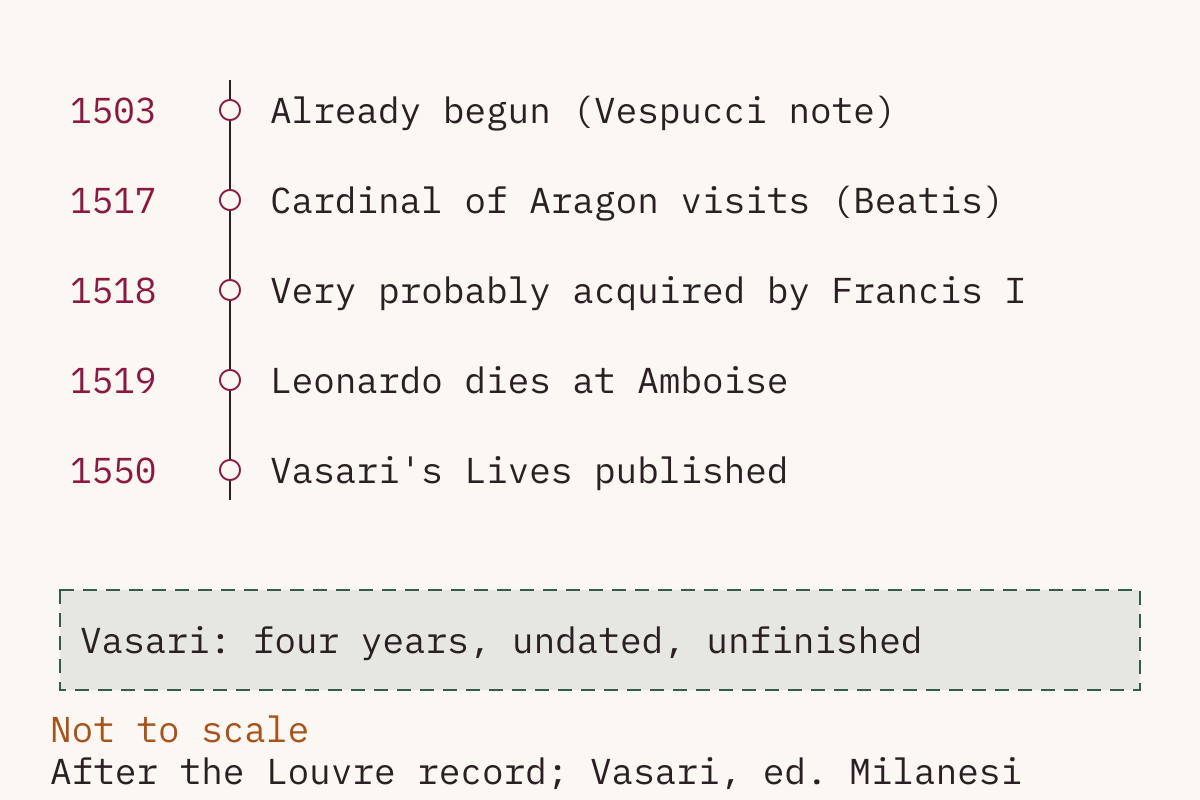 not to scale
Dates that the Louvre's record gives for the painting, in order, with the four years of Vasari's account set to one side because Vasari gives no dates for them.
Source: Musée du Louvre, collection record INV 779 (last updated 25 September 2025); Vasari, Le vite, edited by Gaetano Milanesi, vol. 4 (Florence, 1879), p. 39
Read the figure as text
- 1503, October: the painting already begun, per a note by Agostino Vespucci that the Louvre's record cites.
- 1517, 10 October: the Cardinal of Aragon visits Leonardo at the Château du Clos-Lucé and admires a portrait of a Florentine lady, per the record, which cites the cardinal's travel journal written by Antonio de Beatis.
- 1518: the painting very probably acquired by Francis I, per the record.
- 1519: Leonardo dies at Amboise, per the record.
- 1550: Vasari publishes his life of Leonardo, per the record.
- Undated: in Vasari's account, four years of work, after which the portrait was left unfinished.
"Dates in the Louvre record, with Vasari's four years set apart" by Kiln, Easel & Anvil, https://kilneaselandanvil.com/paintings/mona-lisa/ — CC BY 4.0, https://creativecommons.org/licenses/by/4.0/
Data: Musée du Louvre, collection record INV 779, Mona Lisa (last updated 25 September 2025; Licence Ouverte, Etalab); Giorgio Vasari, Le vite, edited by Gaetano Milanesi, vol. 4 (Florence, 1879), Life of Leonardo da Vinci, p. 39 (public domain)
In Milanesi's edition of the Italian text (volume 4, Florence, 1879), Vasari's account of the portrait begins: “Prese Lionardo a fare per Francesco del Giocondo il ritratto di mona Lisa sua moglie”, Leonardo undertook to make, for Francesco del Giocondo, the portrait of Mona Lisa, his wife (translated here) scanned page.
Vasari goes on: “e quattro anni penatovi, lo lasciò imperfetto”, and after labouring over it for four years he left it unfinished (translated here; p. 39). He adds that the work “oggi è appresso il re Francesco di Francia in Fontanableo”, is today with King Francis of France at Fontainebleau (translated here).
Who commissioned it?
The Louvre's record relies on Vasari for the sitter's name, but it also notes that “Vasari n’a jamais vu le tableau”: Vasari never saw the painting (translated here). Its provenance line is more careful than Vasari about the patron: the picture was begun “vers 1503 au moins”, by around 1503 (translated here), and “sans doute pour Francesco del Giocondo”, probably for him (translated here).
The record then quotes a second witness: the travel journal of the Cardinal of Aragon, written by Antonio de Beatis. The cardinal visited Leonardo on 10 October 1517 and admired three paintings, one of a Florentine lady made “sur les instances de feu le Magnifique Julien de Médicis”, at the request of the late Giuliano de' Medici (translated here). The record's own conclusion, set beside Vasari's account, is that the portrait was perhaps commissioned by Francesco del Giocondo. This page prints both and does not choose.
On the question of finish, the record goes further than Vasari: it says the painting was still “inachevée à sa mort”, unfinished at Leonardo's death (translated here), and points to the roughly laid-in ground at the lower right of the landscape as the sign. Vasari's four years and the record's dates of 1503 to 1519 are different kinds of figure, one a story about the work and the other a span of dates.
Under the loupe: go back to the lower right of the landscape, where the Louvre's record says the ground was left only roughly laid in, and then look at the pearl in Girl with a Pearl Earring, which a Mauritshuis press release of 28 April 2020 describes as “translucent and opaque touches of white paint”.
The Mona Lisa, dated 1503 to 1519 in the Louvre's record, which lists it as oil on wood (poplar).
Collection: Musée du Louvre, Paris, INV 779
"Mona Lisa (Leonardo da Vinci)" by Leonardo da Vinci — https://commons.wikimedia.org/wiki/File:Leonardo_da_Vinci_-_Mona_Lisa_(La_Gioconda)_-_WGA12712.jpg — Public domain (US: published before 1931; DE/FR: Leonardo da Vinci died in 1519 per the Louvre collection record, more than 70 years ago; faithful reproduction of a two-dimensional work)
Sources and reading levels
- Musée du Louvre, collections notice 'Portrait de Lisa Gherardini, épouse de Francesco del Giocondo, dit La Joconde ou Monna Lisa', INV 779; MR 316, Département des Peintures (last updated 25 September 2025; commentary by Vincent Delieuvin, July 2021); quotations in French, with the English translated here collections.louvre.fr/ark:/53355/cl010062370Read: full textText licence: Licence Ouverte / Open Licence 2.0 (Etalab) (terms)
- Giorgio Vasari, Le vite de' più eccellenti pittori, scultori ed architettori, con nuove annotazioni e commenti di Gaetano Milanesi, tomo IV (Firenze: G. C. Sansoni, 1879), Life of Leonardo da Vinci, pp. 39–40; Italian, quoted with the English translated here; public domain in the US and EU (published 1879; Vasari died 1574, Milanesi 1895, per the University of Toronto catalogue record on the Internet Archive) archive.org/details/levitedepiecce04vasauoftRead: scanned page
- Giorgio Vasari, Lives of the Most Eminent Painters, Sculptors and Architects, translated by Gaston du C. de Vere, vol. 4 (London: Philip Lee Warner, publisher to the Medici Society, 1913), Life of Leonardo da Vinci; bibliography only, not quoted on this page www.gutenberg.org/ebooks/28420Read: bibliography
- Rijksmuseum, collection record SK-C-5, Rembrandt van Rijn, The Night Watch, 1642 www.rijksmuseum.nl/en/collection/object/The-Night-Watch-…Read: full text
- Rijksmuseum, 'For the first time in 300 years The Night Watch is complete again', press release, 23 June 2021 www.rijksmuseum.nl/en/press/press-releases/for-the-first…Read: full text
- Mauritshuis, 'Closer to Vermeer and the Girl: New discoveries and insights from the international scientific examination of Vermeer’s Girl with a Pearl Earring', press release, 28 April 2020 www.mauritshuis.nl/en/press-releases/closer-to-vermeer-a…Read: full text
More objects in Paintings
Object reading
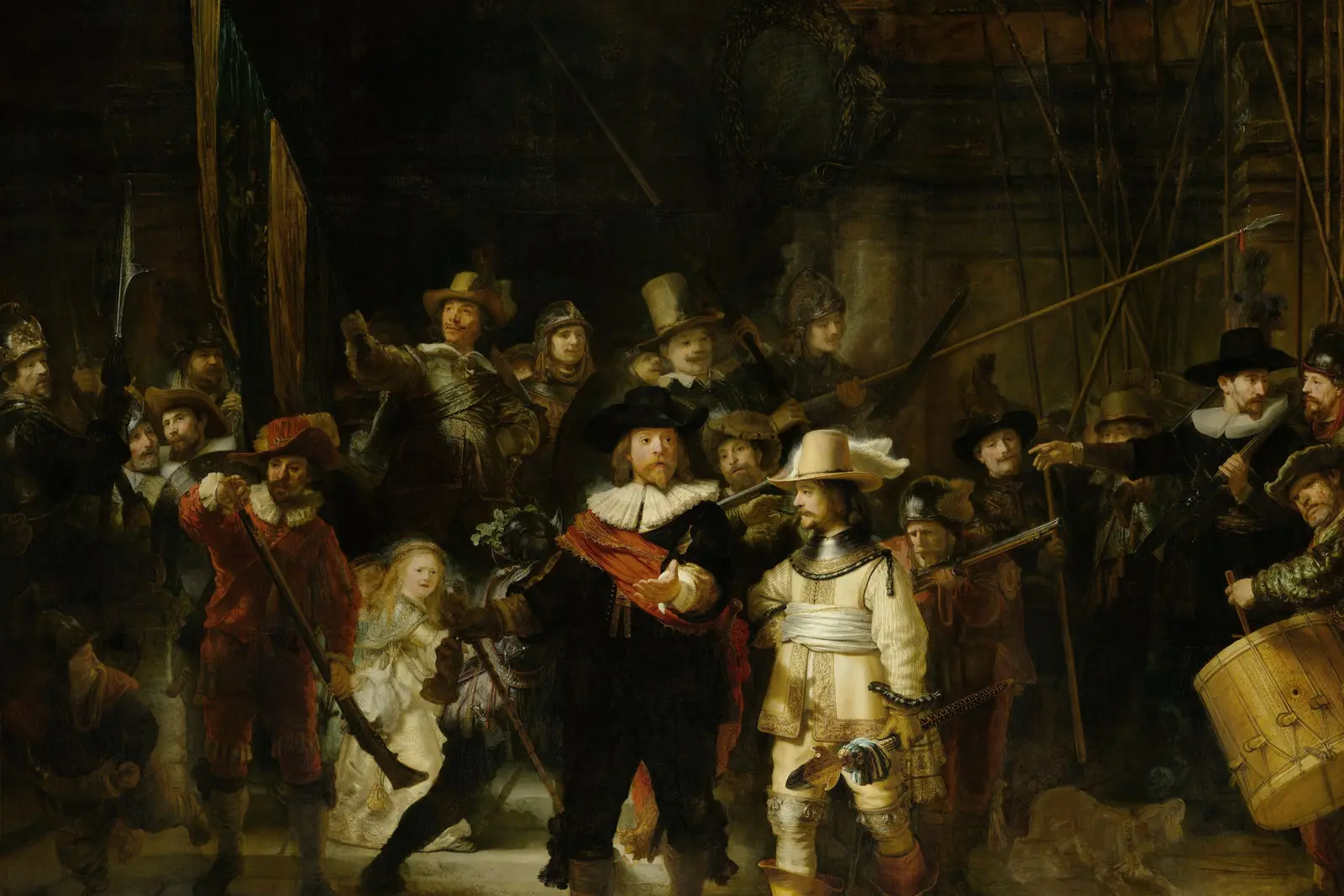
The Night Watch: How Much of the Canvas Was Cut in 1715
Catalogued
Picture credit
"The Night Watch (card)" by Rembrandt van Rijn — https://commons.wikimedia.org/wiki/File:The_Nightwatch_by_Rembrandt_-_Rijksmuseum.jpg — Public domain (US: published before 1931; DE/FR: Rembrandt died in 1669 per the Commons creator template on the file page, more than 70 years ago; faithful reproduction of a two-dimensional work); modified: cropped to a 3:2 frame from the centre (full width, 14168 by 9445 pixels) and reduced to 2400 by 1600 pixels
Object reading
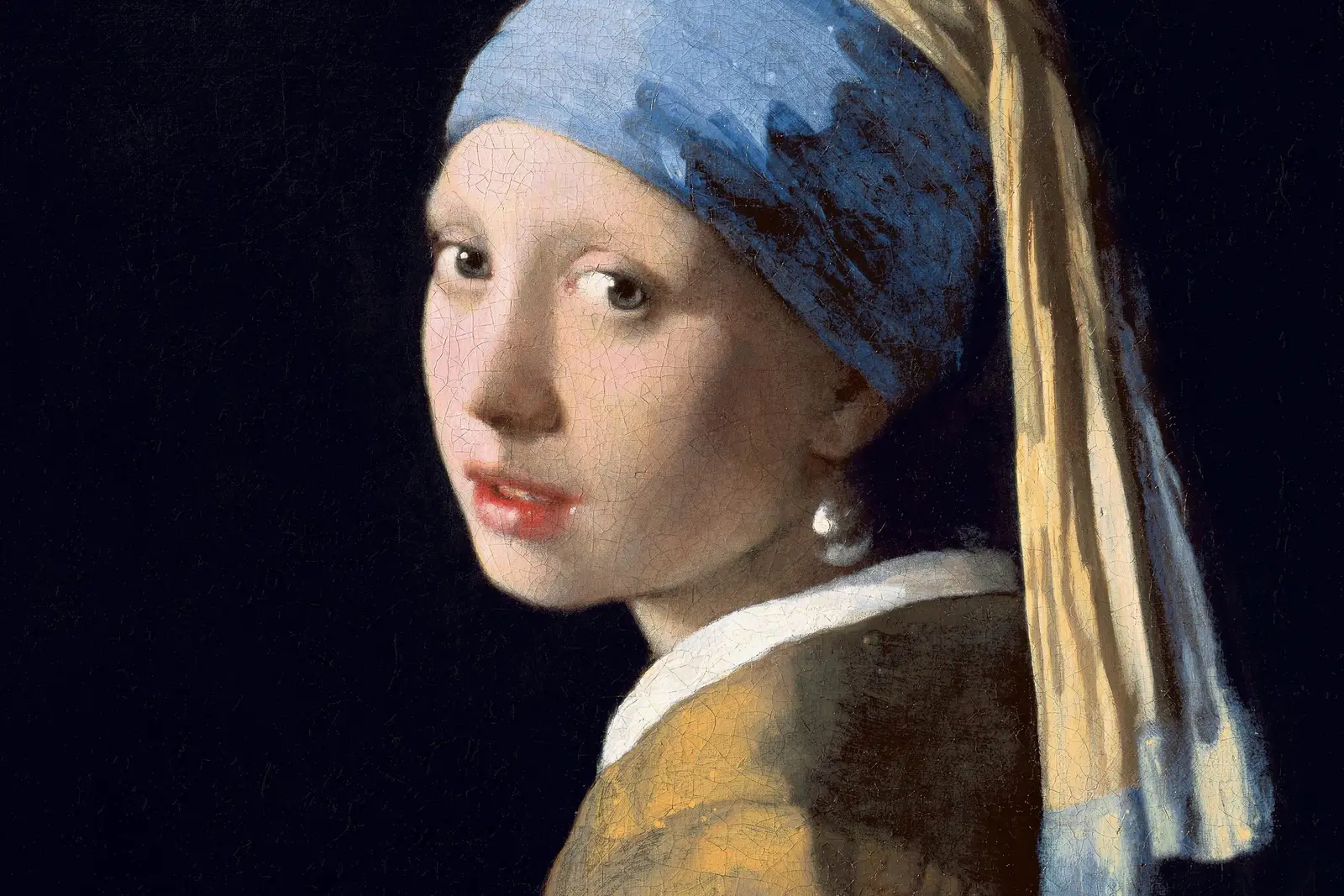
Girl with a Pearl Earring: No Hook, per the Mauritshuis
Catalogued
Picture credit
"Girl with a Pearl Earring (card)" by Mauritshuis, The Hague — https://commons.wikimedia.org/wiki/File:Meisje_met_de_parel.jpg — Public domain (US: published before 1931; DE/FR: Vermeer died in 1675 per the Mauritshuis object page 670, more than 70 years ago; faithful reproduction of a two-dimensional work); modified: cropped to a 3:2 frame from the centre (full width, 4095 by 2730 pixels, from 1032 pixels down) and reduced to 2400 by 1600 pixels
Object reading
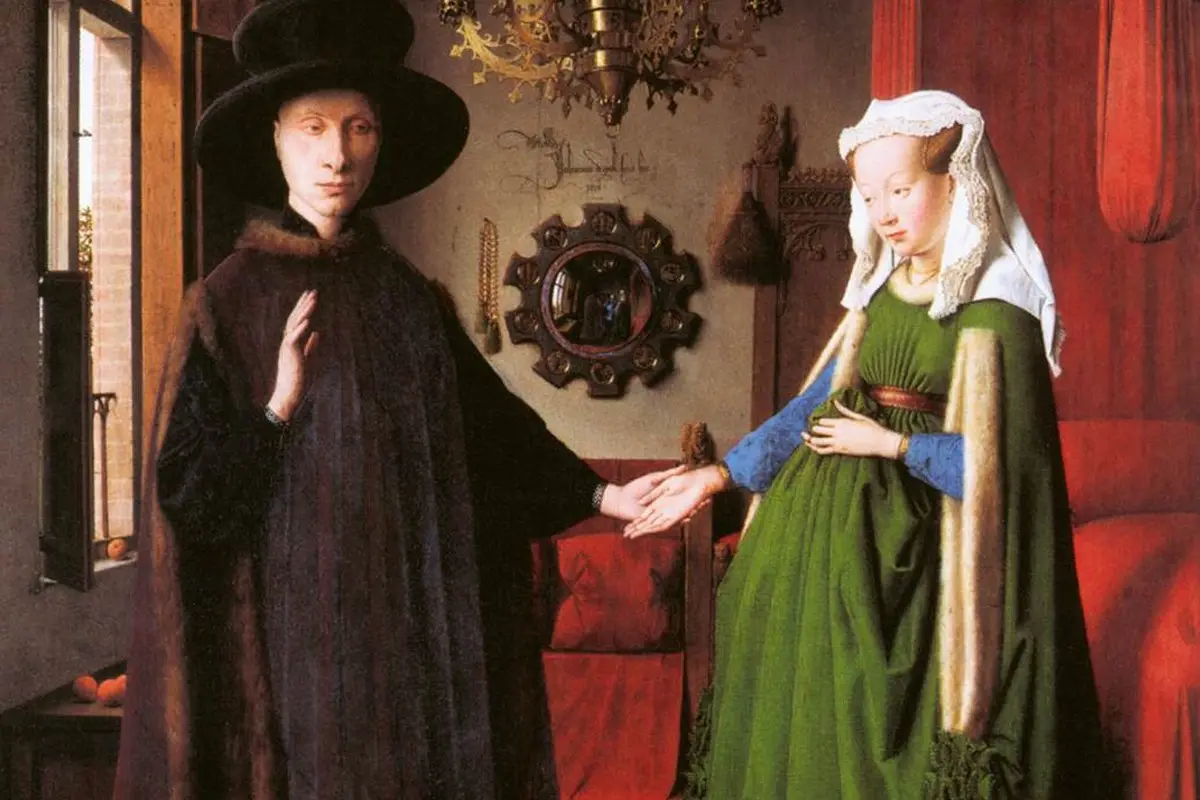
Arnolfini Portrait: Two Figures at the Door, per Weale
Catalogued
Picture credit
"Portrait of Giovanni Arnolfini and his Wife (Jan van Eyck)" by Jan van Eyck — https://commons.wikimedia.org/wiki/File:Jan_van_Eyck_-_Portrait_of_Giovanni_Arnolfini_and_his_Wife_-_WGA7689.jpg — Public domain (US: published before 1931; DE/FR: Jan van Eyck died in 1441 per the Commons creator template on the file page (not checked against a library record), more than 70 years ago; faithful reproduction of a two-dimensional work); modified: cropped to a 3:2 frame from 150 px below the top edge (heads, mirror and hands), enlarged from 1,035 to 1,200 px wide
Cite this page
Kiln, Easel & Anvil. “Mona Lisa: Painted on Poplar, Not Canvas, per the Louvre.” Published 28 November 2026. https://kilneaselandanvil.com/paintings/mona-lisa/ (accessed on the day you read it).
How a record is checked Every correction, dated Report an error on this page (contact@kilneaselandanvil.com)