The Thinker: Cleveland Chose Not to Repair Its 1970 Damage
Short answer
Rodin's bronze The Thinker in Cleveland lost its base, its feet and the lower part of its legs on 24 March 1970, and the museum chose to mount what was left and “essentially do no restoration”, per a 1998 article by the conservator Bruce Christman full text. In the photograph, look below the knees, where the feet are missing.
Object record
- Object
- The Thinker
- Maker
- Auguste Rodin (French, 1840–1917)
- Date
- 1880–81, as dated in the Cleveland record
- Material
- Bronze
- Dimensions
- Overall 182.9 x 98.4 x 142.2 cm (height x width x depth), as published in the Cleveland record
- Collection
- Cleveland Museum of Art, 1917.42, Gift of Ralph King
This record as CSV (the-thinker-record.csv) (notes on this file)
Data: Cleveland Museum of Art, 1917.42 collection record (CC0)
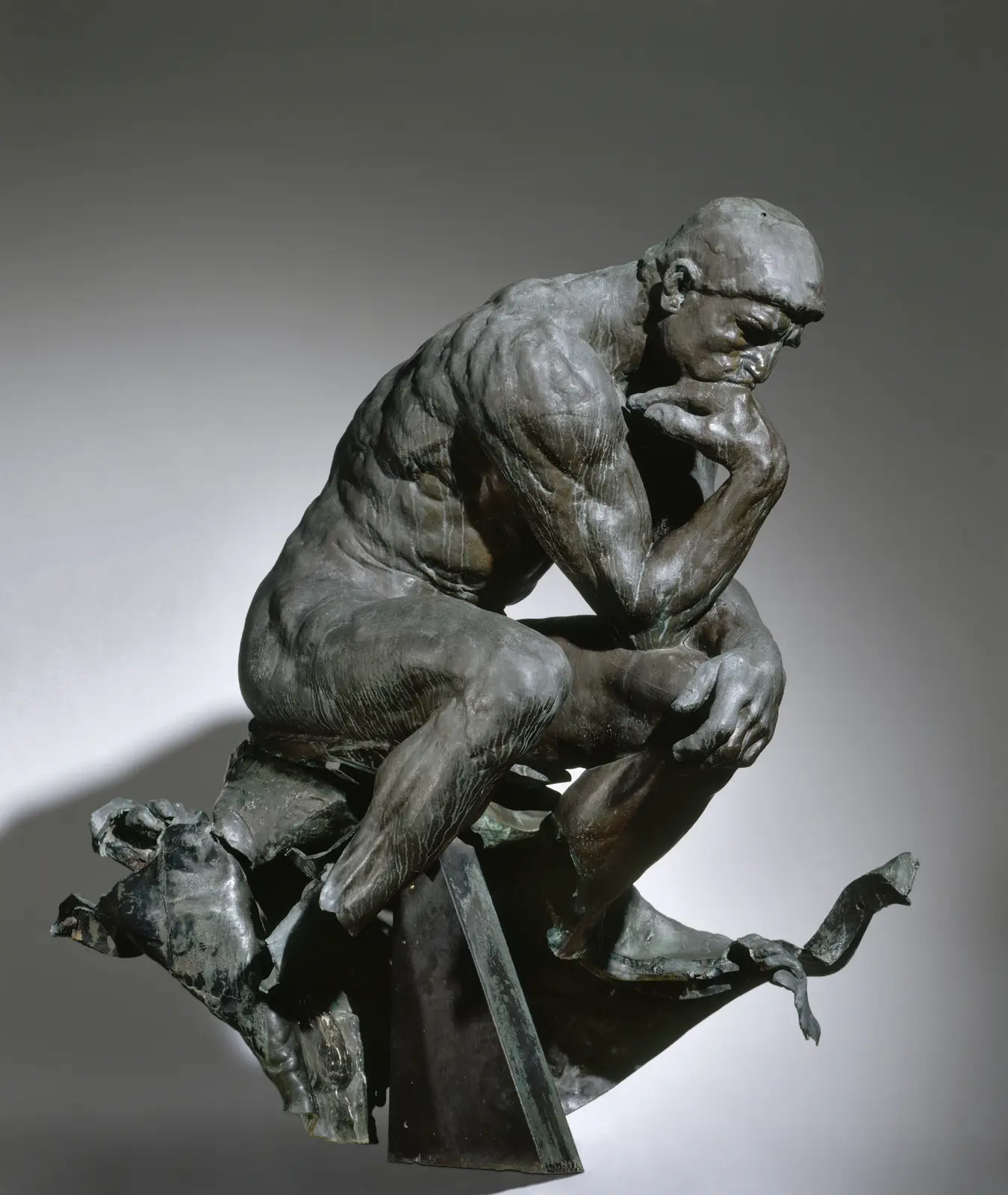
The Thinker by Auguste Rodin, in the Cleveland Museum of Art, photographed against a plain grey background; the record dates the work 1880–81 and gives an overall height of 182.9 cm.
Collection: Cleveland Museum of Art, 1917.42
"The Thinker, Auguste Rodin" by Cleveland Museum of Art — https://www.clevelandart.org/art/1917.42 — CC0 1.0 (https://creativecommons.org/publicdomain/zero/1.0/)
Card and share picture, a 3:2 copy of this object’s photograph: "The Thinker, Auguste Rodin (card)" by Cleveland Museum of Art — https://www.clevelandart.org/art/1917.42 — CC0 1.0 (https://creativecommons.org/publicdomain/zero/1.0/); modified: padded with the photograph's own background to a 3:2 frame, left and right, with a feathered seam
Two shins stop short in the picture above, and the feet below them are gone. As of Christman's 1998 article, nothing had been added to replace what is missing, because the museum had decided to keep the figure in its damaged state. Follow each shin down to its broken edge. Beneath the figure is bent metal, which Christman's article describes as twisted out of shape.
The Cleveland Museum of Art's collection record calls this bronze “This enlarged version of The Thinker” and dates the work 1880–81 full text, but it says nothing about the damage.
Bruce Christman, a conservator at the museum, tells that part of the history in an article published in the Journal of the American Institute for Conservation in 1998 (its French summary names the statue Le Penseur) full text. His account draws on the museum's own archives and letters, and this page follows it for the dates, the damaged parts and the decision.
Where was Cleveland's Thinker damaged?
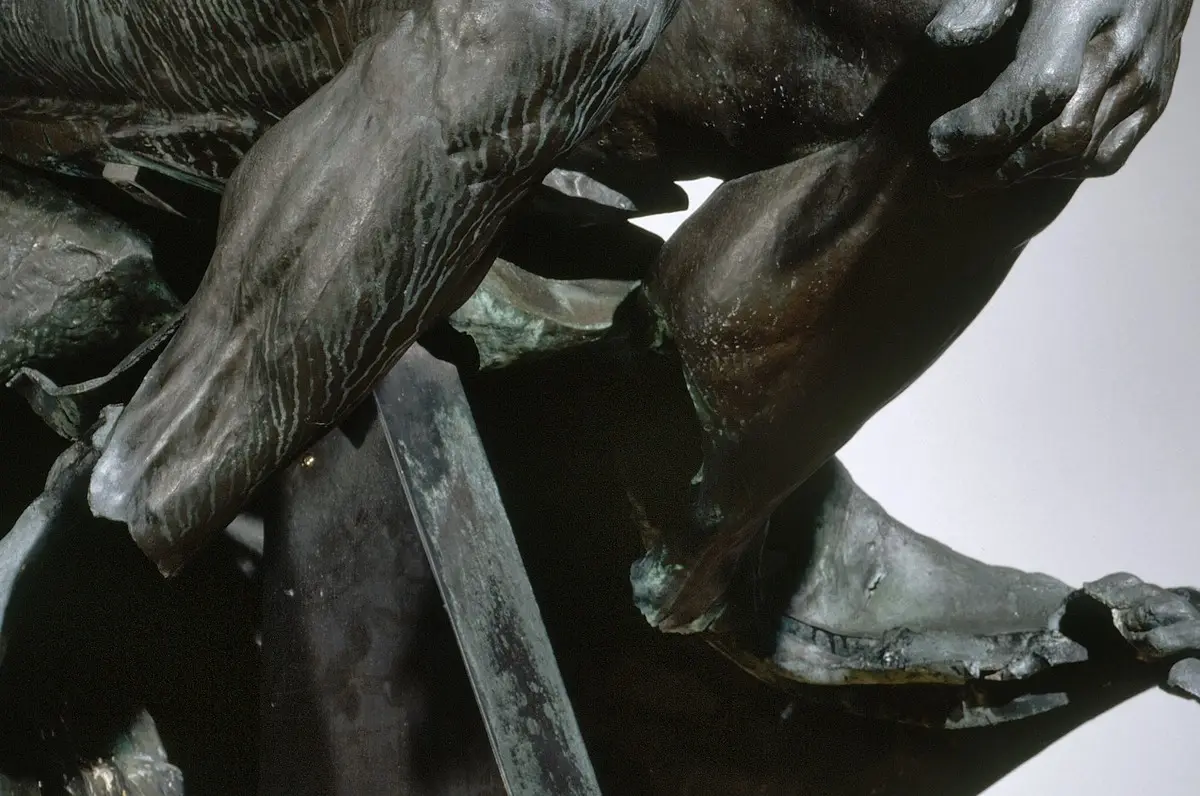

Detail of the lower legs; Christman's article records the loss of the feet and lower areas of the legs on 24 March 1970.
Collection: Cleveland Museum of Art, 1917.42
Detail. The small picture marks where it sits in the whole object.
"The Thinker, Auguste Rodin (detail of the lower legs)" by Cleveland Museum of Art — https://www.clevelandart.org/art/1917.42 — CC0 1.0 (https://creativecommons.org/publicdomain/zero/1.0/); modified: cropped to the detail of the lower legs, from below the knees to where the legs end, and reduced to 1200 px wide (no enlargement)
Christman dates the damage to “the early morning hours of March 24, 1970”, and he records the result in a single sentence: “The base and the lower part of the legs were annihilated”. The rest of the figure was knocked off its pedestal and lay face down.
Later in the same section, he lists “the loss of the feet and lower areas of the legs” as the obvious damage. The detail above shows what remains: both shins stop short of where the feet would have been.
This page has no confirmed maker's tell, meaning a trace on an object that shows how it was made. What the photograph shows at the bottom of the figure is the damage of 1970, a change that came long after the casting. The Cleveland record notes a signature “on base near sinister foot” (the figure's left foot), but neither the record nor Christman says whether that signature survived.
What happened to the rest of the lower half?
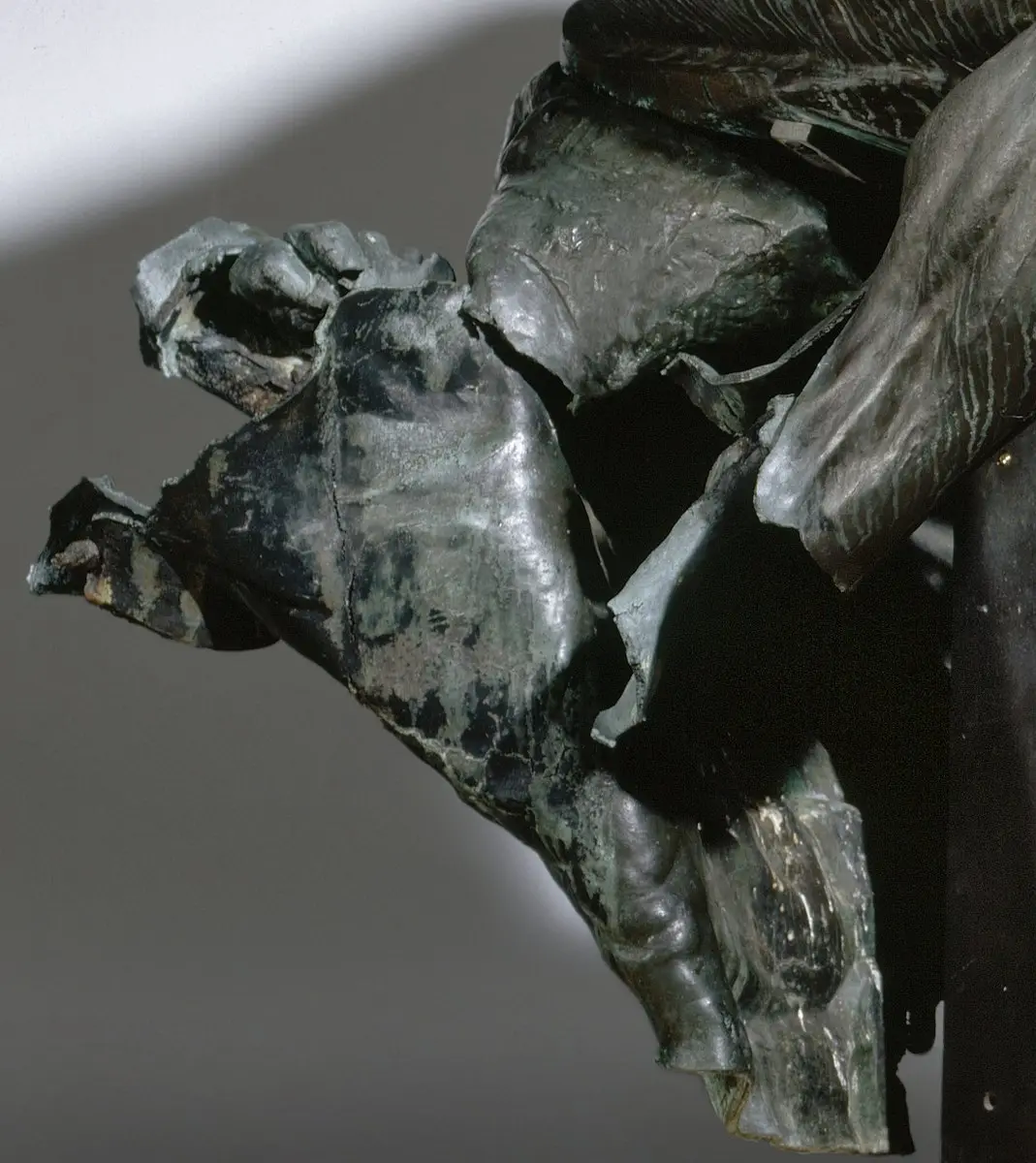
Detail of the lower half, which Christman describes as twisted and contorted in areas, without saying which areas.
Collection: Cleveland Museum of Art, 1917.42
Detail. The small picture marks where it sits in the whole object.
"The Thinker, Auguste Rodin (detail of the lower half)" by Cleveland Museum of Art — https://www.clevelandart.org/art/1917.42 — CC0 1.0 (https://creativecommons.org/publicdomain/zero/1.0/); modified: cropped to the detail of the lower half on the left of the photograph, below the seated figure (no enlargement)
The damage went well beyond the missing parts. According to Christman, “The seat supporting the figure was severely distorted”. Much of the lower half of the sculpture had expanded and was “twisted and contorted in areas”, and the metal was scraped where the head and shoulders struck the pavement.
He also reports a later finding about the surface of the bronze. Deep pits on the legs and other lower surfaces, seen in a detailed examination reported in the 1998 article, may be further damage from the same event, in his reading, and he describes them as “incipient tears and cracks in the metal”.
The swelling and twisting, known from the start, mattered for the decision that followed. A bronze that has swelled and twisted does not keep the shape it had when it left the foundry, and Christman gives that distortion as the reason one of the museum's options could not be seriously considered.
What did the museum decide, and when?
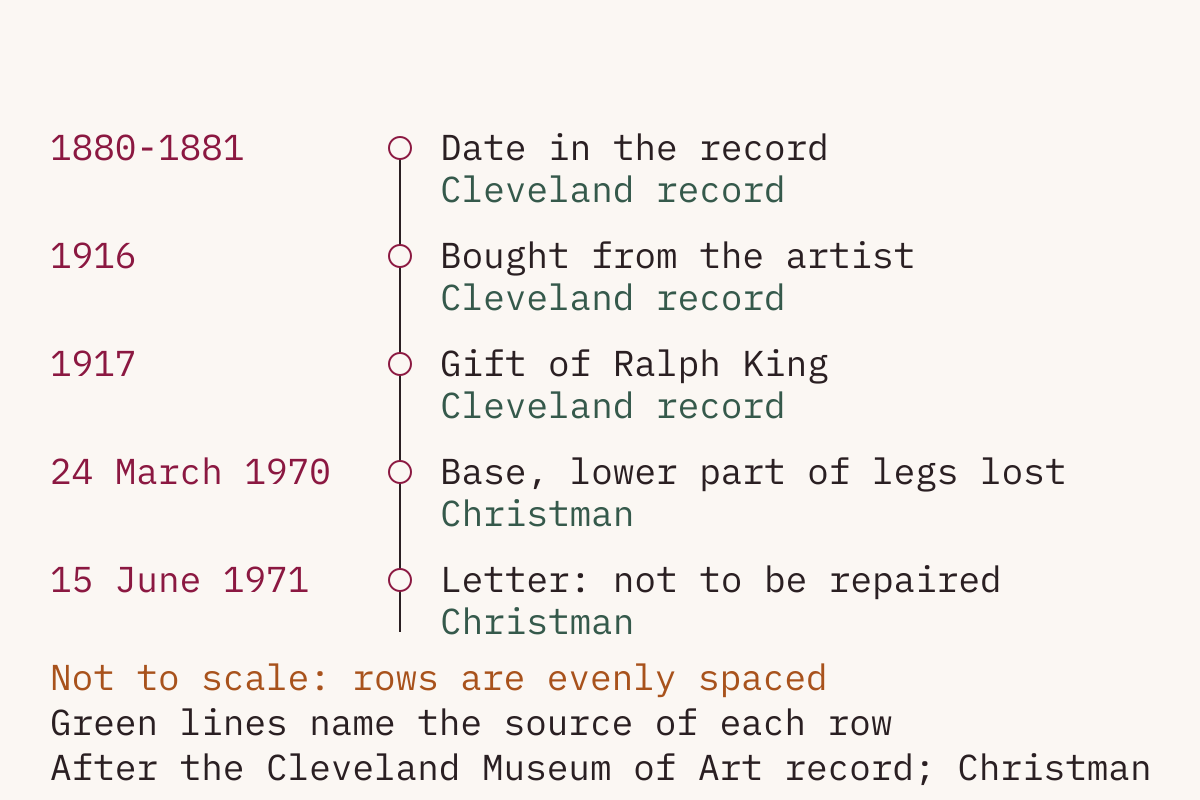 not to scale
Five dates in the history of Cleveland's Thinker, each with its source.
Source: Cleveland Museum of Art, 1917.42 record (CC0); Christman, Journal of the American Institute for Conservation 37 (1998), section 3
Read the figure as text
| Date | Event | Source |
|---|---|---|
| 1880–81 | The date the museum gives for the work | Cleveland record |
| 1916 | Purchased from the artist | Cleveland record |
| 1917 | Gift of Ralph King to the museum | Cleveland record |
| 24 March 1970 | The base and the lower part of the legs destroyed | Christman 1998 |
| 15 June 1971 | The director writes that the museum does not wish the sculpture repaired | Christman 1998 |
"Cleveland's Thinker, from record to decision" by Kiln, Easel & Anvil, https://kilneaselandanvil.com/sculpture/the-thinker/ — CC BY 4.0, https://creativecommons.org/licenses/by/4.0/
Data: Cleveland Museum of Art, 1917.42 collection record (CC0); Bruce Christman, Journal of the American Institute for Conservation 37, no. 2 (1998), section 3
Christman writes that the museum studied three options, and that the questions were discussed with curators, museum directors, conservators and artists. The first was to take moulds from other original Thinkers and make a replacement cast, and the second was to make a new cast and cut it up to replace the damaged parts of the Cleveland bronze. The third was to “mount the damaged sculpture and essentially do no restoration”.
The museum chose the third option. Christman's article gives the reasons. A new cast was rejected because it would be a replica rather than a cast that Rodin had supervised himself. Patching was ruled out because the metal had swelled out of shape, and Christman adds that the whole process of making a new cast generally results in shrinkage of 5 to 10 per cent, so that new parts would not have fitted the old ones.
Sherman Lee, the museum's director, set out the position in a letter of 15 June 1971 to the Rodin scholar Albert Elsen. Lee wrote that the museum would keep the figure “in its present damaged state as a historical document”, and he added: “we do not wish the sculpture to be repaired”.
What does the pedestal say?
The figure was then mounted on a bronze armature and set on a tall granite pedestal. Christman quotes the inscription on that pedestal: The Thinker, by Auguste Rodin, Gift of Ralph King, and then, in smaller letters, “Damaged 24th of March 1970”. The pedestal does not appear in the museum's studio photograph above.
Christman's article, published in 1998, describes the same approach. “The museum's philosophy is to stabilize the sculpture in its present condition”, Christman wrote, and he added that no aesthetic reintegration of the patina had been attempted, since the damage had already altered so much of Rodin's intent.
How many casts are there?
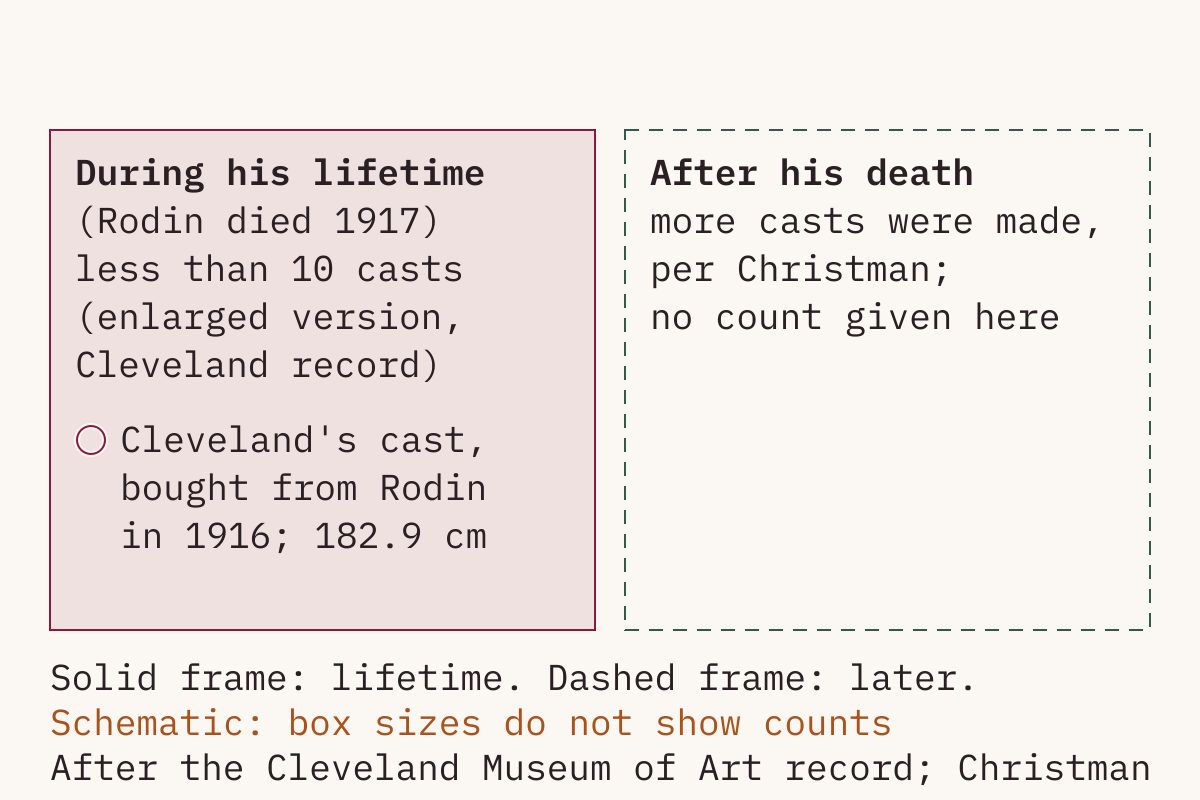 schematic
Casts of the enlarged Thinker made during Rodin's lifetime, per the Cleveland record, and casts made after his death, per Christman; the boxes do not show quantities.
Source: Cleveland Museum of Art, 1917.42 record (CC0); Christman, Journal of the American Institute for Conservation 37 (1998)
Read the figure as text
- During Rodin's lifetime (he died in 1917): this enlarged version is “one of less than 10 cast during Rodin's lifetime”, per the Cleveland record.
- Cleveland's cast: purchased from the artist in 1916, 182.9 cm high overall, per the Cleveland record.
- After Rodin's death: “A number of other Thinkers were cast shortly after Rodin's death”, per Christman 1998, with no count given on this page.
"Casts of the enlarged Thinker: lifetime and later" by Kiln, Easel & Anvil, https://kilneaselandanvil.com/sculpture/the-thinker/ — CC BY 4.0, https://creativecommons.org/licenses/by/4.0/
Data: Cleveland Museum of Art, 1917.42 collection record (CC0); Bruce Christman, Journal of the American Institute for Conservation 37, no. 2 (1998)
The Cleveland record answers the question in one sentence: “This enlarged version of The Thinker is one of less than 10 cast during Rodin's lifetime.” The museum's cast was purchased from the artist in 1916, and it entered the collection in 1917 as the gift of Ralph King. Christman's list of casts gives Alexis Rudier as the caster of the Cleveland bronze.
As for why there are several Thinkers at all, Christman explains that “Casting sculptures in bronze is a technique that lends itself to accurate multiple reproductions”, and he notes that more Thinkers were cast shortly after Rodin's death. For one way a bronze figure is cast in the first place, see lost wax casting, as Cellini described it for his Perseus.
The figure did not begin as an independent statue, according to the museum. The Cleveland record says The Thinker “was first developed as part of Rodin's The Gates of Hell”, a doorway for a proposed museum of decorative arts in Paris, where it was meant for a relief above the doors. The Venus de Milo works the other way round: it is a single marble statue put together from parts, as described in the Venus de Milo, two elements joined at the hips per the Louvre.
What did it look like when it arrived?
Christman's article also records the surface that the Cleveland cast first had. The bronze was shown indoors in the museum's rotunda in 1917 and was moved outside to the south entrance within several months. In a letter of 9 October 1917, the museum's first director, Frederick Whiting, wrote that it had had “a rather lovely blue patina” indoors, and that this had “entirely washed off in the outside weather”.
In a later letter, Whiting called it “the bluish patina which Rodin put on it”. That colour was a trace of the making, but by Whiting's account it had almost entirely washed off by late 1917, and neither source says whether any of it shows in the photograph.
What is he thinking?
That is a question about meaning, which this site leaves to the sources rather than answering itself, and the Cleveland record gives the first part of an answer. It says the figure was “originally conceived as a generalized image of the Italian poet Dante Alighieri”.
Paul Gsell's book of conversations with Rodin, in its 1912 English translation, gives one reader's view together with the sculptor's reply scanned page. Gsell tells Rodin that in his Penseur, “meditation, in its terrible effort to embrace the absolute, contracts the athletic body, bends it, crushes it” (pp. 185–186). Rodin's answer, printed on p. 186, is short: “I do not contradict you”.
A few lines earlier, on p. 185, Rodin says that the feelings in his works “ought to be easily read in my statues”. In Cleveland, the body that Gsell describes lost its feet and the lower part of its legs in 1970. Bending wood, not casting metal, gave its shape to the Thonet No. 14, a bentwood chair.
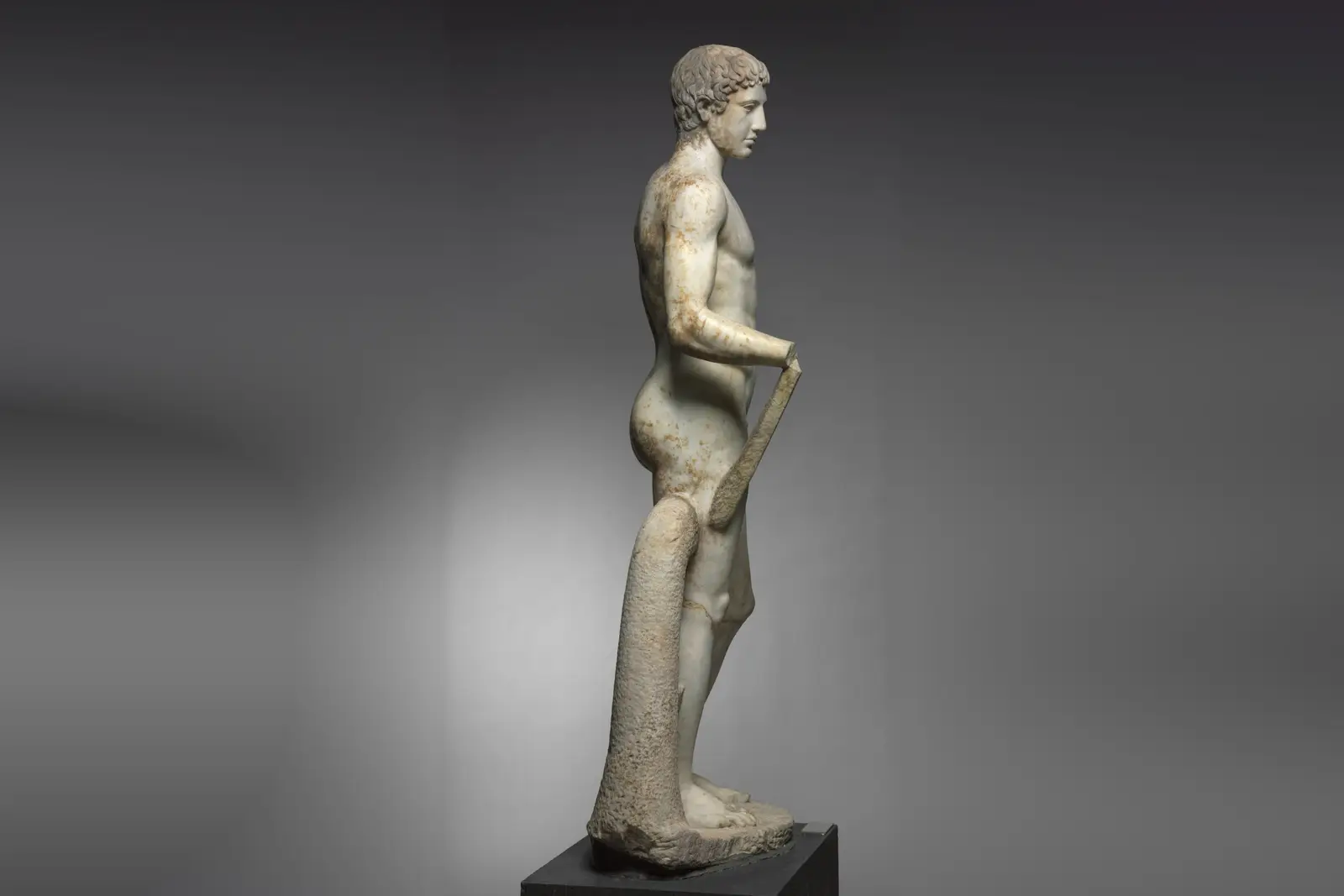
Under the loupe: look again at the two shins, where Cleveland's Thinker lost its feet on 24 March 1970, then compare a support that was added on purpose in a Roman marble athlete with a tree trunk beside its right leg.
Detail of the lower legs; Christman's article records the loss of the feet and lower areas of the legs on 24 March 1970.
Collection: Cleveland Museum of Art, 1917.42
Detail. The small picture marks where it sits in the whole object.
"The Thinker, Auguste Rodin (detail of the lower legs)" by Cleveland Museum of Art — https://www.clevelandart.org/art/1917.42 — CC0 1.0 (https://creativecommons.org/publicdomain/zero/1.0/); modified: cropped to the detail of the lower legs, from below the knees to where the legs end, and reduced to 1200 px wide (no enlargement)
Sources and reading levels
- Cleveland Museum of Art, The Thinker, 1880–81, Auguste Rodin (French, 1840–1917), bronze, accession number 1917.42, Gift of Ralph King, collection online record (CC0) www.clevelandart.org/art/1917.42Read: full textText licence: CC0 1.0 (terms)
- Bruce Christman, "Twenty-Five Years after the Bomb: Maintaining Cleveland's The Thinker", Journal of the American Institute for Conservation 37, no. 2 (1998): 173–186; quoted briefly, copyright of the American Institute for Conservation cool.culturalheritage.org/jaic/articles/jaic37-02-002.htmlRead: full text
- Musée du Louvre, collections notice 'Vénus de Milo', LL 299; N 527; Ma 399, Département des Antiquités grecques, étrusques et romaines (last updated 17 April 2026); quotations in French, with the English translated here collections.louvre.fr/ark:/53355/cl010277627Read: full textText licence: Licence Ouverte / Open Licence 2.0 (Etalab) (terms)
- Auguste Rodin and Paul Gsell, Art, English translation by Katharine Waldo Douglas Fedden (Boston: Small, Maynard & Co., 1912), pp. 185–186; public domain in the US (published 1912) and in the EU (Rodin died 1917, Gsell 1947, the translator 1939, per the library catalogue record) archive.org/details/artbyaugusterodi00rodiRead: scanned page
More objects in Sculpture
Object reading
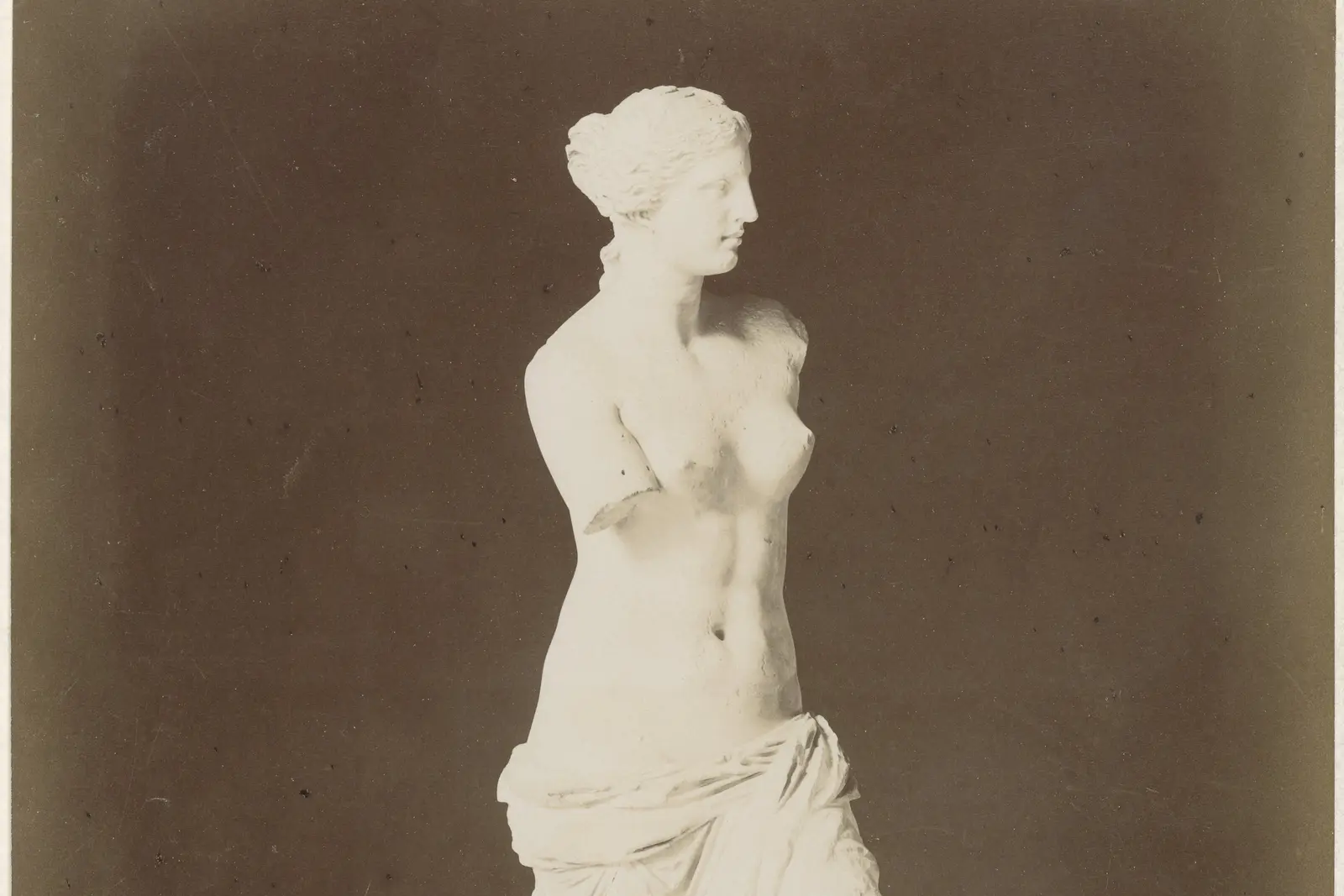
Venus de Milo: Joined at the Hips, per the Louvre's Record
Catalogued
Picture credit
"Venus van Milo, Louvre. Musée du Louvre. - La Vénus de Milo" by Rijksmuseum — https://commons.wikimedia.org/wiki/File:Venus_van_Milo,_Louvre_Mus%C3%A9e_du_Louvre._-_La_V%C3%A9nus_de_Milo_(titel_op_object),_RP-F-F16588.jpg — CC0 1.0 (http://creativecommons.org/publicdomain/zero/1.0/deed.en); modified: cropped to a 3:2 frame from the top of the head to the hip line, with the printed caption line left out
Technique, diagrammed
Contrapposto: The One-Leg Stance Leonardo Describes
Catalogued
Picture credit
"Statue of an Athlete (side view, card)" by Cleveland Museum of Art — https://www.clevelandart.org/art/1924.1046 — CC0 1.0 (https://creativecommons.org/publicdomain/zero/1.0/); modified: padded with the photograph's own background to a 3:2 frame, left and right, with a feathered seam
Technique, diagrammed
Lost Wax Casting: Cellini's Own Account of His Perseus
Catalogued
Picture credit
"Pomona, circle of Andrea Riccio (card)" by Cleveland Museum of Art — https://www.clevelandart.org/art/1948.486 — CC0 1.0 (https://creativecommons.org/publicdomain/zero/1.0/); modified: padded with the photograph's own background to a 3:2 frame, left and right, with a feathered seam
Cite this page
Kiln, Easel & Anvil. “The Thinker: Cleveland Chose Not to Repair Its 1970 Damage.” Published 28 November 2026. https://kilneaselandanvil.com/sculpture/the-thinker/ (accessed on the day you read it).
How a record is checked Every correction, dated Report an error on this page (contact@kilneaselandanvil.com)