Prince Rupert's Drop: Hooke's 1665 Account of a Snapped Stem
Short answer
A Prince Rupert's drop is a bead of glass cooled suddenly in cold water, and Robert Hooke's Micrographia of 1665 records that removing a little of its slender tail made the entire drop burst into fragments. Look at Fig. X and Fig. Y at the bottom of the plate below.
Technique sheet
- Technique
- Prince Rupert's drop, called Glass Drops by Hooke
- Kind of work
- A small drop of glass let fall hot into cold water, per Hooke (1665)
- Principle in one line
- Per Hooke (1665), the quenched glass is left 'under a kind of tension or flexure', held like the stones of a vault
- What to look for
- A round head and a thin stem; snapping off a little of the stem made the whole drop fly to pieces, per Hooke (1665)
- Usual period and place
- Described in London in 1665, in Hooke's Micrographia
- Example in a collection
- Hooke, Micrographia (1665), Schem. IIII, Fig. X and Fig. Y (Getty Research Institute copy)
This record as CSV (prince-ruperts-drop-technique.csv) (notes on this file)
Data: Robert Hooke, Micrographia (London, 1665), Observation VII and Schem. IIII, Getty Research Institute copy (public domain)
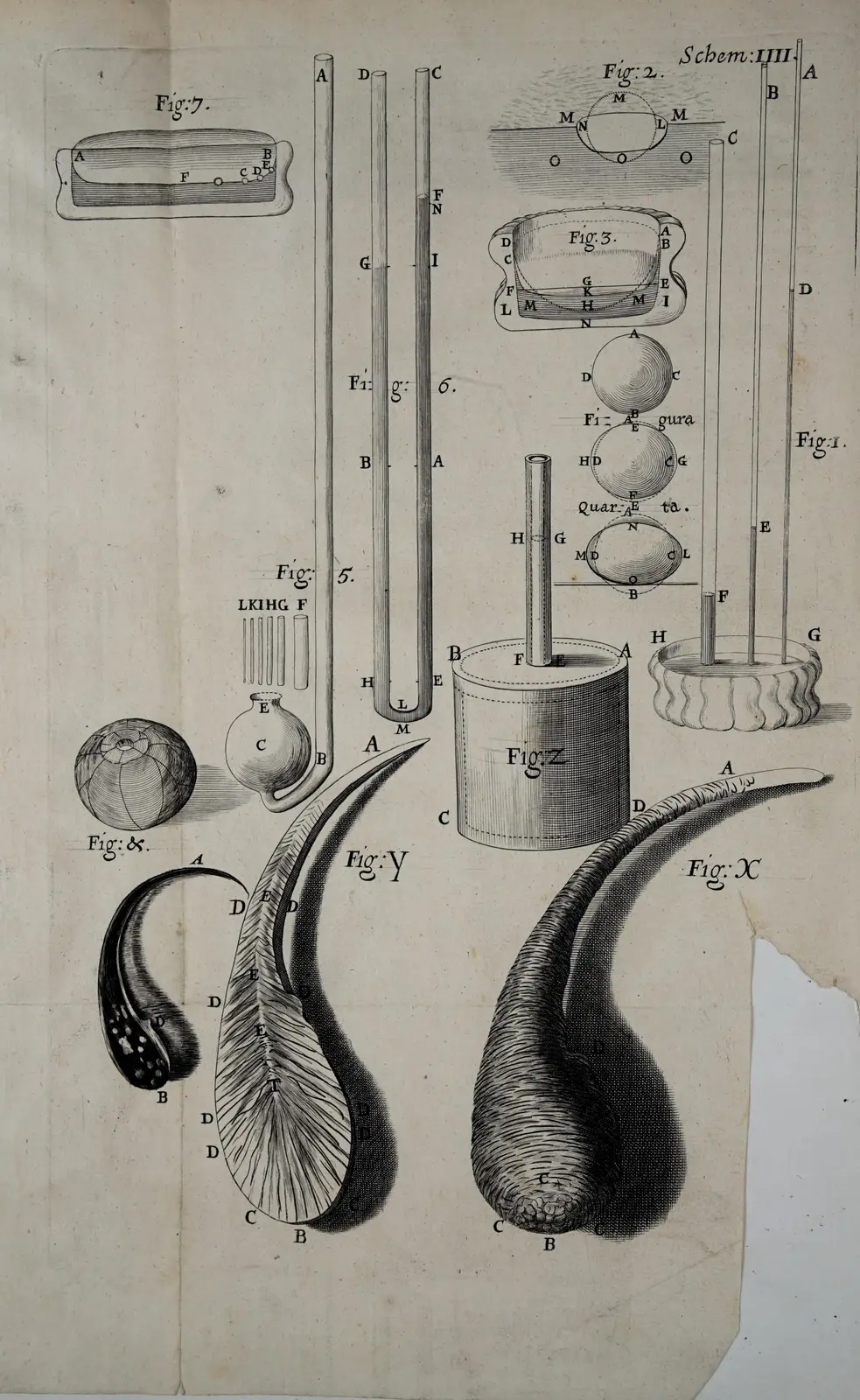
Schem. IIII from Robert Hooke's Micrographia, printed in London in 1665. Hooke's Observation VII names Fig. X and Fig. Y, the two large drops with long tails at the bottom of the plate.
Collection: Getty Research Institute copy, Hooke, Micrographia (London, 1665), Schem. IIII
"Schem. IIII (Hooke, Micrographia)" by Robert Hooke — https://archive.org/details/micrographiaorso00hook_4 — Public domain (US: published in 1665, before 1931; DE/FR: Robert Hooke died in 1703 per the library record of the scan (1635-1703), more than 70 years ago)
Card and share picture, a 3:2 copy of this object’s photograph: "Schem. IIII, glass drops (Hooke, Micrographia)" by Robert Hooke — https://archive.org/details/micrographiaorso00hook_4 — Public domain (US: published in 1665, before 1931; DE/FR: Robert Hooke died in 1703 per the library record of the scan (1635-1703), more than 70 years ago); modified: cropped to a 3:2 frame across the full width of the plate from the drop figures down
Robert Hooke broke glass drops by snapping off the small stem. The slender tail looks like the end that matters least, yet in Micrographia (1665), Hooke reported that “the whole bulk of the drop flew violently, with a very brisk noise, into multitudes of small pieces” (Observ. VII) full text. Now find Fig. X at the bottom right of the plate, a drop that has already burst but remains held in its original shape by a coating of transparent glue.
What did Hooke draw?
Hooke called these objects simply “Glass Drops” at the start of Observation VII, describing them as “small parcels of coarse green Glass” taken from the pots of molten glass and allowed to fall into cold water. His chapter does not use the name Prince Rupert, and none of the sources consulted for this page explains how that name became attached to the drops.
The plate Hooke published with this observation, Schem. IIII, shares a single sheet with tubes and vessels belonging to other experiments, so the drops occupy only its lower half scanned page. In Micrographia (1665), Hooke ties two of the engraved drops to his text by their labels, Fig. X and Fig. Y.
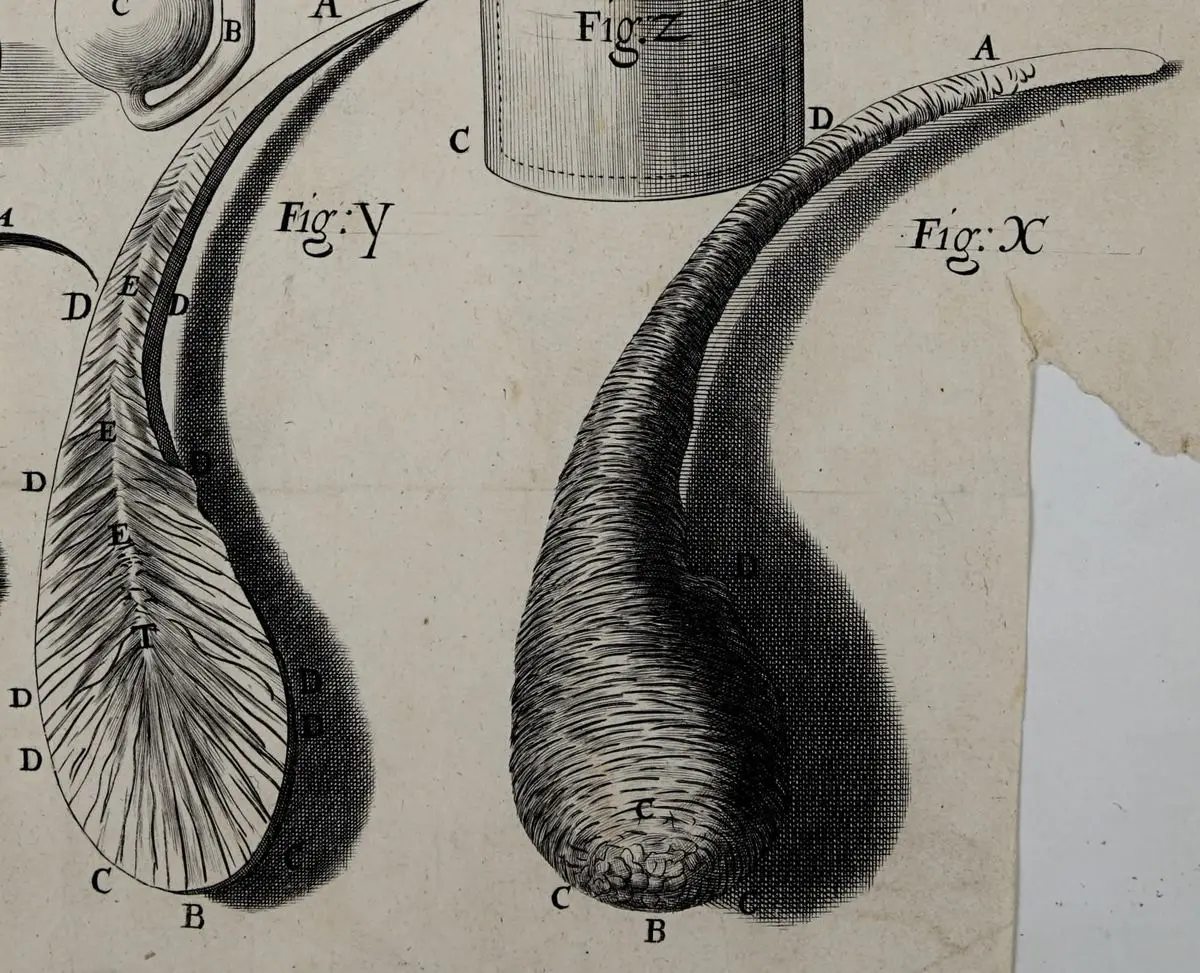
Schem. IIII, detail: Fig. Y on the left and Fig. X on the right. Hooke's text uses the engraved letters A for the tip of the tail, B for the blunt end, CCC for a ring near the blunt end and T for the top of a cone inside the head.
Collection: Getty Research Institute copy, Hooke, Micrographia (London, 1665), Schem. IIII
Detail. The small picture marks where it sits in the whole object.
“Schem. IIII, Fig. Y and Fig. X (Hooke, Micrographia)”, Robert Hooke; public domain.
Complete credit
"Schem. IIII, Fig. Y and Fig. X (Hooke, Micrographia)" by Robert Hooke — https://archive.org/details/micrographiaorso00hook_4 — Public domain (US: published in 1665, before 1931; DE/FR: Robert Hooke died in 1703 per the library record of the scan (1635-1703), more than 70 years ago); modified: cropped to the detail of Fig. Y and Fig. X, the two drops named in Observation VII, reduced to 1200 pixels on the long edge
Fig. X shows a drop that Hooke first coated with isinglass, a transparent glue, and then wrapped tightly in leather before he nipped off its tip. The coating held: in his words it was strong enough “to keep the parts from flying out of their former posture”, so the drop retained its outline while becoming “all over flaw’d”.
Hooke describes the blunt end B, as far as the ring CCC, as cracked with clefts running towards its centre. Above that ring, “all the rest of the Surface from CCC to A was flawed with an infinite number of small and parallel Rings”, which is the pattern of fine bands running along the whole drop in the engraving.
Fig. Y is not a portrait of a single drop. Hooke admits that he “could not so exactly cut” a broken drop through its axis, so he drew it from what he learned by taking apart several broken drops, showing how the interior would appear “could I have artificially divided a flaw’d drop through the Axis”.
The letter T marks the point where a cone rising from the blunt end terminates, and a spongier core that Hooke calls a “Pith” continues from T upwards into the narrow neck.
How is a drop made, in principle?
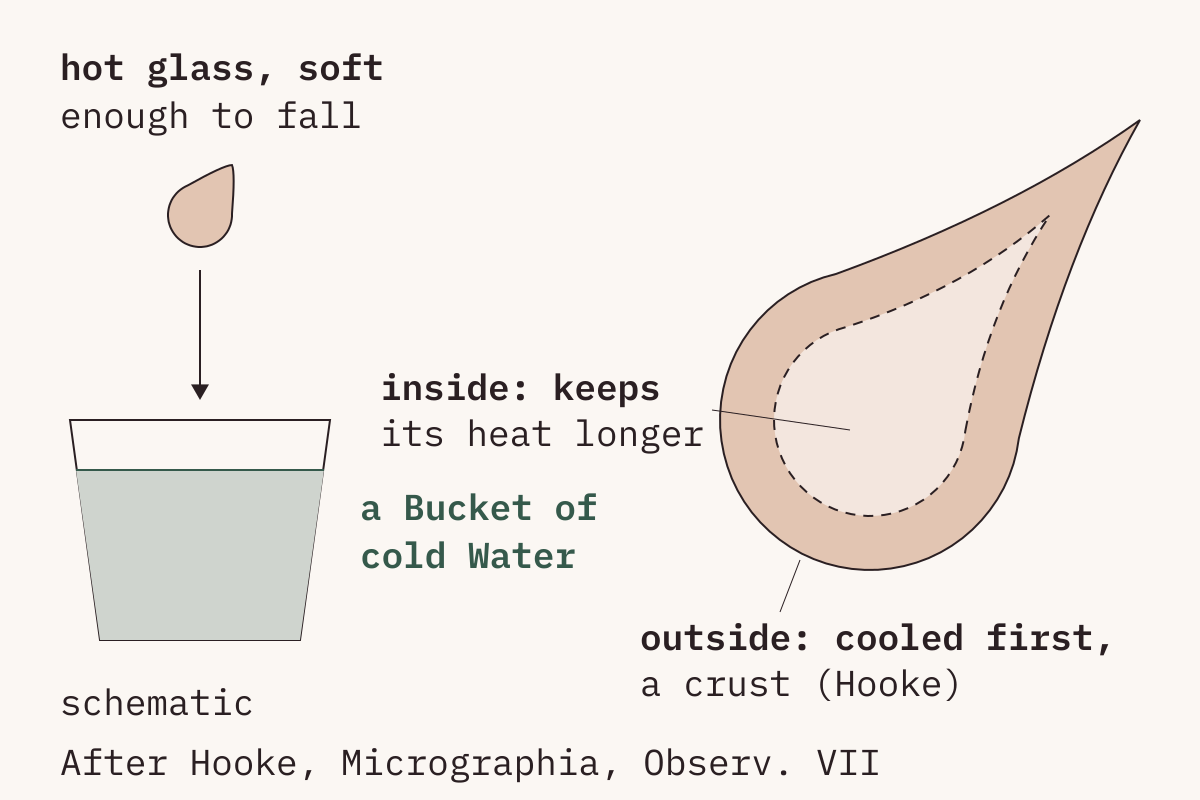
Hooke's description of the making occupies a single sentence. The glass was gathered “upon the end of an Iron Pipe” from the pots in which it was molten, and while it was still “of a kind of sluggish fluid Consistence”, it was “suffered to drop from thence into a Bucket of cold Water” and left there until it had grown cold.
 schematic
How a glass drop is made, in principle, after Hooke's description: the hot glass falls into cold water, the outside cools first into a crust and the inside keeps its heat for longer. Do not try this: it involves molten glass.
Source: Hooke, Micrographia (London, 1665), Observ. VII
"A glass drop falls into cold water, per Hooke 1665" by Kiln, Easel & Anvil, https://kilneaselandanvil.com/glass/prince-ruperts-drop/ — CC BY 4.0, https://creativecommons.org/licenses/by/4.0/
Data: Robert Hooke, Micrographia (London, 1665), Observation VII, Of some Phænomena of Glass drops
According to Hooke, the result depends on the order in which the parts of the drop cool. The outside is “presently cool’d and crusted”, while “the innermost parts of the drop” retain much of their heat, and by the time the interior cools, the hardened crust will not allow it to shrink back towards the centre. He also attributed the uneven surface of the drops, “irregularly flatted and pitted”, to this hasty cooling in water.
Do not try to make a glass drop at home: the process involves molten glass, and Hooke records that when a drop burst in the open air, some of the fragments “pierced my skin”.
Why does snapping the stem shatter it?
Hooke's explanation was that the quenched glass is trapped in a strained, bent condition from which it cannot release itself; in his words, “the parts of the Glass are under a kind of tension or flexure”. In modern physics the drop is usually explained as an outer skin held in compression around an inner core held in tension, as cited by Aben and colleagues in a 2016 paper in Applied Physics Letters, On the extraordinary strength of Prince Rupert's drops bibliography.
This page relies only on that paper's title and citation, so its measurements are not reported here.
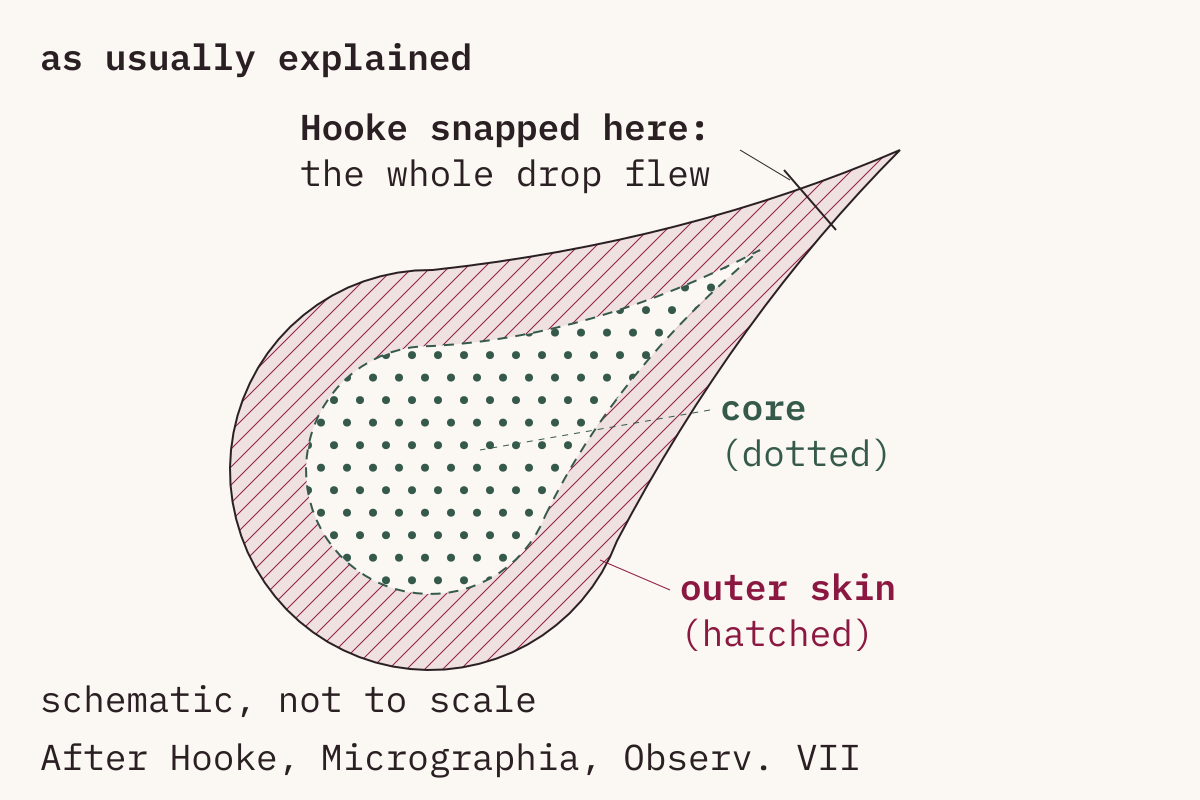 schematic, not to scale
The skin and core of a glass drop, with a mark on the thin stem where Hooke snapped it. The drop is usually explained as a hatched skin in compression around a dotted core in tension, as cited by Aben and colleagues (citation only).
Source: Hooke, Micrographia (London, 1665), Observ. VII; Aben and colleagues, Applied Physics Letters, December 2016 (citation only)
Read the figure as text
- Outer skin: hatched, as usually explained.
- Core: dotted, as usually explained.
- Thin stem: where Hooke snapped the drop and the whole drop flew to pieces.
"Skin and core of a glass drop, as usually explained" by Kiln, Easel & Anvil, https://kilneaselandanvil.com/glass/prince-ruperts-drop/ — CC BY 4.0, https://creativecommons.org/licenses/by/4.0/
Data: Robert Hooke, Micrographia (London, 1665), Observation VII; Aben and colleagues, "On the extraordinary strength of Prince Rupert's drops", Applied Physics Letters, December 2016 (citation only)
Hooke also offered a picture of why a single break undoes the entire drop. The parts, he wrote, are arranged “much like the stones in a Vault”, in which no stone can be removed “but the whole Arch falls”. In his account, snapping the stem removes one part of that arch, so that the rest springs violently apart.
The reheating trial points the same way. Drops that he heated again and allowed to cool slowly “quite lost all their fulminating or flying quality”, and their stems could then be “very easily broken and snapt any where, without at all making the drop fly”. Hooke judged them to be much like “other green Glass well nealed in the Oven”; nealing is his word for that gradual heating and cooling.
What did Hooke write down?
Observation VII reads as a series of trials, each of which changes one condition of how a drop was broken and records the outcome. The table below lists the trials in Hooke's own words. The same rows, with four more (how the drops were made, the snapped stem of a reheated drop and two for his explanation), can be downloaded as a CSV file.
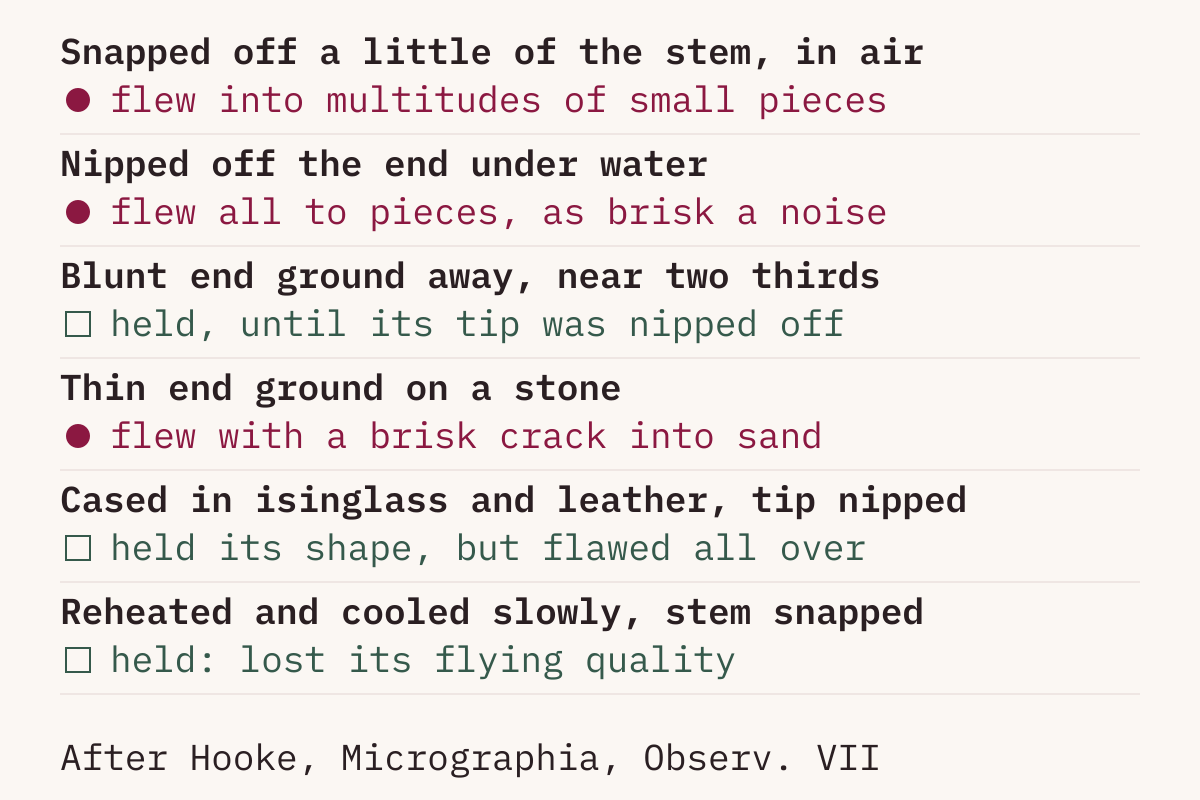
Hooke's trials with glass drops in Observation VII, each with what he recorded: in three the drop flew apart, and in three it held, one of them only until its tip was nipped off.
Source: Hooke, Micrographia (London, 1665), Observ. VII
"Hooke's trials with glass drops, Micrographia 1665" by Kiln, Easel & Anvil, https://kilneaselandanvil.com/glass/prince-ruperts-drop/ — CC BY 4.0, https://creativecommons.org/licenses/by/4.0/
Data: Robert Hooke, Micrographia (London, 1665), Observation VII, Of some Phænomena of Glass drops
| Trial | What Hooke recorded |
|---|---|
| Stem snapped off in the open air | “flew violently, with a very brisk noise, into multitudes of small pieces” |
| End nipped off under water | “flew all to pieces with as brisk a noise” |
| Blunt end ground away, near two thirds of the ball | “yet would it not fly to pieces” |
| Same drop, tip of the slender end then nipped off | “to fly immediately all into sand” |
| Thin end ground on a stone | “flew with a brisk crack into sand or small dust” |
| Drop cased in isinglass and leather, tip nipped off | “keep the parts from flying out of their former posture” |
| Drops reheated and cooled slowly | “quite lost all their fulminating or flying quality” |
Download the data (CSV, prince-ruperts-drop-hooke.csv) (notes on this file) Data: Robert Hooke, Micrographia (London, 1665), Observation VII, quoted from the Project Gutenberg text (public domain)
Two of these trials matter most for the explanation. A drop whose end Hooke nipped off “whilst all the bodies and ends of them lay buried under the water” still flew apart, which suggests that contact with air played no part in the break. The drop that was ground down shows the reverse case: its blunt end could lose most of its bulk without bursting, yet the whole drop disintegrated as soon as the very tip was nipped off.
In Hooke's account, a drop cooled suddenly in water carries the record of that cooling in its own strained parts.
The page asking whether glass is a liquid answers that question per one paper's abstract. Elsewhere the site reads a marble athlete on the contrapposto page, whose supports the Cleveland record says were added for stability, and, per Marryat's 1850 history, Meissen hard-paste porcelain, made with kaolin, for the way its body was made scanned page.
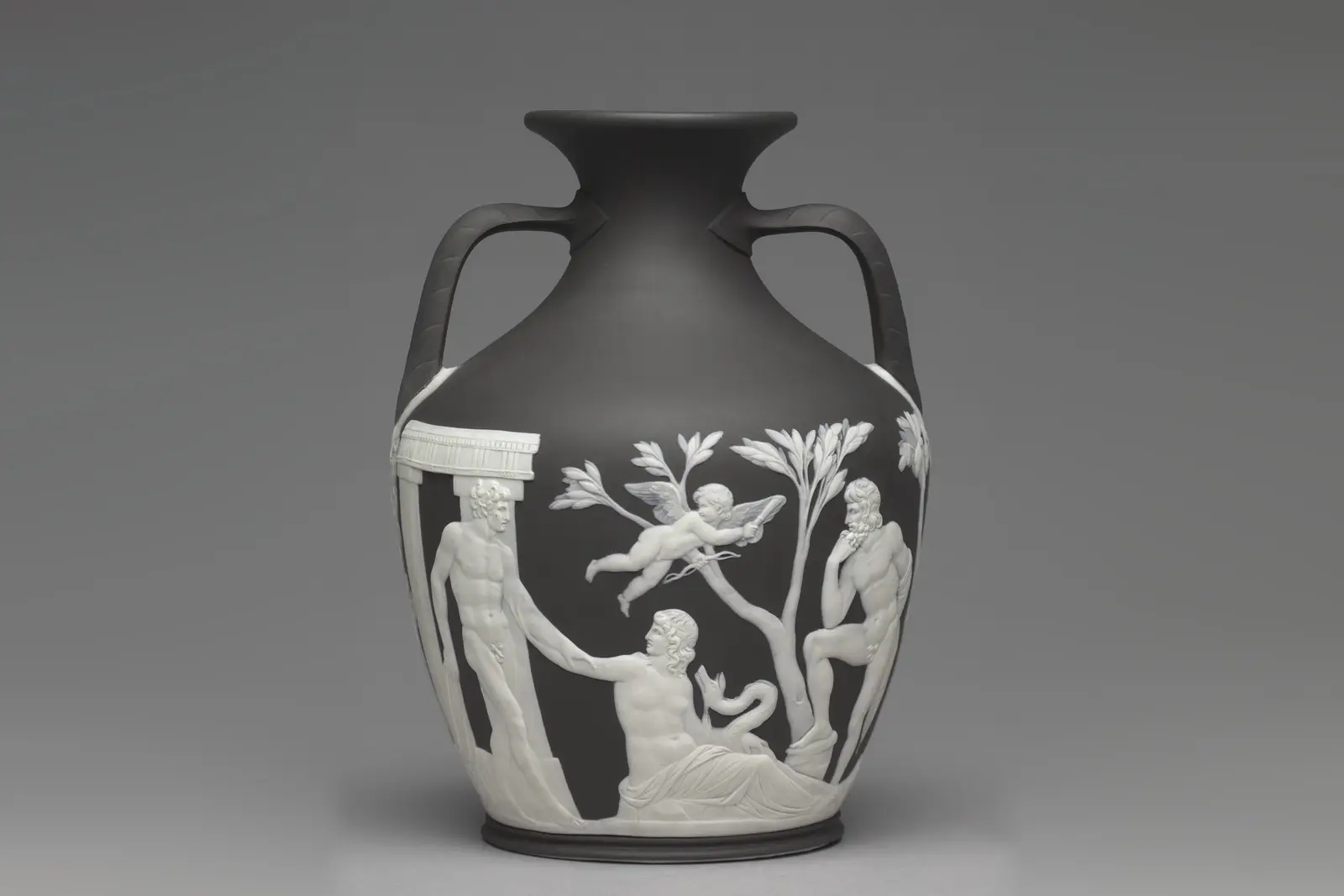
Under the loupe: go back to the thin end A of Fig. X, where Hooke saw small parallel rings of cracks run the whole length of the neck, and then look at the two layers of glass in the Portland Vase.
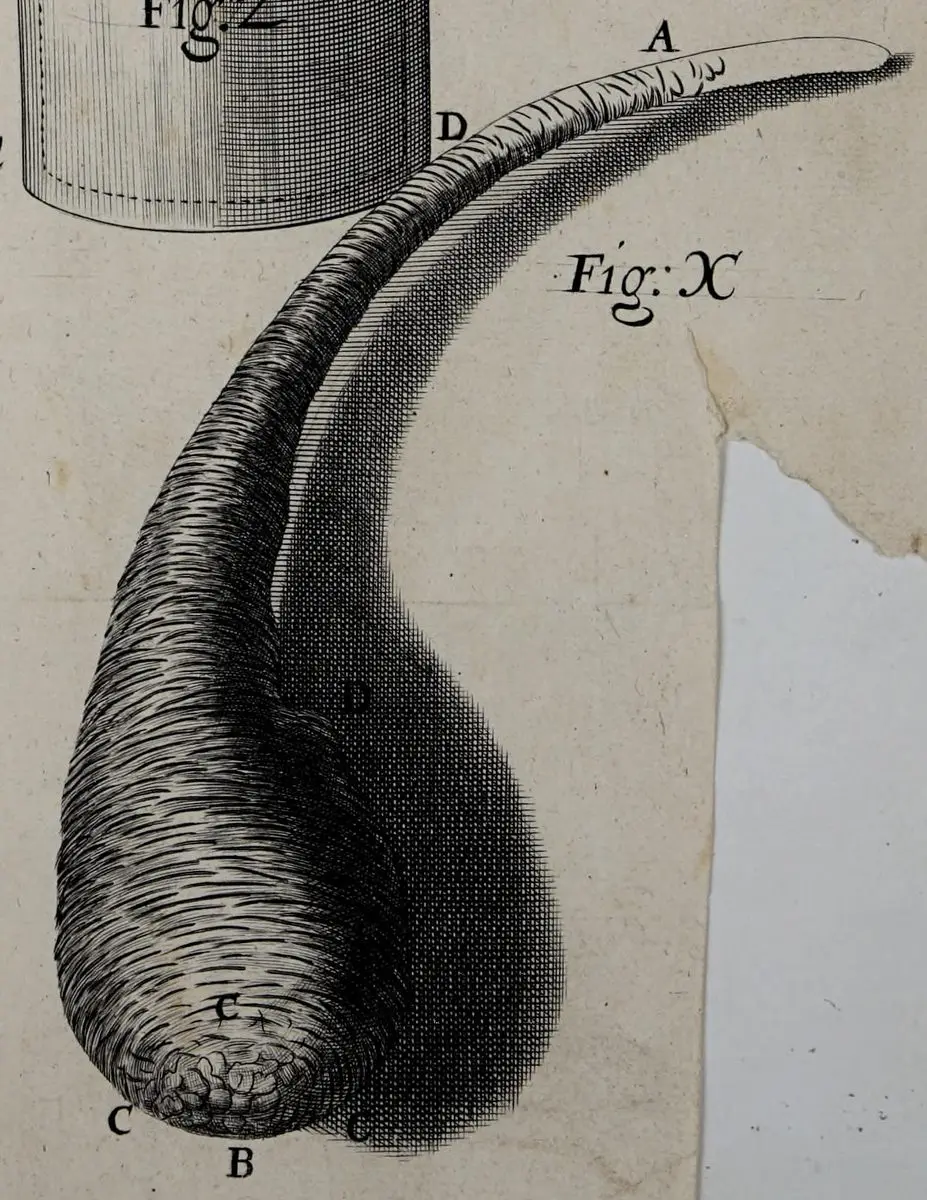
Schem. IIII, Fig. X: the drop Hooke cased in isinglass before breaking it, with the blunt end B, the ring CCC and the tip A.
Collection: Getty Research Institute copy, Hooke, Micrographia (London, 1665), Schem. IIII
Detail. The small picture marks where it sits in the whole object.
“Schem. IIII, Fig. X (Hooke, Micrographia)”, Robert Hooke; public domain.
Complete credit
"Schem. IIII, Fig. X (Hooke, Micrographia)" by Robert Hooke — https://archive.org/details/micrographiaorso00hook_4 — Public domain (US: published in 1665, before 1931; DE/FR: Robert Hooke died in 1703 per the library record of the scan (1635-1703), more than 70 years ago); modified: cropped to the detail of Fig. X, from the tip A to the blunt end B, reduced to 1200 pixels on the long edge
Sources and reading levels
- Hooke, Robert, Micrographia: or Some Physiological Descriptions of Minute Bodies Made by Magnifying Glasses (London: Jo. Martyn and Ja. Allestry, 1665), Observ. VII, "Of some Phænomena of Glass drops". Project Gutenberg eBook 15491. Public domain in the US and EU (Hooke died 1703) www.gutenberg.org/ebooks/15491Read: full text
- Hooke, Robert, Micrographia (London: Jo. Martyn and Ja. Allestry, 1665), Schem. IIII, engraved plate with Fig. X and Fig. Y. Getty Research Institute copy, scanned for the Internet Archive. Public domain in the US and EU (Hooke died 1703) archive.org/details/micrographiaorso00hook_4Read: scanned page; Schem. IIII (leaf n55)
- Aben, H., J. Anton, M. Õis, K. Viswanathan, S. Chandrasekar and M. M. Chaudhri, "On the extraordinary strength of Prince Rupert's drops", Applied Physics Letters 109 (23), 231903 (5 December 2016). DOI 10.1063/1.4971339 doi.org/10.1063/1.4971339Read: bibliography
- Cleveland Museum of Art, Statue of an Athlete, 1–100 CE, marble, accession number 1924.1046, collection online record (CC0) www.clevelandart.org/art/1924.1046Read: full textText licence: CC0 1.0 (terms)
- Joseph Marryat, Collections towards a History of Pottery and Porcelain in the 15th, 16th, 17th, and 18th Centuries (London: J. Murray, 1850); public domain in the US and EU (published 1850 by an author already adult then, who cannot have died later than 1955; no readable record of his death year was found) archive.org/details/collectionstowar00marrRead: scanned page
More objects in Glass
Pairs and lists
Is Glass a Liquid? Old Window Panes Don't Prove It
Catalogued
Picture credit
"Verrerie en bois, Pl. XV, Fig. 2 (Encyclopédie, Recueil de planches vol. 10)" by Radel (drawing) and Robert Bénard (engraving) — https://archive.org/details/gri_33125006581942 — Public domain (US: published in 1772, before 1931; DE/FR: drawn and engraved for a volume printed in Paris in 1772 (title page), so its makers died more than 70 years ago; engraver Robert Bénard born 1734 per the library record of the scan); modified: cropped to a 3:2 frame around Fig. 2
Object reading
Portland Vase: How the White Glass Was Cut, per Wedgwood
Catalogued
Picture credit
"Portland Vase, Wedgwood copy (Cleveland Museum of Art) (card)" by Cleveland Museum of Art — https://www.clevelandart.org/art/1918.823 — CC0 1.0 (https://creativecommons.org/publicdomain/zero/1.0/); modified: padded with the photograph's own background to a 3:2 frame, left and right, with a feathered seam
Cite this page
Kiln, Easel & Anvil. “Prince Rupert's Drop: Hooke's 1665 Account of a Snapped Stem.” Published 28 November 2026. https://kilneaselandanvil.com/glass/prince-ruperts-drop/ (accessed on the day you read it).
How a record is checked Every correction, dated Report an error on this page (contact@kilneaselandanvil.com)