Arnolfini Portrait: Two Figures at the Door, per Weale
Short answer
Per W. H. James Weale's 1908 catalogue, the glass hanging behind the couple reflects them together with an oak portal holding two more people, apparently Jan van Eyck himself and a youth in scarlet scanned page. Look at the small mirror on the back wall, just below the line of ornate writing.
Object record
- Object
- Portraits of John Arnolfini and Joan Cenani, his wife, Weale's title for the Arnolfini Portrait
- Maker
- Jan van Eyck, per Weale 1908; the 1516 inventory Weale quotes reads Fait du painctre Iohannes
- Date
- 1434, the year in the inscription as Weale transcribes it
- Material
- Oak panel, as published by Weale
- Dimensions
- 84.5 by 62.4 cm, height first: this site's reading of Weale's H. 0,845 ; B. 0,624 as metres (Weale prints no unit; decimal commas written as points)
- Collection
- National Gallery, London, no. 186, as of 1908, acquired in 1842, per Weale 1908 (not the museum's current record)
This record as CSV (arnolfini-portrait-record.csv) (notes on this file)
Data: W. H. James Weale, Hubert and John Van Eyck (London, 1908), pp. 69-72
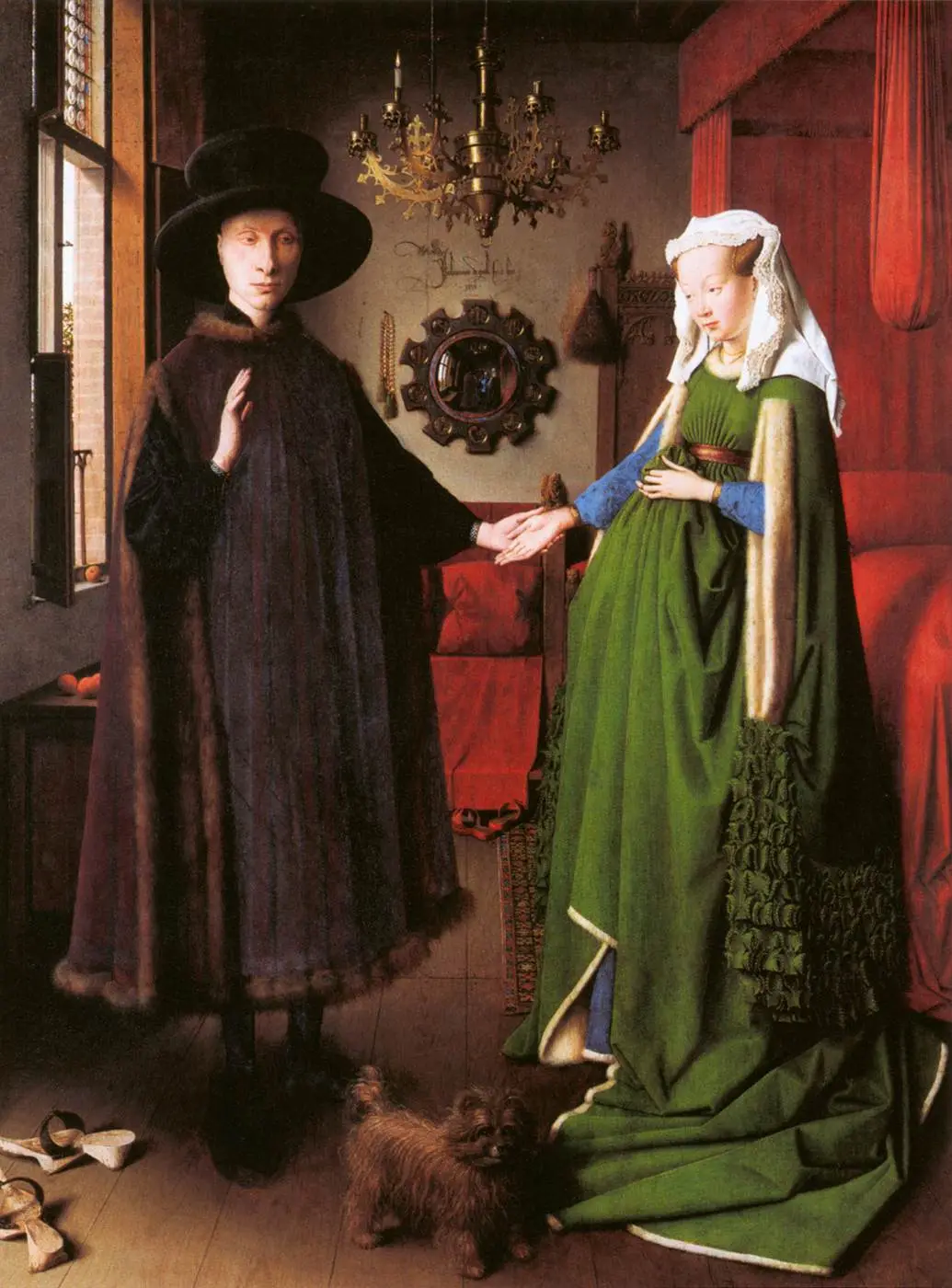
The Arnolfini Portrait, dated 1434 by the writing on its back wall. Weale's 1908 catalogue lists it as an oak panel in the National Gallery, London, under the number 186.
Collection: National Gallery, London, 186, as of 1908
"Portrait of Giovanni Arnolfini and his Wife (Jan van Eyck)" by Jan van Eyck — https://commons.wikimedia.org/wiki/File:Jan_van_Eyck_-_Portrait_of_Giovanni_Arnolfini_and_his_Wife_-_WGA7689.jpg — Public domain (US: published before 1931; DE/FR: Jan van Eyck died in 1441 per the Commons creator template on the file page (not checked against a library record), more than 70 years ago; faithful reproduction of a two-dimensional work)
Card and share picture, a 3:2 copy of this object’s photograph: "Portrait of Giovanni Arnolfini and his Wife (Jan van Eyck)" by Jan van Eyck — https://commons.wikimedia.org/wiki/File:Jan_van_Eyck_-_Portrait_of_Giovanni_Arnolfini_and_his_Wife_-_WGA7689.jpg — Public domain (US: published before 1931; DE/FR: Jan van Eyck died in 1441 per the Commons creator template on the file page (not checked against a library record), more than 70 years ago; faithful reproduction of a two-dimensional work); modified: cropped to a 3:2 frame from 150 px below the top edge (heads, mirror and hands), enlarged from 1,035 to 1,200 px wide
In the convex mirror on the back wall, two small figures stand in a doorway. They are not the man and woman in the foreground, because Weale's catalogue entry scanned page says that the mirror shows “the two figures” of the couple and, beyond them, “an oak portal” in which “two persons are standing”. Look at the mirror in the photograph above, and then at the line of writing on the wall just above it.
As Weale prints it, that line says that Jan van Eyck was here, not that he made the picture.
Where are the details on the panel?
Weale catalogued the picture as “Portraits of John Arnolfini and Joan Cenani, his wife” (p. 69), and he calls the painter John van Eyck, using the English form of Jan. His description walks around the room before it reaches the mirror, and it gives most objects a definite place.
The man holds his right hand raised, while the woman has laid her hand in his left, and at her feet, in the foreground, stands “a lively little griffin terrier”. A six-branched brass chandelier hangs from a ceiling beam in the middle of the room, and Weale notes that “one of the candles is burning.” On the right is an aumbry, a small cupboard, “with a couple of oranges on it”, while a third orange lies on the sill of the window above it (p. 71).
On the floor in the right foreground, Weale lists “two pattens of white wood with black leather latchets” (p. 72), which are wooden overshoes. He has already noted that the upper part of the window “is filled with pearl-white roundels”, while the lower part “is not glazed” (p. 71). For what old window glass can and cannot reveal about how it was made, see Is Glass a Liquid?.
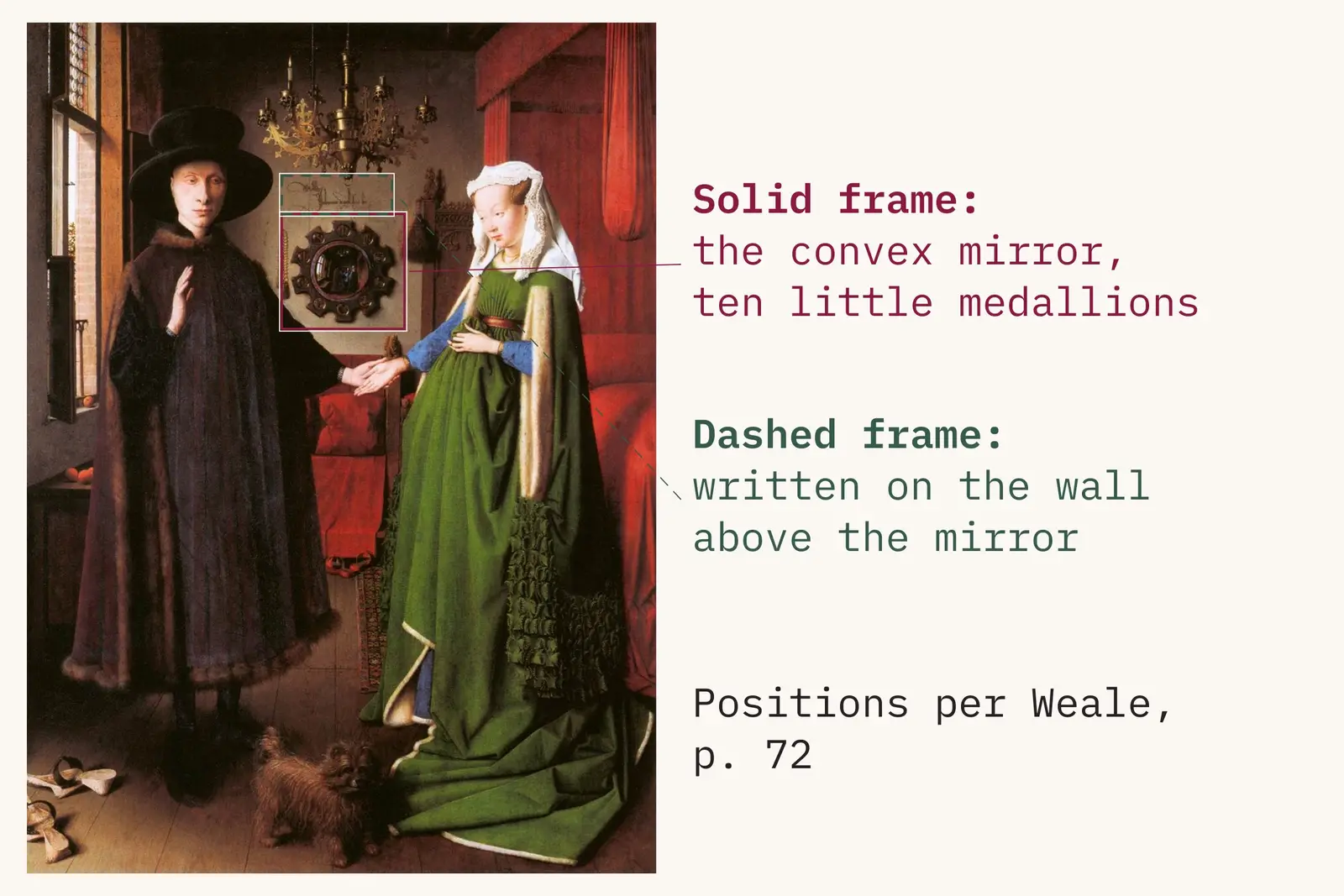
The whole painting with the two places this page looks at closely. The solid frame marks the convex mirror with its ten little medallions; the dashed frame marks the writing on the wall above the mirror. Both are placed as Weale describes them on p. 72.
Collection: National Gallery, London, 186, as of 1908
Source: W. H. James Weale, Hubert and John Van Eyck (London, 1908), p. 72; base photograph a public-domain reproduction on Wikimedia Commons, source not traced beyond the Web Gallery of Art
“Arnolfini Portrait: the mirror and the writing above it, per Weale”, Kiln, Easel & Anvil; CC BY 4.0.
Complete credit
"Arnolfini Portrait: the mirror and the writing above it, per Weale" by Kiln, Easel & Anvil, https://kilneaselandanvil.com/paintings/arnolfini-portrait/ — CC BY 4.0, https://creativecommons.org/licenses/by/4.0/. Base layer: "Portrait of Giovanni Arnolfini and his Wife (Jan van Eyck)" by Jan van Eyck — https://commons.wikimedia.org/wiki/File:Jan_van_Eyck_-_Portrait_of_Giovanni_Arnolfini_and_his_Wife_-_WGA7689.jpg — Public domain (US: published before 1931; DE/FR: Jan van Eyck died in 1441 per the Commons creator template on the file page (not checked against a library record), more than 70 years ago; faithful reproduction of a two-dimensional work); modified: scaled to 760 of 800 frame units high and set on a paper ground, 3:2 frame, labels added: a solid frame on the convex mirror and a dashed frame on the writing above it, with words quoting Weale (1908), p. 72.
Data: W. H. James Weale, Hubert and John Van Eyck (London, 1908), p. 72
Along the further wall stands a bench with a crimson cover, and Weale's next sentence reads: “Above the back, terminated at each end by a carved monster, hangs a circular convex mirror” (p. 72). That sentence fixes the mirror's place on the far wall, directly above the back of the bench.
| Detail | Where Weale places it | Weale's words | Qualifier |
|---|---|---|---|
| Convex mirror | on the back wall, above the back of the bench | “hangs a circular convex mirror” | as Weale describes it |
| Ten medallions | in the carved frame of the mirror | “ten little medallions” | Passion scenes, starting at the foot |
| Two figures in the mirror | in an oak portal reflected in the mirror | “two persons are standing” | apparently van Eyck and a youth in scarlet, per Weale |
| Inscription | on the wall above the mirror | “Iohannes de eyck fuit hic 1434” | as printed by Weale |
| Damage | across the mirror | “save in one place, across the mirror” | Weale does not describe the damage |
Download the data (CSV, arnolfini-portrait-details.csv) (notes on this file) Data: W. H. James Weale, Hubert and John Van Eyck (London, 1908), pp. 72-73
What does the mirror reflect?
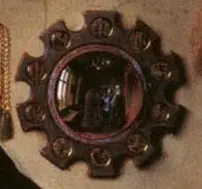
Detail of the convex mirror on the back wall. Weale counts ten little medallions in the carved frame and two persons standing in the reflected doorway.
Collection: National Gallery, London, 186, as of 1908
Detail. The small picture marks where it sits in the whole object.
“Portrait of Giovanni Arnolfini and his Wife (Jan van Eyck), detail”, Jan van Eyck; public domain.
Complete credit
"Portrait of Giovanni Arnolfini and his Wife (Jan van Eyck), detail" by Jan van Eyck — https://commons.wikimedia.org/wiki/File:Jan_van_Eyck_-_Portrait_of_Giovanni_Arnolfini_and_his_Wife_-_WGA7689.jpg — Public domain (US: published before 1931; DE/FR: Jan van Eyck died in 1441 per the Commons creator template on the file page (not checked against a library record), more than 70 years ago; faithful reproduction of a two-dimensional work); modified: cropped to the detail of the convex mirror and its frame
Weale describes the frame before the glass. The mirror hangs “in a carved frame adorned with ten little medallions”, and in these medallions “are painted a series of miniatures”. The sequence starts “at the foot” with the Agony in the Garden and runs on through the Betrayal, Christ before Pilate, the Scourging, the Carrying of the Cross, Calvary, the Deposition, the Entombment and the Descent into Limbo. It ends with the Resurrection, which gives ten scenes from the Passion for the ten medallions (p. 72).
Then comes the reflection itself. In Weale's words, “In the mirror are seen faithfully reflected, not only the two figures and that portion of the room comprised in the picture, but an oak portal beyond projecting into it, in which two persons are standing” (p. 72).
The small glass holds more people than the room in front of it: the two in the foreground, and two more in a doorway that the rest of the painting leaves out.
Who is standing in the doorway?
Weale identifies the pair with a careful word, calling them “apparently John van Eyck, dressed in blue, and a youth in scarlet” (p. 72). Apparently is Weale's own qualifier, and this page keeps it, because the catalogue offers the painter as the likeliest reading rather than as a recorded fact, and it names nobody for the youth.
In the mirror itself, Weale also records a weakness. He calls the panel as a whole “in the finest state of preservation save in one place, across the mirror” (p. 73), but he does not say what the damage is or how large it is.
An earlier writer misread the frame altogether. According to Weale, Laborde claimed in 1855 that the painter had surrounded the convex mirror with ten smaller mirrors, each one reflecting the scene (pp. 73–74). Weale prints the claim with two exclamation marks, since his own description calls the medallions painted miniatures.
What did van Eyck write above it?
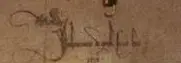
Detail of the wall directly above the mirror, where Weale places the inscription written “in a highly ornate hand”.
Collection: National Gallery, London, 186, as of 1908
Detail. The small picture marks where it sits in the whole object.
“Portrait of Giovanni Arnolfini and his Wife (Jan van Eyck), detail”, Jan van Eyck; public domain.
Complete credit
"Portrait of Giovanni Arnolfini and his Wife (Jan van Eyck), detail" by Jan van Eyck — https://commons.wikimedia.org/wiki/File:Jan_van_Eyck_-_Portrait_of_Giovanni_Arnolfini_and_his_Wife_-_WGA7689.jpg — Public domain (US: published before 1931; DE/FR: Jan van Eyck died in 1441 per the Commons creator template on the file page (not checked against a library record), more than 70 years ago; faithful reproduction of a two-dimensional work); modified: cropped to the detail of the writing on the wall above the mirror
Weale's description then moves up the wall: “On the wall above the mirror is written, in a highly ornate hand, ‘Iohannes de eyck fuit hic 1434.’” (p. 72). The Latin means Johannes of Eyck was here, 1434 (translated here), and the first word is given here exactly as Weale printed it, Iohannes.
The verb is the point. Fuit hic states that the painter was present, but it does not state that he painted the picture. Weale still labels his close-up plate “Mirror and signature of John van Eyck, 1434”, treating the line as the painter's signature even though its words record presence.
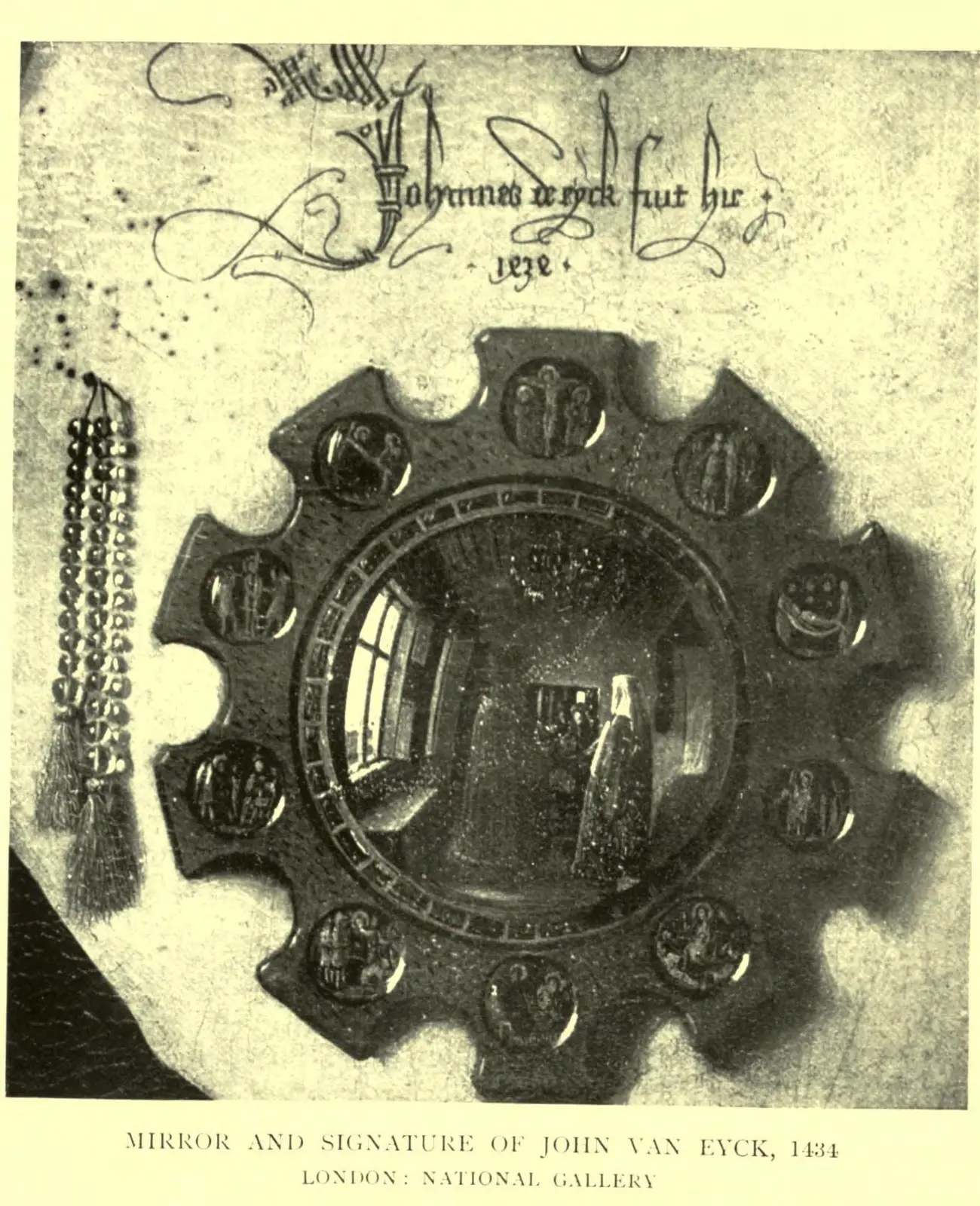
Weale's photogravure plate of the mirror and the writing above it, captioned “Mirror and signature of John van Eyck, 1434”. The plate shows the two details in one frame, one above the other.
Collection: University of Toronto copy, Weale, Hubert and John Van Eyck (1908), plate between pp. 72 and 73, scanned for the Internet Archive
“Mirror and signature of John van Eyck, 1434 (plate)”, Unknown author / Unknown photographer, in W. H. James Weale, Hubert and John Van Eyck (London, 1908); public domain.
Complete credit
"Mirror and signature of John van Eyck, 1434 (plate)" by Unknown photographer, in W. H. James Weale, Hubert and John Van Eyck (London, 1908) — https://archive.org/details/hubertjohnvaneyc00wealuoft — Public domain (US: published in 1908, before 1931; DE/FR: anonymous photogravure published in 1908, more than 70 years ago; the book's author, W. H. James Weale, died in 1917 per the library record of the scan); modified: cropped to the plate and its printed caption from the page image
The wording that names van Eyck as the maker comes from a different document. Weale quotes an inventory of Margaret of Austria's paintings drawn up in 1516, which describes “Ung grant tableau qu'on appelle Hernoul le fin, avec sa femme dedens une chambre” (a large picture called Hernoul le fin, with his wife in a room; translated here) and ends “Fait du painctre Iohannes”, made by the painter Johannes (translated here; p. 70, note 1).
The claim of authorship belongs to the inventory, while the painted line on the wall records only that he was there. The inscription has been misread before, too: Weale's list of earlier writers says that Carton, in 1847, read it as “JOHNINES DE EYCK, HIC. 1438”, a reading that Carton himself found to have “no sense” (p. 73).
How did Weale picture it in 1908?
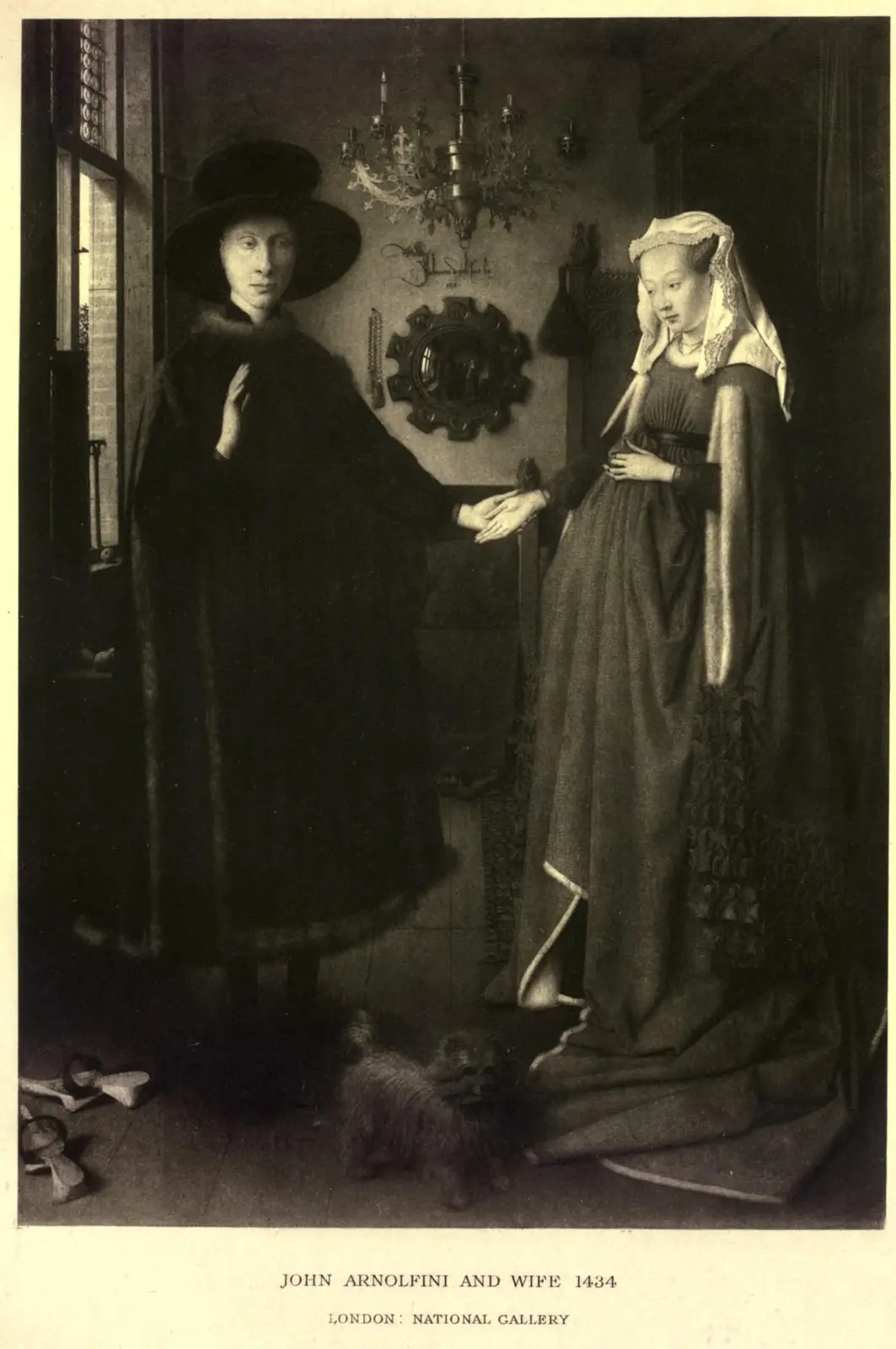
The whole painting as Weale's book reproduced it in 1908, a photogravure plate captioned “John Arnolfini and wife 1434” and “London: National Gallery”.
Collection: University of Toronto copy, Weale, Hubert and John Van Eyck (1908), plate between pp. 70 and 71, scanned for the Internet Archive
“John Arnolfini and wife 1434 (plate)”, Unknown author / Unknown photographer, in W. H. James Weale, Hubert and John Van Eyck (London, 1908); public domain.
Complete credit
"John Arnolfini and wife 1434 (plate)" by Unknown photographer, in W. H. James Weale, Hubert and John Van Eyck (London, 1908) — https://archive.org/details/hubertjohnvaneyc00wealuoft — Public domain (US: published in 1908, before 1931; DE/FR: anonymous photogravure published in 1908, more than 70 years ago; the book's author, W. H. James Weale, died in 1917 per the library record of the scan); modified: cropped to the plate and its printed caption from the page image
Weale's entry opens with a single line of facts: “London: National Gallery, 186. Oak. H. 0,845 ; B. 0,624.” (p. 69).
The panel is oak, and the two numbers use decimal commas without printing any unit.
Read as height and breadth in metres, they give a panel 84.5 by 62.4 centimetres, height first, but that conversion is this site's reading, because the page itself does not name the unit.
For another portrait that the Louvre's record gives as painted on a wooden board rather than on canvas, see the Mona Lisa.
The same entry traces the panel's owners. Don Diego de Guevara acquired it after 1490 and added shutters painted with his arms, and before 1516 he gave it to Margaret of Austria; at her death in 1530 it passed to Mary of Hungary, after which it was taken to Spain. In 1815 Major-General Hay found it in Brussels and brought it to England, and “in 1842 it was acquired by the Gallery” (pp. 69–70).
A painting's later history can change the object itself: per the Rijksmuseum, The Night Watch was cut down in 1715.
Is it a wedding picture?
Weale describes the scene that way himself, since his entry states that “In the centre stand a newly married couple” (p. 70) and his plate calls them “John Arnolfini and wife”. That is Weale's own reading of the scene.
He also lists earlier readings that differ from his own. Per Weale, Viardot in 1852 described “a scene of chiromancy”, in which the man is trying to read the lady's palm for “the future of the babe whose birth she is expecting” (p. 73), while Waagen, in 1854, considered the figures to be “the portraits of John van Eyck and his wife”, according to the same list.
Laborde, in 1855, titled the picture La Légitimation and interpreted it as a declaration that the expected child was the man's, a description that Weale calls “extraordinarily inaccurate” (p. 74). This page sets these readings side by side as Weale reports them and does not choose among them.
Under the loupe: go back to the foot of the mirror frame, where Weale says the series of ten medallions begins with the Agony in the Garden, and then look closely at the pearl in Girl with a Pearl Earring.
Detail of the convex mirror on the back wall. Weale counts ten little medallions in the carved frame and two persons standing in the reflected doorway.
Collection: National Gallery, London, 186, as of 1908
Detail. The small picture marks where it sits in the whole object.
“Portrait of Giovanni Arnolfini and his Wife (Jan van Eyck), detail”, Jan van Eyck; public domain.
Complete credit
"Portrait of Giovanni Arnolfini and his Wife (Jan van Eyck), detail" by Jan van Eyck — https://commons.wikimedia.org/wiki/File:Jan_van_Eyck_-_Portrait_of_Giovanni_Arnolfini_and_his_Wife_-_WGA7689.jpg — Public domain (US: published before 1931; DE/FR: Jan van Eyck died in 1441 per the Commons creator template on the file page (not checked against a library record), more than 70 years ago; faithful reproduction of a two-dimensional work); modified: cropped to the detail of the convex mirror and its frame
Sources and reading levels
- W. H. James Weale, Hubert and John Van Eyck, Their Life and Work (London and New York: John Lane, 1908), catalogue entry 5, 'Portraits of John Arnolfini and Joan Cenani, his wife', pp. 69-74, with the plates 'John Arnolfini and wife 1434' and 'Mirror and signature of John van Eyck, 1434'; University of Toronto copy; public domain in the US and EU (Weale died in 1917, per the library record) archive.org/details/hubertjohnvaneyc00wealuoftRead: scanned page
- Rijksmuseum, 'For the first time in 300 years The Night Watch is complete again', press release, 23 June 2021 www.rijksmuseum.nl/en/press/press-releases/for-the-first…Read: full text
More objects in Paintings
Object reading
The Night Watch: How Much of the Canvas Was Cut in 1715
Catalogued
Picture credit
"The Night Watch (card)" by Rembrandt van Rijn — https://commons.wikimedia.org/wiki/File:The_Nightwatch_by_Rembrandt_-_Rijksmuseum.jpg — Public domain (US: published before 1931; DE/FR: Rembrandt died in 1669 per the Commons creator template on the file page, more than 70 years ago; faithful reproduction of a two-dimensional work); modified: cropped to a 3:2 frame from the centre (full width, 14168 by 9445 pixels) and reduced to 2400 by 1600 pixels
Object reading
Girl with a Pearl Earring: No Hook, per the Mauritshuis
Catalogued
Picture credit
"Girl with a Pearl Earring (card)" by Mauritshuis, The Hague — https://commons.wikimedia.org/wiki/File:Meisje_met_de_parel.jpg — Public domain (US: published before 1931; DE/FR: Vermeer died in 1675 per the Mauritshuis object page 670, more than 70 years ago; faithful reproduction of a two-dimensional work); modified: cropped to a 3:2 frame from the centre (full width, 4095 by 2730 pixels, from 1032 pixels down) and reduced to 2400 by 1600 pixels
Technique, diagrammed
Mona Lisa: Painted on Poplar, Not Canvas, per the Louvre
Catalogued
Picture credit
"Mona Lisa (Leonardo da Vinci)" by Leonardo da Vinci — https://commons.wikimedia.org/wiki/File:Leonardo_da_Vinci_-_Mona_Lisa_(La_Gioconda)_-_WGA12712.jpg — Public domain (US: published before 1931; DE/FR: Leonardo da Vinci died in 1519 per the Louvre collection record, more than 70 years ago; faithful reproduction of a two-dimensional work); modified: cropped to a 3:2 frame from 120 px below the top edge (face), enlarged from 800 to 1,200 px wide
Cite this page
Kiln, Easel & Anvil. “Arnolfini Portrait: Two Figures at the Door, per Weale.” Published 28 November 2026. https://kilneaselandanvil.com/paintings/arnolfini-portrait/ (accessed on the day you read it).
How a record is checked Every correction, dated Report an error on this page (contact@kilneaselandanvil.com)