Venus de Milo: Joined at the Hips, per the Louvre's Record
Short answer
The Venus de Milo is made of two elements of marble joined at the hips, according to the Louvre's record of the statue. In the photograph, look at the roll of drapery around the hips, where an 1878 study says the seam is hidden.
Object record
- Object
- Venus de Milo (Vénus de Milo), statue of Aphrodite
- Maker
- Not named in the Louvre record
- Date
- 150 to 125 BC (third quarter of the 2nd century BC), Hellenistic, as published
- Material
- Marble from Paros (marbre de Paros, lychnites), as published
- Dimensions
- 204 cm high, as published
- Collection
- Musée du Louvre, Paris, Ma 399 (also LL 299 and N 527)
This record as CSV (venus-de-milo-record.csv) (notes on this file)
Data: Louvre collections notice for the Venus de Milo, Ma 399 (last updated 17.04.2026; Licence Ouverte, Etalab)
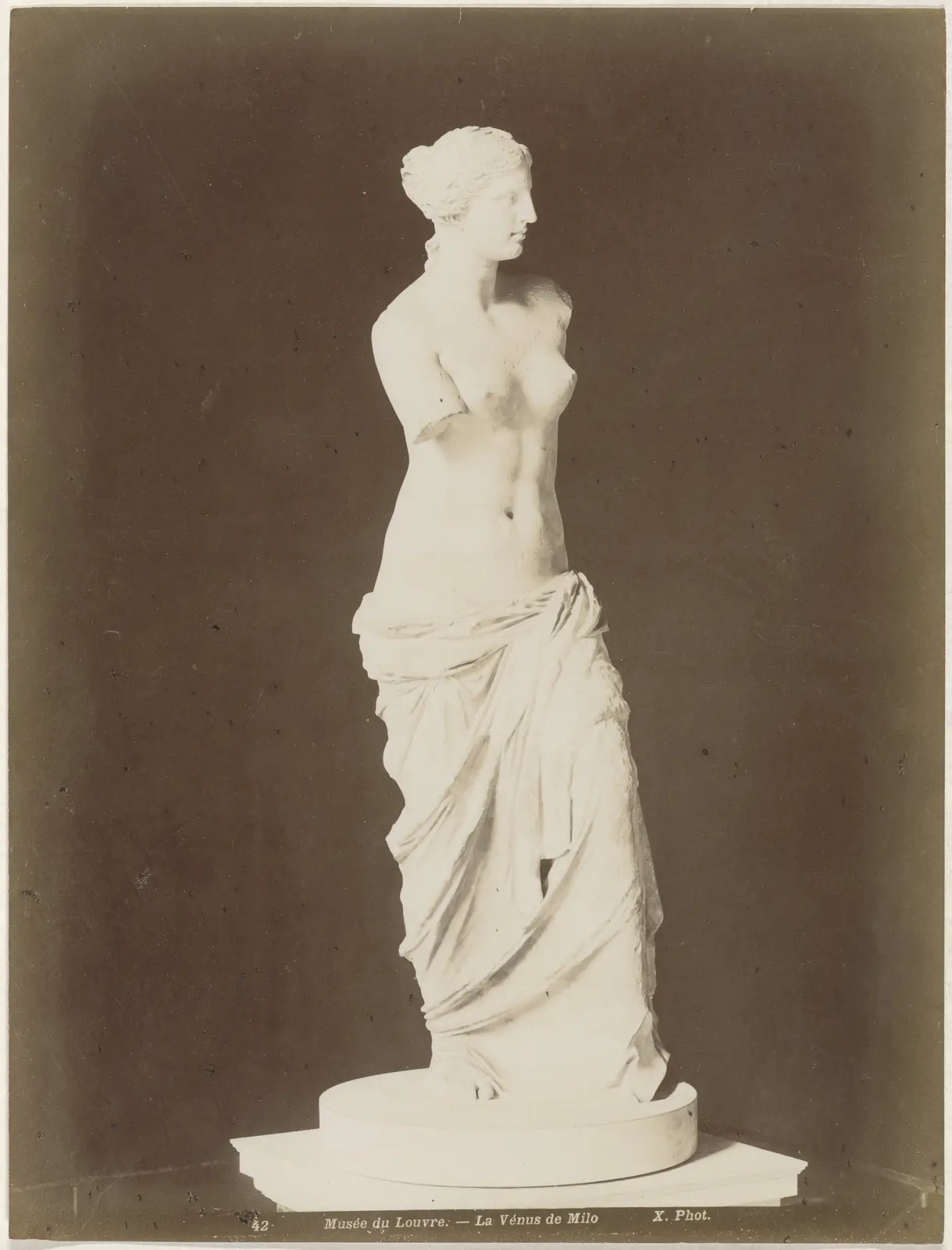
The Venus de Milo in an anonymous albumen print made between 1870 and 1900. The statue is in the Louvre, Paris (Ma 399); the print is in the Rijksmuseum.
Collection: Rijksmuseum, Amsterdam, RP-F-F16588
"Venus van Milo, Louvre. Musée du Louvre. - La Vénus de Milo" by Rijksmuseum — https://commons.wikimedia.org/wiki/File:Venus_van_Milo,_Louvre_Mus%C3%A9e_du_Louvre._-_La_V%C3%A9nus_de_Milo_(titel_op_object),_RP-F-F16588.jpg — CC0 1.0 (http://creativecommons.org/publicdomain/zero/1.0/deed.en)
Card and share picture, a 3:2 copy of this object’s photograph: "Venus van Milo, Louvre. Musée du Louvre. - La Vénus de Milo" by Rijksmuseum — https://commons.wikimedia.org/wiki/File:Venus_van_Milo,_Louvre_Mus%C3%A9e_du_Louvre._-_La_V%C3%A9nus_de_Milo_(titel_op_object),_RP-F-F16588.jpg — CC0 1.0 (http://creativecommons.org/publicdomain/zero/1.0/deed.en); modified: cropped to a 3:2 frame from the top of the head to the hip line, with the printed caption line left out
Follow the roll of drapery that sags around the Venus de Milo's hips. The bare body above it and the draped legs below it are two joined elements of marble: the Louvre's record full text describes the statue as “composée de deux éléments joints au niveau des hanches”, made of two elements joined at the level of the hips (translated here). In 1878 William Price Shreve added that the seam was “concealed by the drapery” scanned page, so look at that fold rather than for a visible crack.
The Louvre dates the Venus de Milo (Vénus de Milo in its record) to 150 to 125 BC, during the Hellenistic period, and records the place of manufacture as “Mélos = Milo (?)”, keeping the question mark. According to the same record, the statue was discovered on the island of Melos in 1820, presented to King Louis XVIII by the marquis de Rivière, and delivered to the museum in 1821. The record names the French State as the statue's registered owner.
Where do the two elements meet?
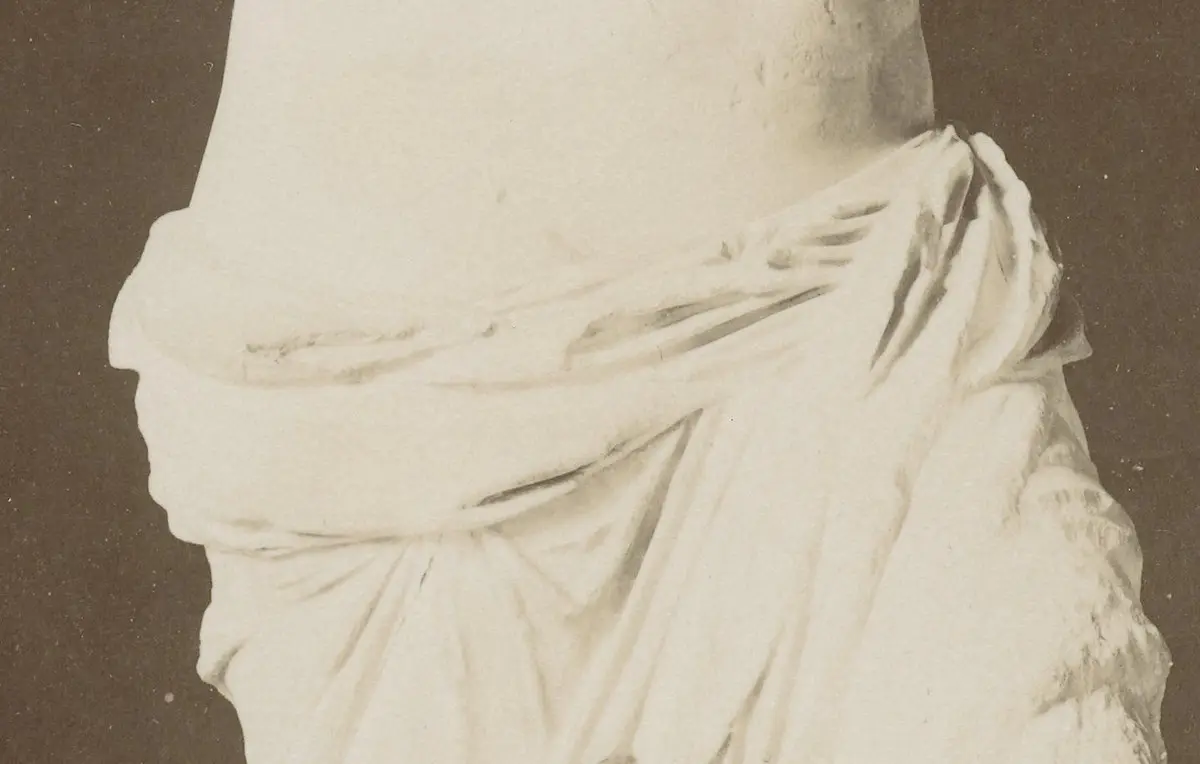
Detail of the same print: the roll of drapery at the hips, the level at which the Louvre's record places the join. Shreve wrote in 1878 that the drapery conceals the seam.
Collection: Rijksmuseum, Amsterdam, RP-F-F16588
Detail. The small picture marks where it sits in the whole object.
"Venus van Milo, Louvre. Musée du Louvre. - La Vénus de Milo (detail)" by Rijksmuseum — https://commons.wikimedia.org/wiki/File:Venus_van_Milo,_Louvre_Mus%C3%A9e_du_Louvre._-_La_V%C3%A9nus_de_Milo_(titel_op_object),_RP-F-F16588.jpg — CC0 1.0 (http://creativecommons.org/publicdomain/zero/1.0/deed.en); modified: cropped to the detail of the drapery roll at the hips
The Louvre's record identifies the join by a level rather than a line: its technical description places the two elements “au niveau des hanches”, at the level of the hips. The record does not explain how the contact surfaces were prepared, or where their edge runs around the body.
Shreve offered an explanation for why the division is so difficult to detect. In The Venus of Milo, his history of the statue's discovery and later treatment, he concluded that “There can be no doubt it was made in two pieces, the seam or joint being concealed by the drapery of the inferior half” (p. 14). On his reading, the carved cloth belonging to the lower block covers the contact between the two stones.
He also argued that the division was intentional rather than accidental, observing that the bust and the draped portion “are so finished at the point of union as to preclude the idea that the statue was ever broken at the waist” (p. 14).
A trace of this kind is what this site calls the maker's tell: a trace on an object that shows how it was made, which counts only when a museum record, a museum press release or a public-domain source states where it is and what caused it. For the Venus de Milo, the Louvre's record supplies the location, and Shreve's description of contact surfaces finished at the point of union supplies the cause.
Other pages apply the same term to the Portland Vase, a vase built from two layers of glass, and to Boulle marquetry, in which, on Roubo's account, two decorative panels are sawn from a single stack.
How are the two elements arranged?
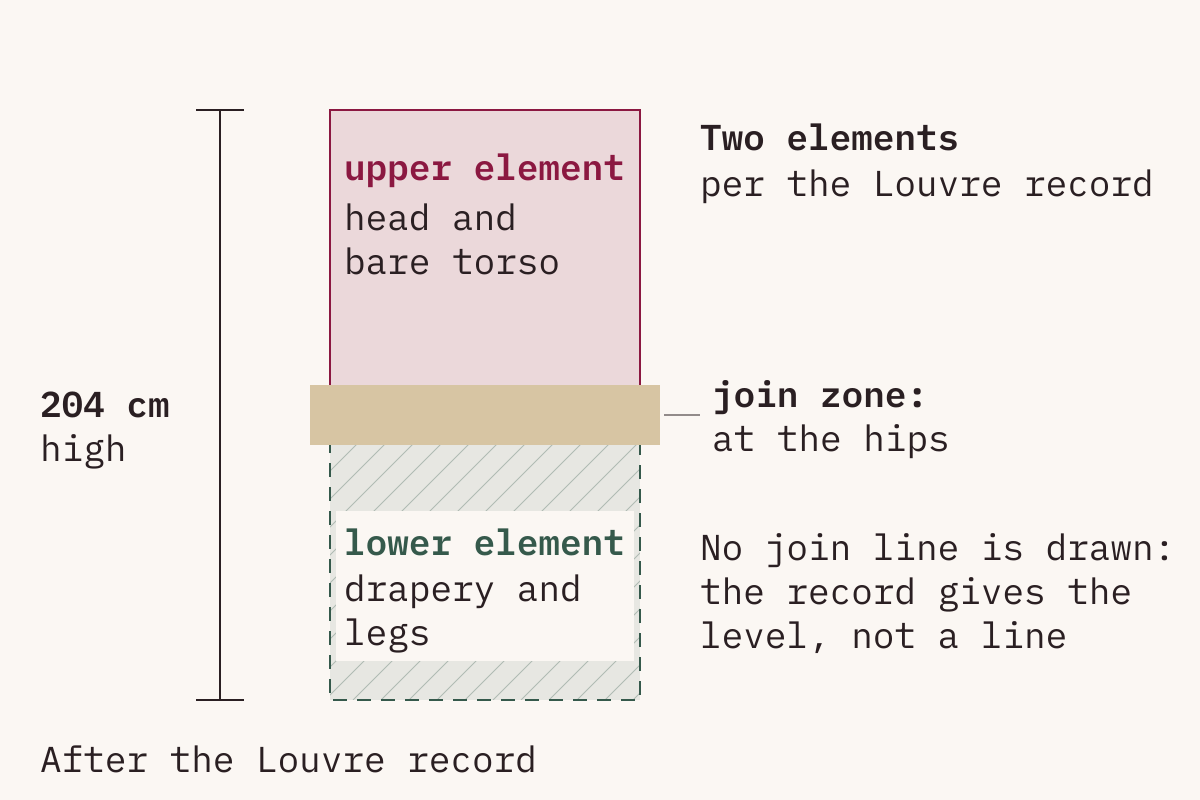 schematic, not to scale
The two elements drawn as boxes beside a 204 cm height bar. The join is a shaded band at the hips, because the Louvre's record names a level and not a line.
Source: Louvre collections notice for the Venus de Milo, Ma 399 (last updated 17.04.2026); William Price Shreve, The Venus of Milo (1878), p. 14
Read the figure as text
- Height: 204 cm, per the Louvre's record.
- Upper element: the head and the bare torso (Shreve's “bust”).
- Lower element: the drapery and the legs (Shreve's “draped portion”).
- Join: at the level of the hips, per the Louvre's record; no join line is drawn.
"Venus de Milo: two elements joined at the hips" by Kiln, Easel & Anvil, https://kilneaselandanvil.com/sculpture/venus-de-milo/ — CC BY 4.0, https://creativecommons.org/licenses/by/4.0/
Data: Louvre collections notice for the Venus de Milo, Ma 399 (last updated 17.04.2026; Licence Ouverte, Etalab); William Price Shreve, The Venus of Milo (Boston, 1878), p. 14
According to the Louvre's record, the statue stands 204 cm high and is carved in “marbre de Paros (lychnites)”, marble from the Greek island of Paros. Shreve recorded the height in 1878 as “two metres, thirty-eight millimetres”, which converts to 203.8 cm; the two measurements are printed here side by side, without averaging or choosing between them.
Shreve described how the two stones were held together: “iron bolts were placed at the right and left of the centre, near the thighs”, a conclusion he based on “the oxidation and the particles of solder that secured the iron to the marble” (p. 14). In a later chapter he added that the pieces at the thighs “had evidently been fractured at some early day by the iron bolts that had held the two blocks in place” (p. 47).
Iron fixings hidden inside a marble figure belong to a different technique from a statue made entirely of metal. The page on lost-wax casting follows Cellini's account of casting his bronze Perseus.
The table below repeats, field by field, what the Louvre's record full text states about the statue's manufacture.
| Field | Value in the record | Note |
|---|---|---|
| Height | 204 cm | as published |
| Material | marbre de Paros (lychnites) | marble from Paros |
| Parts | 2 elements | joined at the level of the hips |
| Left arm | made separately and fitted | a mortise is recorded; the record does not say where it is |
Download the data (CSV, venus-de-milo-measurements.csv) (notes on this file) Data: Louvre collections notice for the Venus de Milo, Ma 399 (last updated 17.04.2026; Licence Ouverte, Etalab)
What happened to the arms?
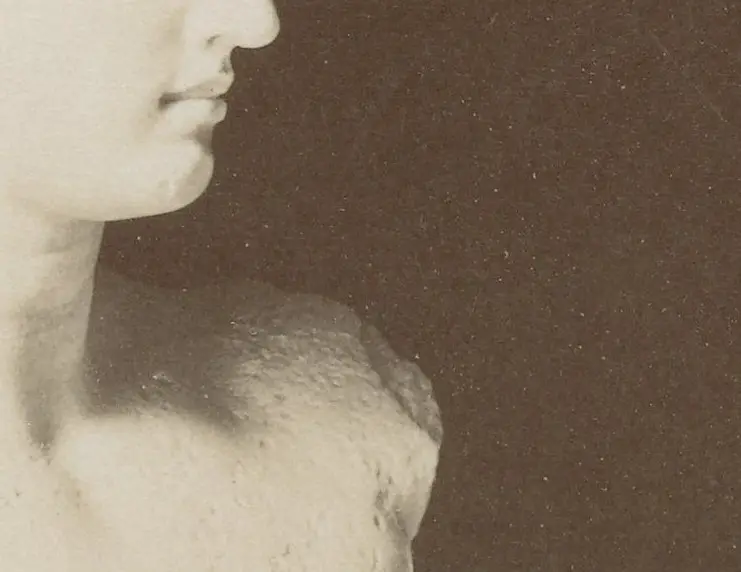
Detail of the same print: the statue's left shoulder, on the right of the picture. The Louvre's record says the left arm was made separately and fitted, with a mortise, but not where the mortise is; Shreve put the socket of the left arm at the shoulder.
Collection: Rijksmuseum, Amsterdam, RP-F-F16588
Detail. The small picture marks where it sits in the whole object.
"Venus van Milo, Louvre. Musée du Louvre. - La Vénus de Milo (detail)" by Rijksmuseum — https://commons.wikimedia.org/wiki/File:Venus_van_Milo,_Louvre_Mus%C3%A9e_du_Louvre._-_La_V%C3%A9nus_de_Milo_(titel_op_object),_RP-F-F16588.jpg — CC0 1.0 (http://creativecommons.org/publicdomain/zero/1.0/deed.en); modified: cropped to the detail of the statue's left shoulder
The Louvre's record lists the missing parts as “il manque le bras gauche, une grande partie du bras droit, le pied gauche”: the left arm, a large portion of the right arm and the left foot are absent (translated here).
The record states “Le bras gauche était rapporté (présence d'une mortaise)”: the left arm was made as a separate piece and attached, and a mortise is present (translated here). A mortise is a socket cut into one piece to receive a matching projection on another. Shreve wrote in 1878 that “the socket of the left arm at the shoulder is perfectly indicated” (p. 14).
The record also mentions bronze additions that were once fastened to the marble, noting holes for a diadem and for a bracelet on the right arm.
What the arms originally did is a separate question, and this page does not reconstruct the pose. The Louvre's record links casts produced in the museum's workshop between 1848 and 1852, including a “Tirage d'une main gauche accompagnant la Vénus de Milo”, a cast of a left hand that accompanies the statue (translated here).
Adolf Furtwängler wrote at the opening of his 1895 chapter on the statue scanned page: “It is now almost universally acknowledged that a left upper arm and a hand holding an apple, which were found with the Venus, really belong to it.” That sentence records Furtwängler's interpretation. The museum's record, as published, does not state what either hand held.
What did 19th-century writers record?
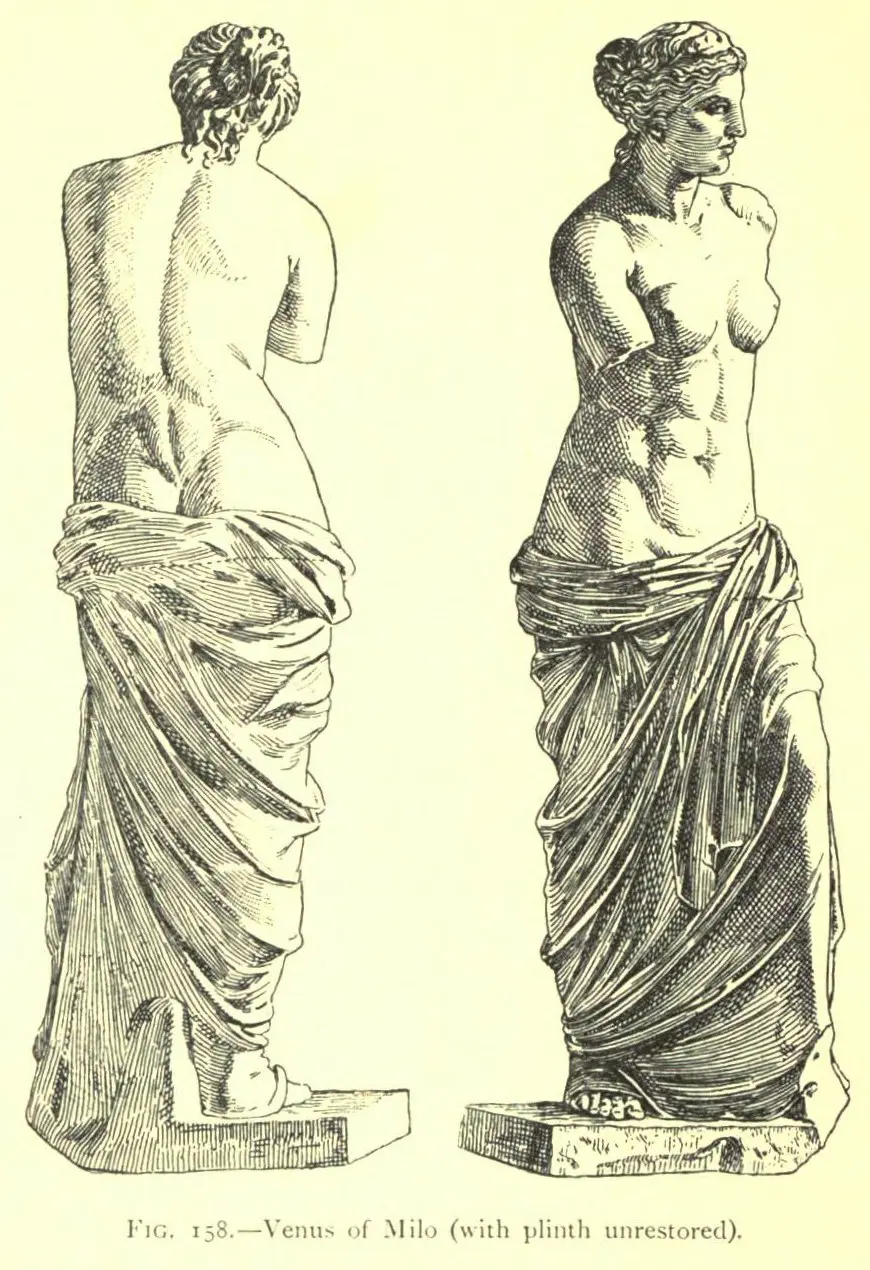
Fig. 158 in Adolf Furtwängler's 1895 book “Masterpieces of Greek Sculpture”, captioned “Venus of Milo (with plinth unrestored)”: the statue seen from the back and from the front.
Collection: University of Toronto copy, Furtwängler, “Masterpieces of Greek Sculpture” (1895), p. 370, Fig. 158, scanned for the Internet Archive
“Venus of Milo (with plinth unrestored), Fig. 158”, Unknown author / Unknown author, in Adolf Furtwängler, “Masterpieces of Greek Sculpture” (London, 1895); public domain.
Complete credit
"Venus of Milo (with plinth unrestored), Fig. 158" by Unknown author, in Adolf Furtwängler, “Masterpieces of Greek Sculpture” (London, 1895) — https://archive.org/details/masterpiecesofgr00furtuoft — Public domain (US: published in 1895, before 1931; DE/FR: anonymous illustration published in 1895, more than 70 years ago; the book's author, Adolf Furtwängler, died in 1907 per the library record of the scan); modified: cropped to Fig. 158 and its printed caption from p. 370
Furtwängler identified further piecing below the hips. Referring to casts “without the restorations”, he argued that “any one can easily convince themselves that the plinth, like the whole statue, was put together out of different pieces” (p. 370). He then explained that “The block of marble was insufficient, and the plinth had to be continued to the right by joining on a piece.”
Two pages later he described the left foot, “the front and larger portion of which was, as is well known, made of a separate piece” (p. 372).
Shreve's chapter on the statue's subsequent history records what a committee observed when the pieces were separated, including “the inferior block from which were detached the two thighs in three pieces, and the base” (p. 47).
The same chapter describes “two wooden wedges between the upper and lower blocks”, measuring “two centimetres in thickness and twenty-five in length”, that is, 2 cm thick and 25 cm long. According to Shreve, these wedges “were put there to remedy a fault in the restoration of the fragment of the left thigh on the lower block”, and they “gave the body an inclination to the front and to the right side” (p. 48). The committee afterwards “caused the pieces to be properly fitted”.
Shreve's account is a single writer's report, published in Boston in 1878. The Louvre's record, last updated in April 2026, confirms the two elements and the join at the hips, but it does not mention the iron bolts or the wooden wedges.
Under the loupe: go back to the roll of drapery at the hips, which Shreve said conceals the seam, and then look at the tree trunk beside another marble figure, the Cleveland athlete on the contrapposto page.
Detail of the same print: the roll of drapery at the hips, the level at which the Louvre's record places the join. Shreve wrote in 1878 that the drapery conceals the seam.
Collection: Rijksmuseum, Amsterdam, RP-F-F16588
Detail. The small picture marks where it sits in the whole object.
"Venus van Milo, Louvre. Musée du Louvre. - La Vénus de Milo (detail)" by Rijksmuseum — https://commons.wikimedia.org/wiki/File:Venus_van_Milo,_Louvre_Mus%C3%A9e_du_Louvre._-_La_V%C3%A9nus_de_Milo_(titel_op_object),_RP-F-F16588.jpg — CC0 1.0 (http://creativecommons.org/publicdomain/zero/1.0/deed.en); modified: cropped to the detail of the drapery roll at the hips
Sources and reading levels
- Musée du Louvre, collections notice 'Vénus de Milo', LL 299; N 527; Ma 399, Département des Antiquités grecques, étrusques et romaines (last updated 17 April 2026); quotations in French, with the English translated here collections.louvre.fr/ark:/53355/cl010277627Read: full textText licence: Licence Ouverte / Open Licence 2.0 (Etalab) (terms)
- William Price Shreve, The Venus of Milo: Its Discovery, the Theories Concerning It, Its Subsequent History (Boston: Shreve, Crump & Low, 1878), pp. 14, 47 and 48; Boston Public Library copy; public domain in the US (published 1878) archive.org/details/venusofmiloitsdi00shreRead: scanned page
- Adolf Furtwängler, “Masterpieces of Greek Sculpture: A Series of Essays on the History of Art” (London: Heinemann, 1895), chapter 'The Venus of Milo', opening page and pp. 370 and 372, Fig. 158; University of Toronto copy; public domain in the US and EU (Furtwängler died in 1907; the English edition's editor, Eugénie Sellers Strong, died in 1943) archive.org/details/masterpiecesofgr00furtuoftRead: scanned page
More objects in Sculpture
Technique, diagrammed
Contrapposto: The One-Leg Stance Leonardo Describes
Catalogued
Picture credit
"Statue of an Athlete (side view, card)" by Cleveland Museum of Art — https://www.clevelandart.org/art/1924.1046 — CC0 1.0 (https://creativecommons.org/publicdomain/zero/1.0/); modified: padded with the photograph's own background to a 3:2 frame, left and right, with a feathered seam
Technique, diagrammed
Lost Wax Casting: Cellini's Own Account of His Perseus
Catalogued
Picture credit
"Pomona, circle of Andrea Riccio (card)" by Cleveland Museum of Art — https://www.clevelandart.org/art/1948.486 — CC0 1.0 (https://creativecommons.org/publicdomain/zero/1.0/); modified: padded with the photograph's own background to a 3:2 frame, left and right, with a feathered seam
Object reading
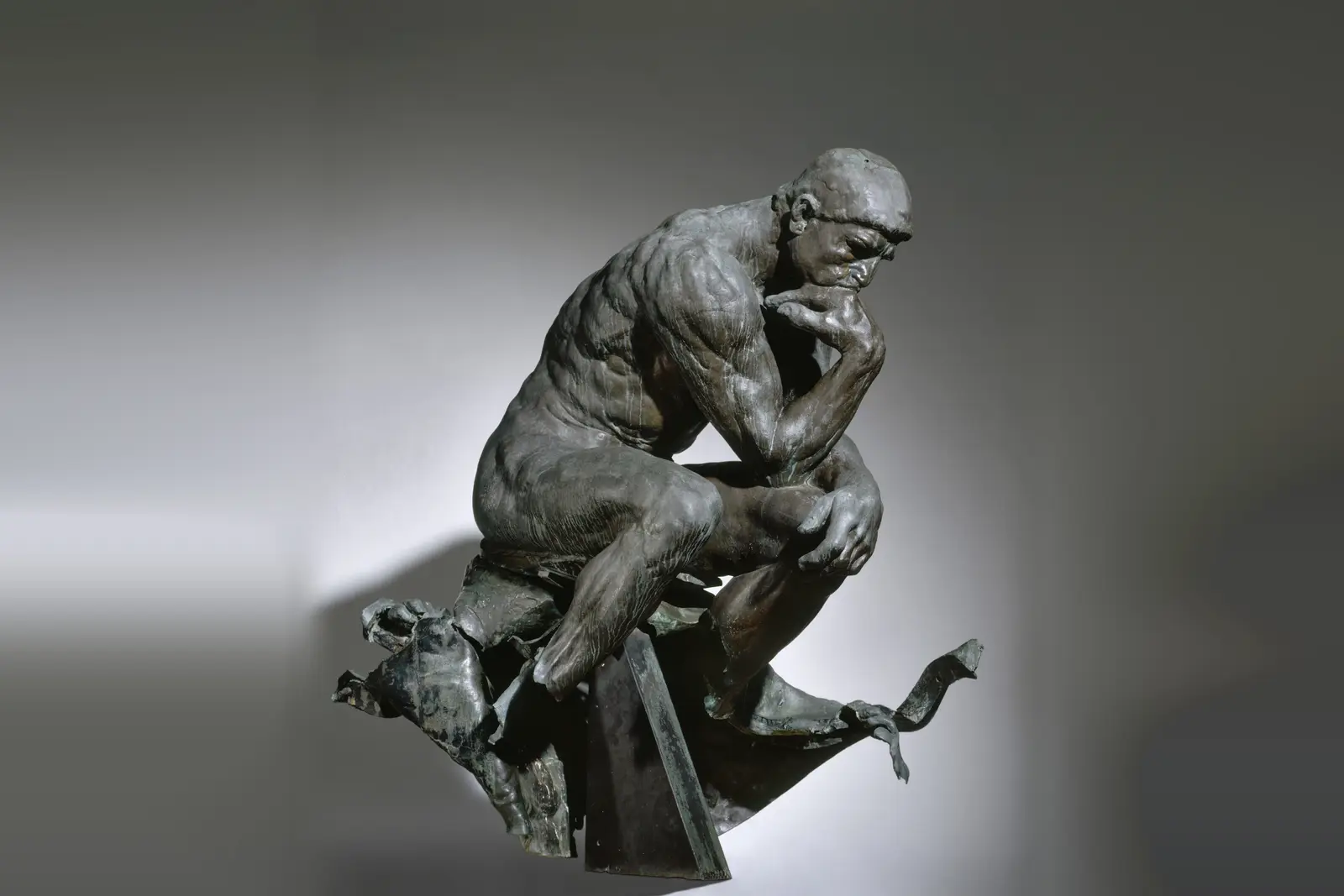
The Thinker: Cleveland Chose Not to Repair Its 1970 Damage
Catalogued
Picture credit
"The Thinker, Auguste Rodin (card)" by Cleveland Museum of Art — https://www.clevelandart.org/art/1917.42 — CC0 1.0 (https://creativecommons.org/publicdomain/zero/1.0/); modified: padded with the photograph's own background to a 3:2 frame, left and right, with a feathered seam
Cite this page
Kiln, Easel & Anvil. “Venus de Milo: Joined at the Hips, per the Louvre's Record.” Published 28 November 2026. https://kilneaselandanvil.com/sculpture/venus-de-milo/ (accessed on the day you read it).
How a record is checked Every correction, dated Report an error on this page (contact@kilneaselandanvil.com)