Contrapposto: The One-Leg Stance Leonardo Describes
Short answer
This page uses the Italian word contrapposto for a standing pose with the weight mainly on one leg, and the Cleveland Museum of Art’s record for a Roman statue says sculptors working in marble rather than bronze added struts and a trunk “for stability”. In the photograph below, look at the left-hand side of the picture.
Object record
- Object
- Statue of an Athlete
- Maker
- Italy, Roman (culture as given in the record; no maker named)
- Date
- 1–100 CE
- Material
- marble
- Dimensions
- Overall: 173.9 cm (height), as published
- Collection
- Cleveland Museum of Art, 1924.1046
This record as CSV (contrapposto-record.csv) (notes on this file)
Data: Cleveland Museum of Art, Statue of an Athlete, 1924.1046, collection record (CC0)
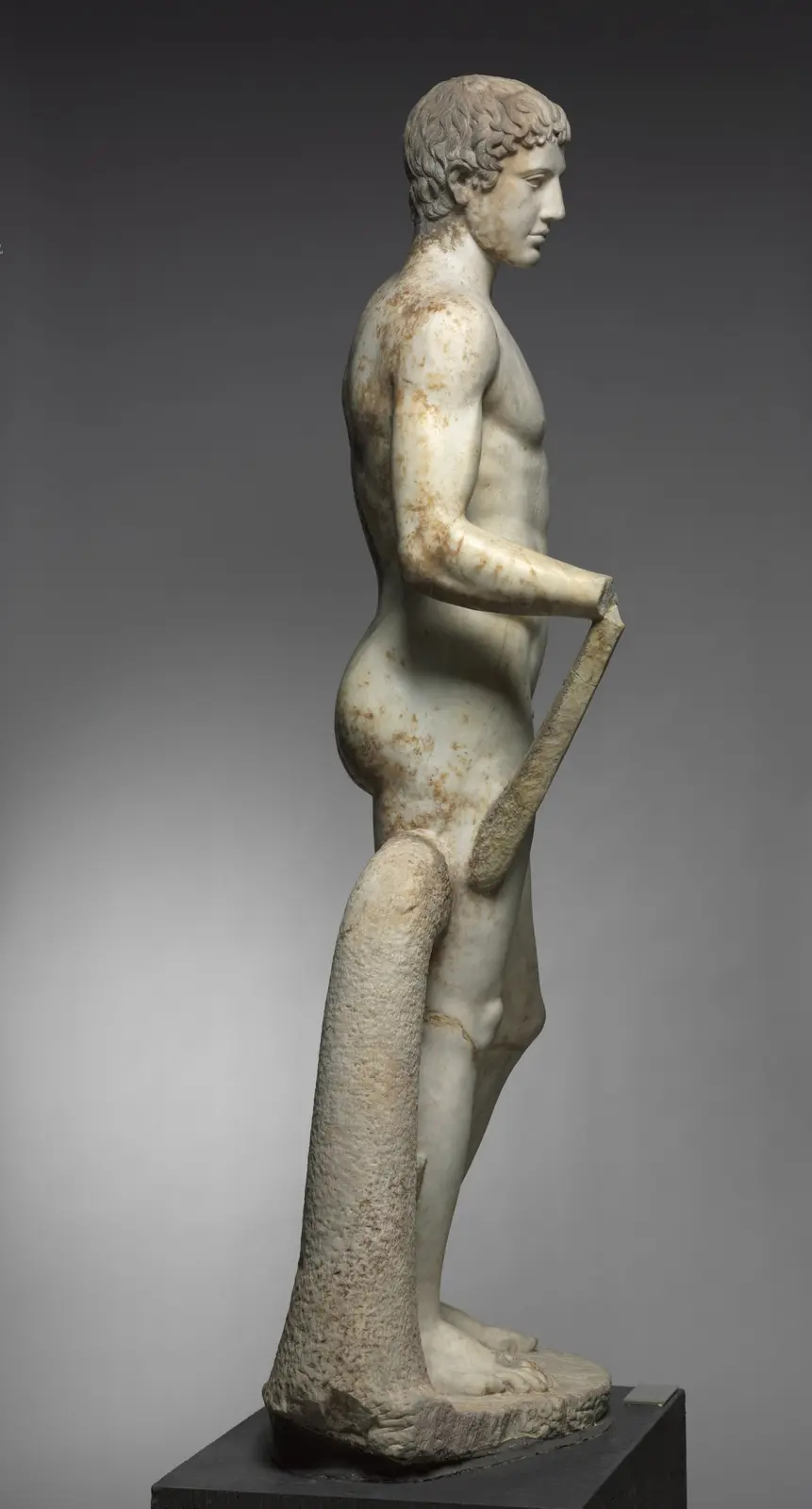
The Statue of an Athlete from the side, as photographed by the Cleveland Museum of Art; the record dates it 1–100 CE and gives an overall height of 173.9 cm.
Collection: Cleveland Museum of Art, 1924.1046
"Statue of an Athlete (side view)" by Cleveland Museum of Art — https://www.clevelandart.org/art/1924.1046 — CC0 1.0 (https://creativecommons.org/publicdomain/zero/1.0/)
Card and share picture, a 3:2 copy of this object’s photograph: "Statue of an Athlete (side view, card)" by Cleveland Museum of Art — https://www.clevelandart.org/art/1924.1046 — CC0 1.0 (https://creativecommons.org/publicdomain/zero/1.0/); modified: padded with the photograph's own background to a 3:2 frame, left and right, with a feathered seam
Beside the right leg of a marble athlete in Cleveland stands a large tree trunk. The museum’s record says it was added for stability and gives the reason: the sculptors were “Working in marble rather than bronze” full text. In the photograph, the trunk stands on the viewer’s left, beside the statue’s right leg.
What does the Cleveland athlete stand on?
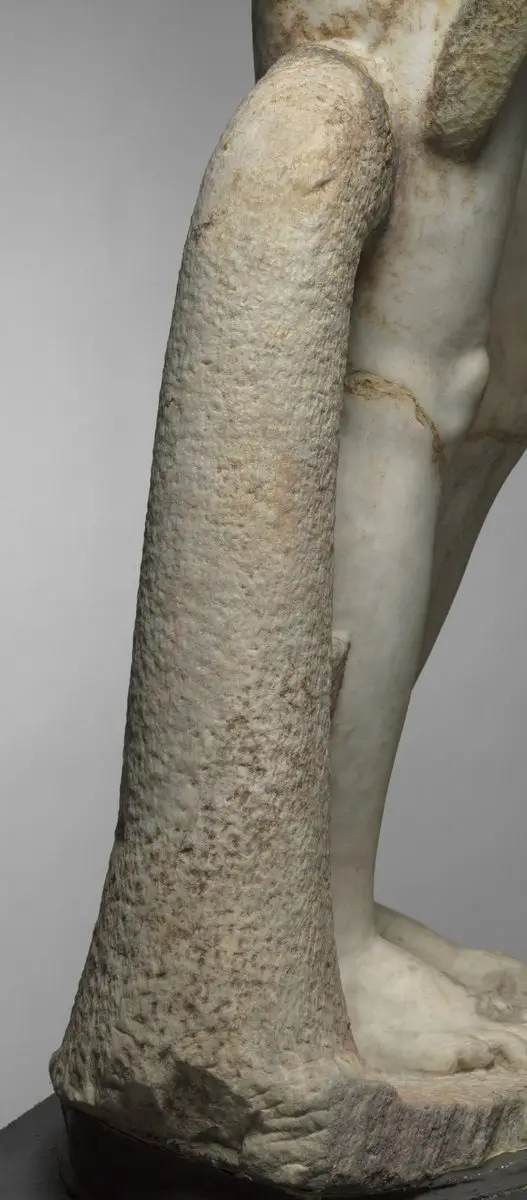
Detail of the large tree trunk beside the right leg, the support the Cleveland record names and places.
Collection: Cleveland Museum of Art, 1924.1046
Detail. The small picture marks where it sits in the whole object.
"Statue of an Athlete, the tree trunk (detail)" by Cleveland Museum of Art — https://www.clevelandart.org/art/1924.1046 — CC0 1.0 (https://creativecommons.org/publicdomain/zero/1.0/); modified: cropped to the detail of the large tree trunk beside the right leg
The Cleveland Museum of Art lists the statue as “Statue of an Athlete”, dated 1–100 CE, from “Italy, Roman”, in marble, with an overall height of 173.9 cm full text. Its accession number is 1924.1046, and the museum releases the photograph used on this page under CC0, so it can be shown here in full.
The record places the statue in a long line of copying. It says the figure “recalls Greek sculptural types” of the 400s BC, and that large athletes like it “were originally created by famous artists as sanctuary dedications” before, centuries later, they “were widely copied and adapted by Roman sculptors” full text.
The record ends its description on that double origin, calling such sculptures “made by and for Romans but descended from Greek ancestors.” It does not use the word contrapposto anywhere, and it does not name a particular Greek original for this statue, so this page does not name one either.
What the record does say about the supports is specific. The tree trunk is “beside the right leg here”, and it belongs to the “certain elements” that these sculptors added, which places it in the making of the statue rather than in its later history.
Where are the trunk and the struts?
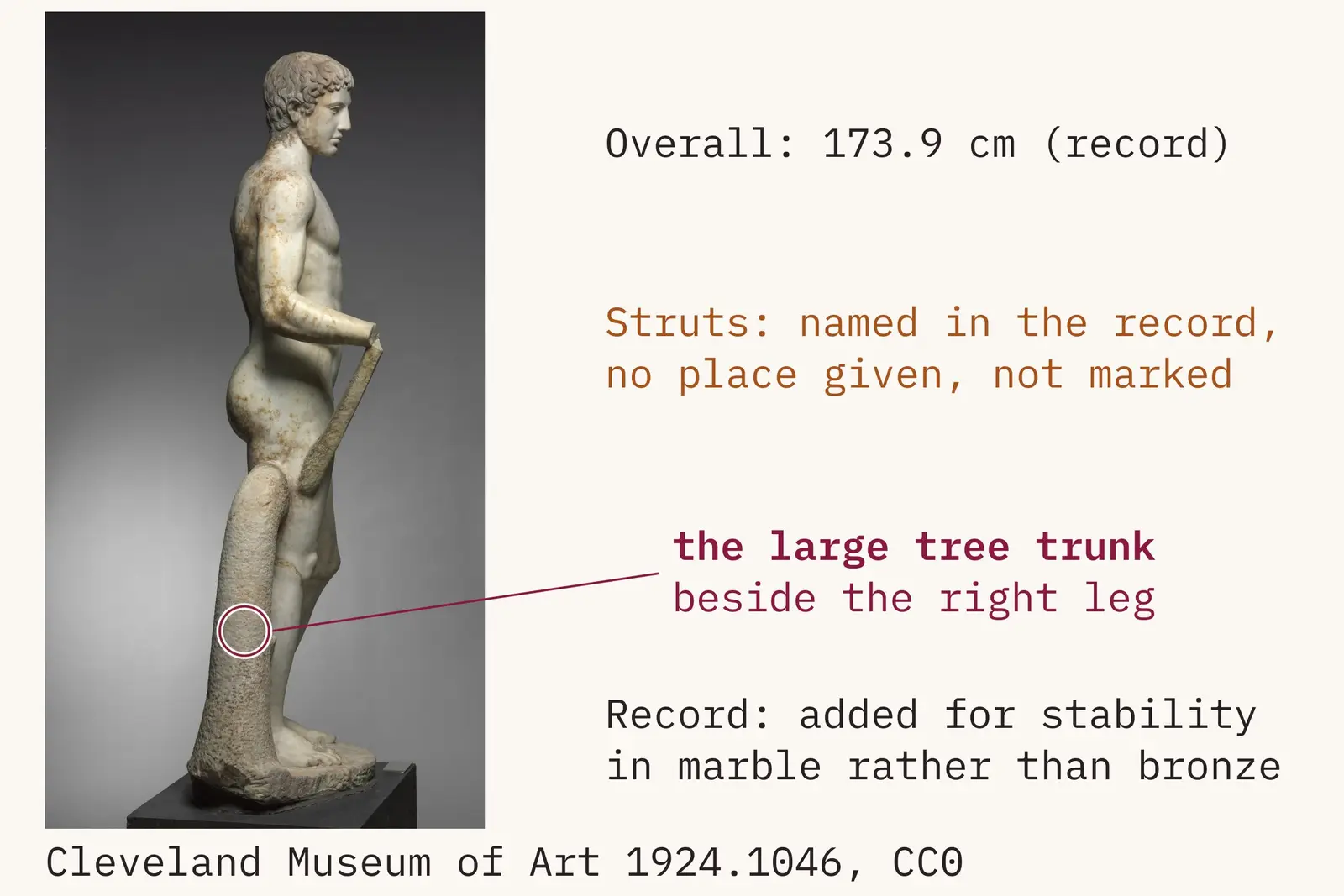
The Cleveland athlete from the side. The ring marks the large tree trunk beside the right leg; the record also names struts but gives no place for them, so none is marked.
Collection: Cleveland Museum of Art, 1924.1046
Source: photograph and record, Cleveland Museum of Art, Statue of an Athlete, 1924.1046 (CC0); the labels quote the record's sentence on the struts and the large tree trunk beside the right leg
“Statue of an Athlete: the tree trunk the record names”, Kiln, Easel & Anvil; CC BY 4.0.
Complete credit
"Statue of an Athlete: the tree trunk the record names" by Kiln, Easel & Anvil, https://kilneaselandanvil.com/sculpture/contrapposto/ — CC BY 4.0, https://creativecommons.org/licenses/by/4.0/. Base layer: "Statue of an Athlete (side view)" by Cleveland Museum of Art — https://www.clevelandart.org/art/1924.1046 — CC0 1.0 (https://creativecommons.org/publicdomain/zero/1.0/); modified: scaled to 730 of 800 frame units high and set on a paper ground, 3:2 frame, labels added: a ring on the large tree trunk and words quoting the museum record; the struts named in words only, museum, accession number and licence lettered under the photograph.
Data: Cleveland Museum of Art, Statue of an Athlete, 1924.1046, collection record (CC0)
The full sentence in the Cleveland record reads: “Working in marble rather than bronze, these sculptors added certain elements for stability, such as the struts and the large tree trunk beside the right leg here.” That sentence names two kinds of support. Only one of them is given a place on the statue.
That difference decides what this page can point to. The trunk counts as the maker’s tell here, meaning a trace on an object that shows how it was made, counted only when a museum record or a public-domain source states where it is and what caused it. The Cleveland record gives both: the place, beside the right leg, and the cause, stability in a statue made of marble.
The struts are another matter. The record names them but does not say where they are on this statue, and a photograph can show shapes without telling which of them the museum means. So the struts appear on the annotated photograph in words only and are left unmarked, following the rule for details set out on the Provenance check page.
For another marble figure whose record explains how it was put together, see the Venus de Milo, which the Louvre’s record full text describes as made of two elements joined at the hips.
What does contrapposto do to the weight?
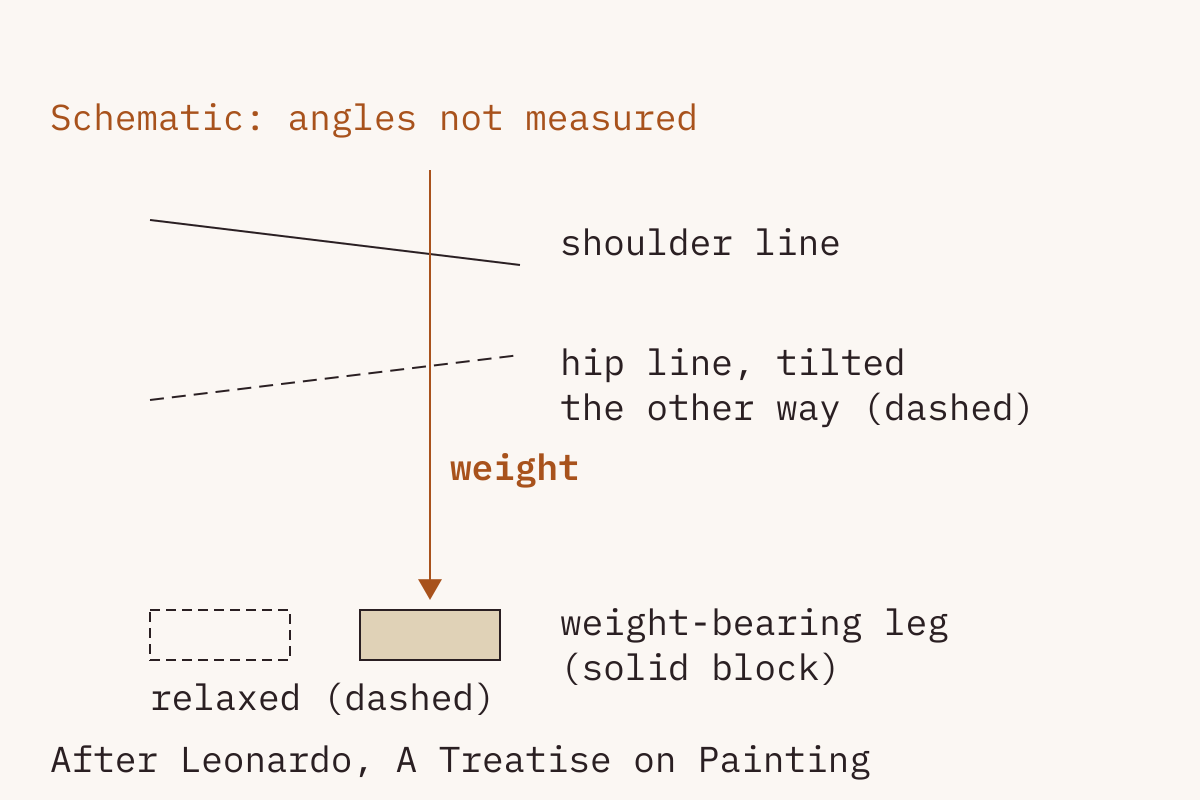 schematic
Contrapposto in lines only: the shoulders and the hips tilt in opposite directions, and the weight comes down onto one leg while the other relaxes.
Source: drawn from Leonardo da Vinci, A Treatise on Painting, translated by John Francis Rigaud (London, 1802), chapters XCVIII and XCIX; no measurements from any statue
Read the figure as text
- Solid line: the shoulder line, tilted one way.
- Dashed line: the hip line, tilted the other way.
- Arrow: the body’s weight, carried down onto one leg.
- Solid block: the weight-bearing leg.
- Dashed block: the relaxed leg.
"Contrapposto: weight on one leg, hips and shoulders tilted" by Kiln, Easel & Anvil, https://kilneaselandanvil.com/sculpture/contrapposto/ — CC BY 4.0, https://creativecommons.org/licenses/by/4.0/
Data: Leonardo da Vinci, A Treatise on Painting, translated by John Francis Rigaud (London, 1802), chapters XCVIII and XCIX (public domain); no measurements from any statue
On this page, the Italian word contrapposto is used as a label for the pose that Leonardo describes below, with the body’s weight mainly on one leg and the other leg relaxed. Leonardo da Vinci’s Treatise on Painting, in John Francis Rigaud’s English translation of 1802, describes that balance without using the word: “If the figure rest upon one leg, the shoulder on that side will be lower than the other” full text.
Chapter XCVIII goes on to say that the other leg, “being a little bent, does not support the body any more than if it were dead”. In chapter XCIX Leonardo pairs a higher right hip with a right shoulder “lower than the left”, the two opposite tilts.
In the schematic, nothing is measured from a statue, and no figure is drawn. The lines only show the two tilts and the path of the weight, which is as far as Leonardo’s two chapters go.
The Cleveland record does not explain how such a pose behaves in stone. It records that the sculptors, working in marble, added supports “for stability”, and this page keeps to that reading. The record also does not say which leg of this athlete carries the weight, so the schematic shows the pose in general rather than this statue’s stance.
The record links its athlete only to Greek types in general. Pliny’s Natural History shows how one famous standing type was described in antiquity. In the English translation by John Bostock and Henry T. Riley (1855–57), its chapter on works in brass lists a statue by Polycletus “of a youth full of manly vigour, and called the Doryphoros” scanned page. The same page, in Book XXXIV, chapter 19, adds that Polycletus “also made what the artists have called the Model statue”.
Why would bronze not need the same props?
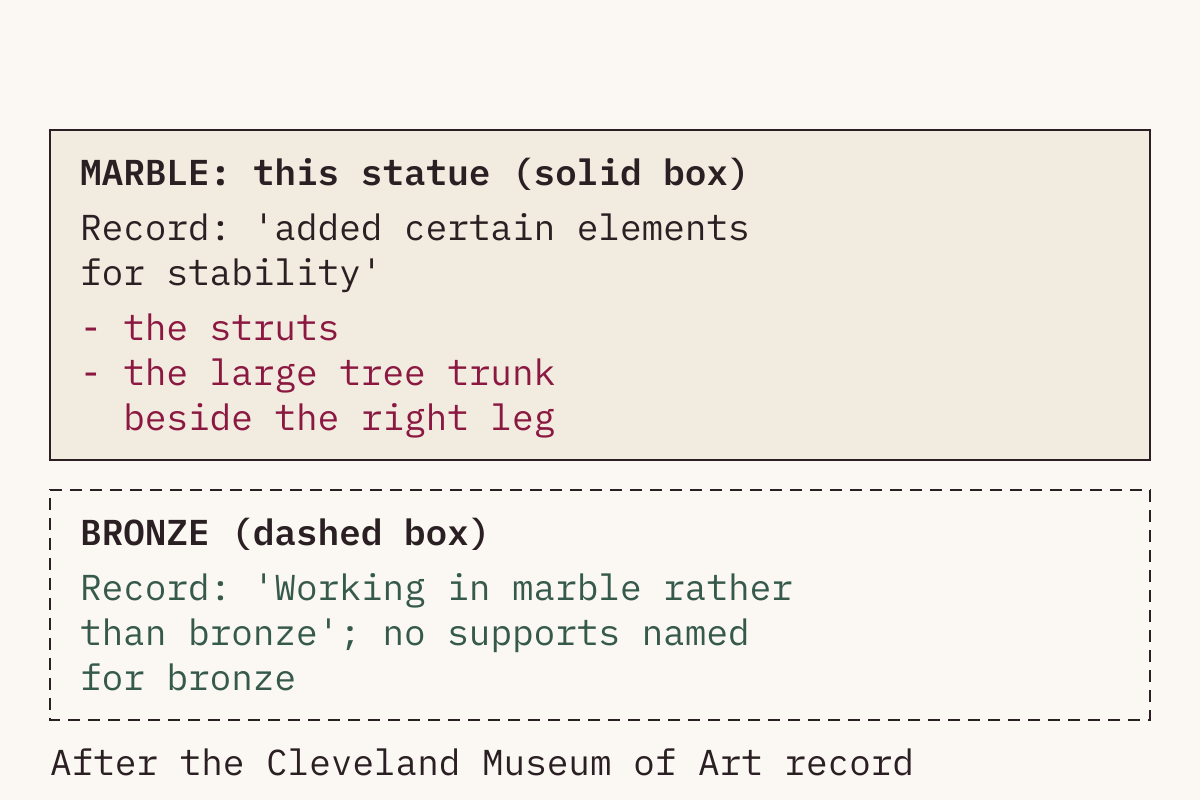
What the Cleveland record says about marble and bronze, with its words quoted in each box. The record gives the reason for the marble supports and names no supports for bronze.
Source: Cleveland Museum of Art, Statue of an Athlete, 1924.1046, record (CC0)
"Marble or bronze: what the Cleveland record says" by Kiln, Easel & Anvil, https://kilneaselandanvil.com/sculpture/contrapposto/ — CC BY 4.0, https://creativecommons.org/licenses/by/4.0/
Data: Cleveland Museum of Art, Statue of an Athlete, 1924.1046, collection record (CC0)
The Cleveland sentence sets two materials against each other: working in marble rather than bronze, these sculptors added struts and a trunk. That contrast suggests that the same kind of figure, made in bronze, could stand without such additions. The record does not say how, and this page does not add figures for the strength of either material.
How one bronze figure was made is the subject of the page on lost-wax casting. The Cleveland sentence names the difference in material and leaves the mechanics unstated.
| Element | What the record says | Place given in the record |
|---|---|---|
| Material | marble | not applicable |
| The struts | added “for stability” | none given |
| The large tree trunk | added “for stability” | “beside the right leg here” |
| Bronze | the material these sculptors did not use: “Working in marble rather than bronze” | not applicable |
| Height | “Overall: 173.9 cm” | not applicable |
Download the data (CSV, contrapposto-athlete-record.csv) (notes on this file) Data: Cleveland Museum of Art, Statue of an Athlete, 1924.1046, collection record (CC0)
Stress in glass is the subject of the page on Prince Rupert’s drop, the glass drop that Robert Hooke illustrated in Micrographia, published in 1665 scanned page.
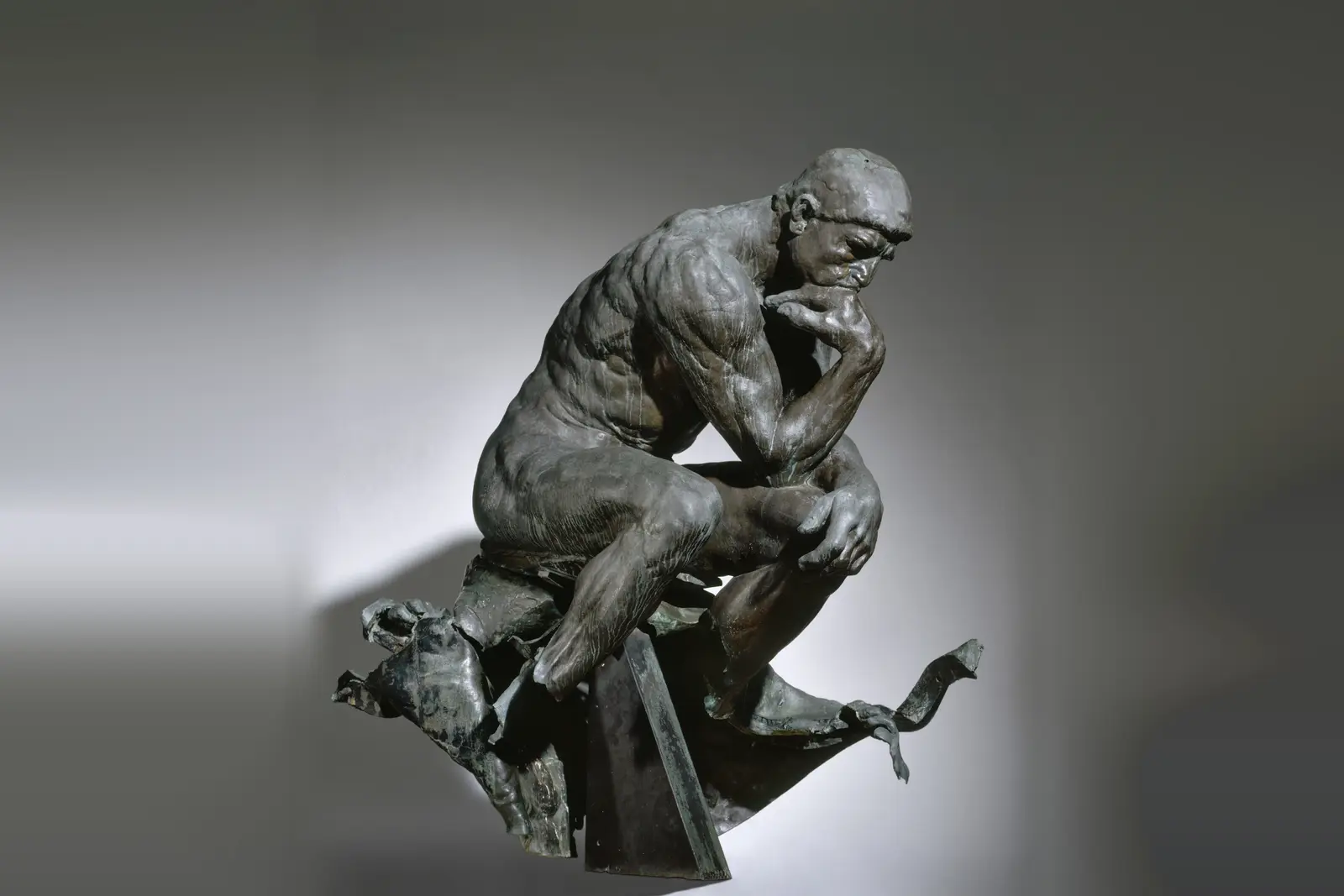
Under the loupe: look again at the large tree trunk beside the right leg, the one support that the record both names and places, then compare The Thinker, a bronze in the same museum.
Detail of the large tree trunk beside the right leg, the support the Cleveland record names and places.
Collection: Cleveland Museum of Art, 1924.1046
Detail. The small picture marks where it sits in the whole object.
"Statue of an Athlete, the tree trunk (detail)" by Cleveland Museum of Art — https://www.clevelandart.org/art/1924.1046 — CC0 1.0 (https://creativecommons.org/publicdomain/zero/1.0/); modified: cropped to the detail of the large tree trunk beside the right leg
Sources and reading levels
- Cleveland Museum of Art, Statue of an Athlete, 1–100 CE, marble, accession number 1924.1046, collection online record (CC0) www.clevelandart.org/art/1924.1046Read: full textText licence: CC0 1.0 (terms)
- Musée du Louvre, collections notice 'Vénus de Milo', LL 299; N 527; Ma 399, Département des Antiquités grecques, étrusques et romaines (last updated 17 April 2026); quotations in French, with the English translated here collections.louvre.fr/ark:/53355/cl010277627Read: full textText licence: Licence Ouverte / Open Licence 2.0 (Etalab) (terms)
- Leonardo da Vinci, A Treatise on Painting, translated by John Francis Rigaud (London: J. Taylor, 1802), chapters XCVIII and XCIX; public domain in the US and EU (published 1802; Leonardo died 1519, and a translator already a Royal Academician in 1802 cannot have died later than 1955) www.gutenberg.org/ebooks/46915Read: full text
- Pliny the Elder, The Natural History of Pliny, translated by John Bostock and Henry T. Riley, vol. 6 (London: H. G. Bohn, 1855–57), Book XXXIV, chapter 19, p. 171; public domain in the US and EU (Riley died 1878) archive.org/details/naturalhistoryof06plinrichRead: scanned page
- Hooke, Robert, Micrographia (London: Jo. Martyn and Ja. Allestry, 1665), Schem. IIII, engraved plate with Fig. X and Fig. Y. Getty Research Institute copy, scanned for the Internet Archive. Public domain in the US and EU (Hooke died 1703) archive.org/details/micrographiaorso00hook_4Read: scanned page; Schem. IIII (leaf n55)
More objects in Sculpture
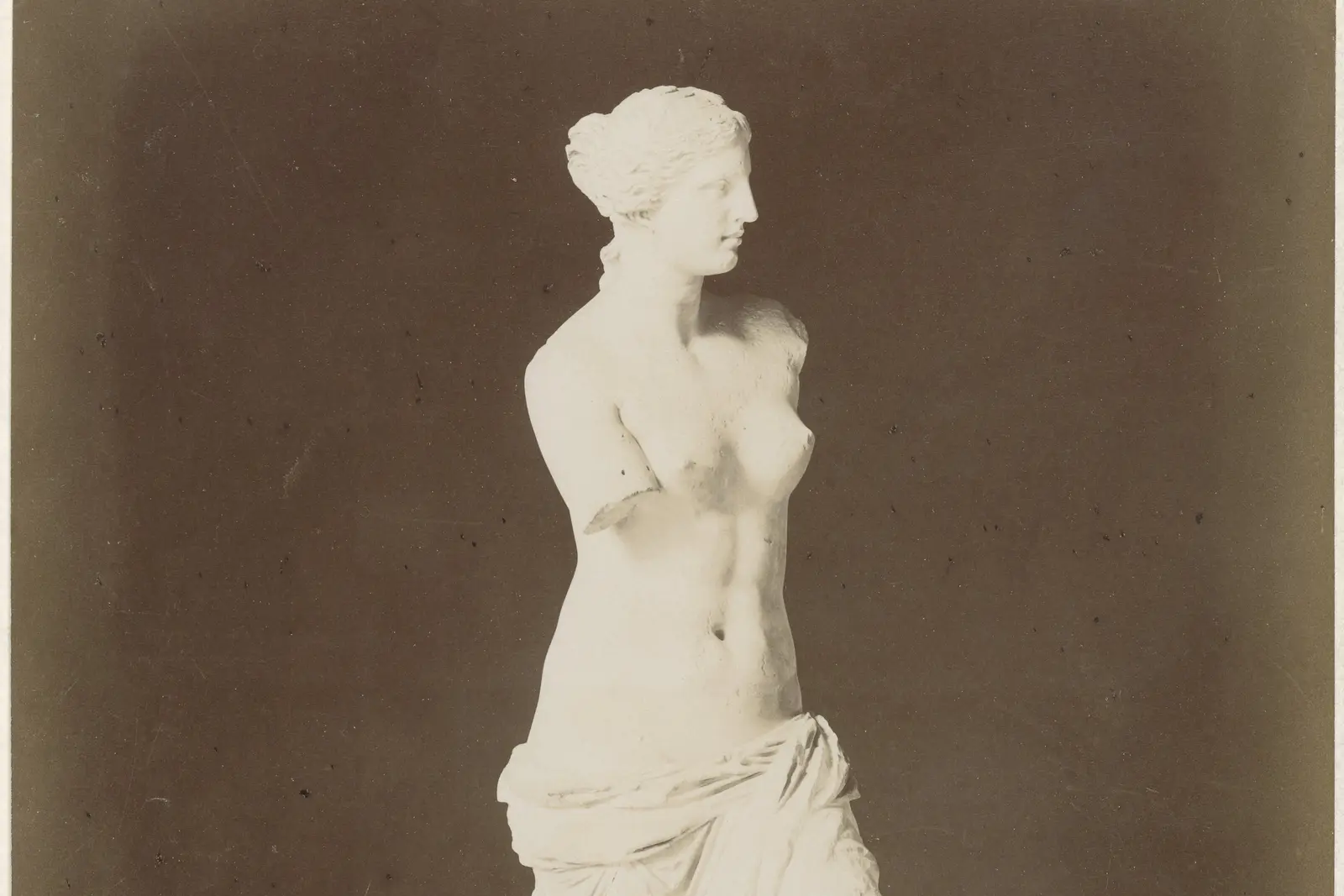
Object reading
Venus de Milo: Joined at the Hips, per the Louvre's Record
Catalogued
Picture credit
"Venus van Milo, Louvre. Musée du Louvre. - La Vénus de Milo" by Rijksmuseum — https://commons.wikimedia.org/wiki/File:Venus_van_Milo,_Louvre_Mus%C3%A9e_du_Louvre._-_La_V%C3%A9nus_de_Milo_(titel_op_object),_RP-F-F16588.jpg — CC0 1.0 (http://creativecommons.org/publicdomain/zero/1.0/deed.en); modified: cropped to a 3:2 frame from the top of the head to the hip line, with the printed caption line left out
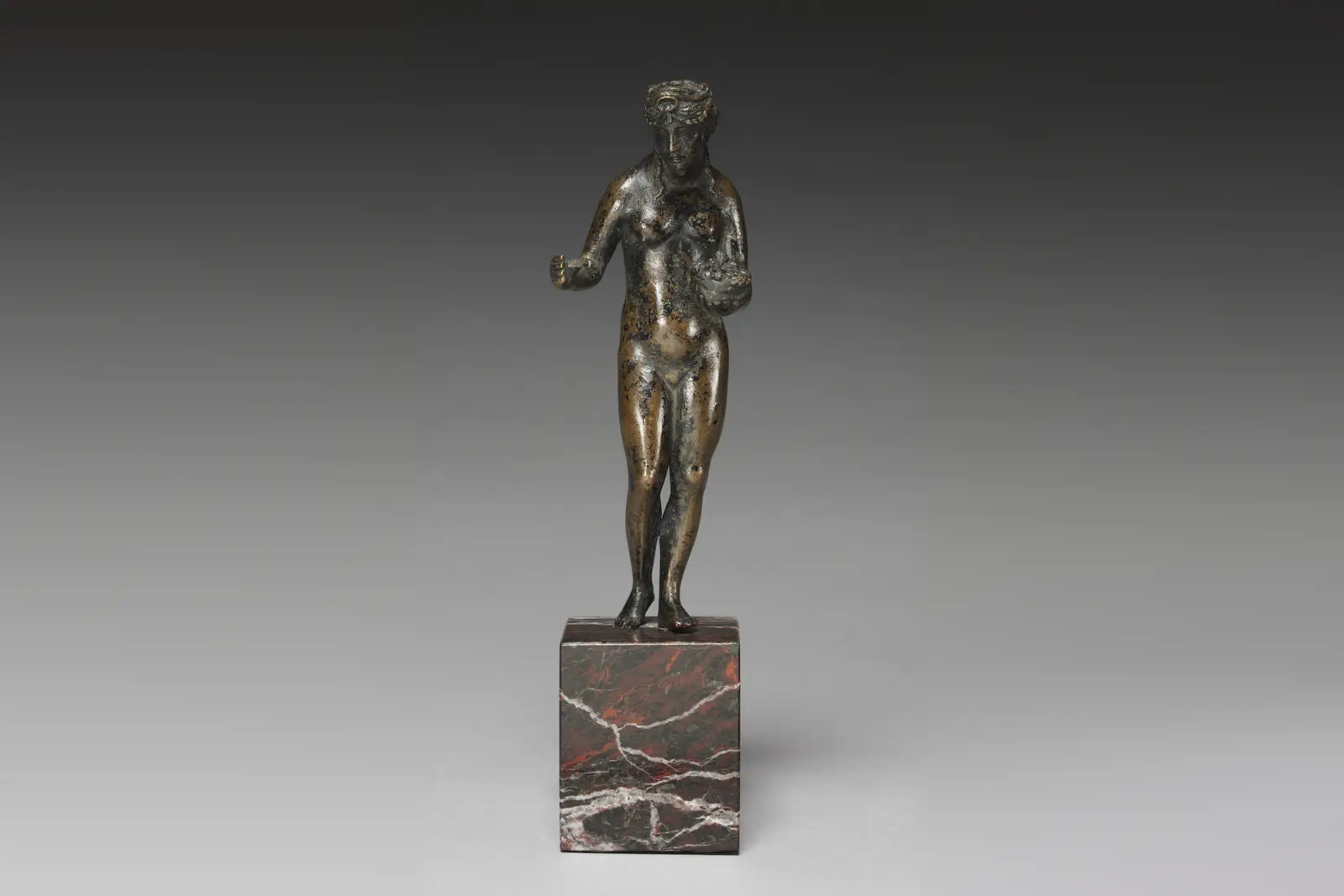
Technique, diagrammed
Lost Wax Casting: Cellini's Own Account of His Perseus
Catalogued
Picture credit
"Pomona, circle of Andrea Riccio (card)" by Cleveland Museum of Art — https://www.clevelandart.org/art/1948.486 — CC0 1.0 (https://creativecommons.org/publicdomain/zero/1.0/); modified: padded with the photograph's own background to a 3:2 frame, left and right, with a feathered seam
Object reading
The Thinker: Cleveland Chose Not to Repair Its 1970 Damage
Catalogued
Picture credit
"The Thinker, Auguste Rodin (card)" by Cleveland Museum of Art — https://www.clevelandart.org/art/1917.42 — CC0 1.0 (https://creativecommons.org/publicdomain/zero/1.0/); modified: padded with the photograph's own background to a 3:2 frame, left and right, with a feathered seam
Cite this page
Kiln, Easel & Anvil. “Contrapposto: The One-Leg Stance Leonardo Describes.” Published 28 November 2026. https://kilneaselandanvil.com/sculpture/contrapposto/ (accessed on the day you read it).
How a record is checked Every correction, dated Report an error on this page (contact@kilneaselandanvil.com)