Girl with a Pearl Earring: No Hook, per the Mauritshuis
Short answer
Per the Mauritshuis study published in 2020, Vermeer's pearl is an illusion built from translucent and opaque strokes, with no hook connecting it to the earlobe. Look below her ear in the picture, at a bright highlight above a softer reflection.
Object record
- Object
- Girl with a Pearl Earring (Meisje met de parel)
- Maker
- Johannes Vermeer (Delft 1632 - 1675 Delft)
- Date
- c. 1665
- Material
- oil on canvas (technique: oil; material: canvas)
- Dimensions
- 44.5 x 39 cm, as published (axes not named on the page)
- Collection
- Mauritshuis, The Hague, 670
This record as CSV (girl-with-a-pearl-earring-record.csv) (notes on this file)
Data: Mauritshuis object page 670, Girl with a Pearl Earring; Wikimedia Commons file page File:Meisje_met_de_parel.jpg, Title field (Dutch title)
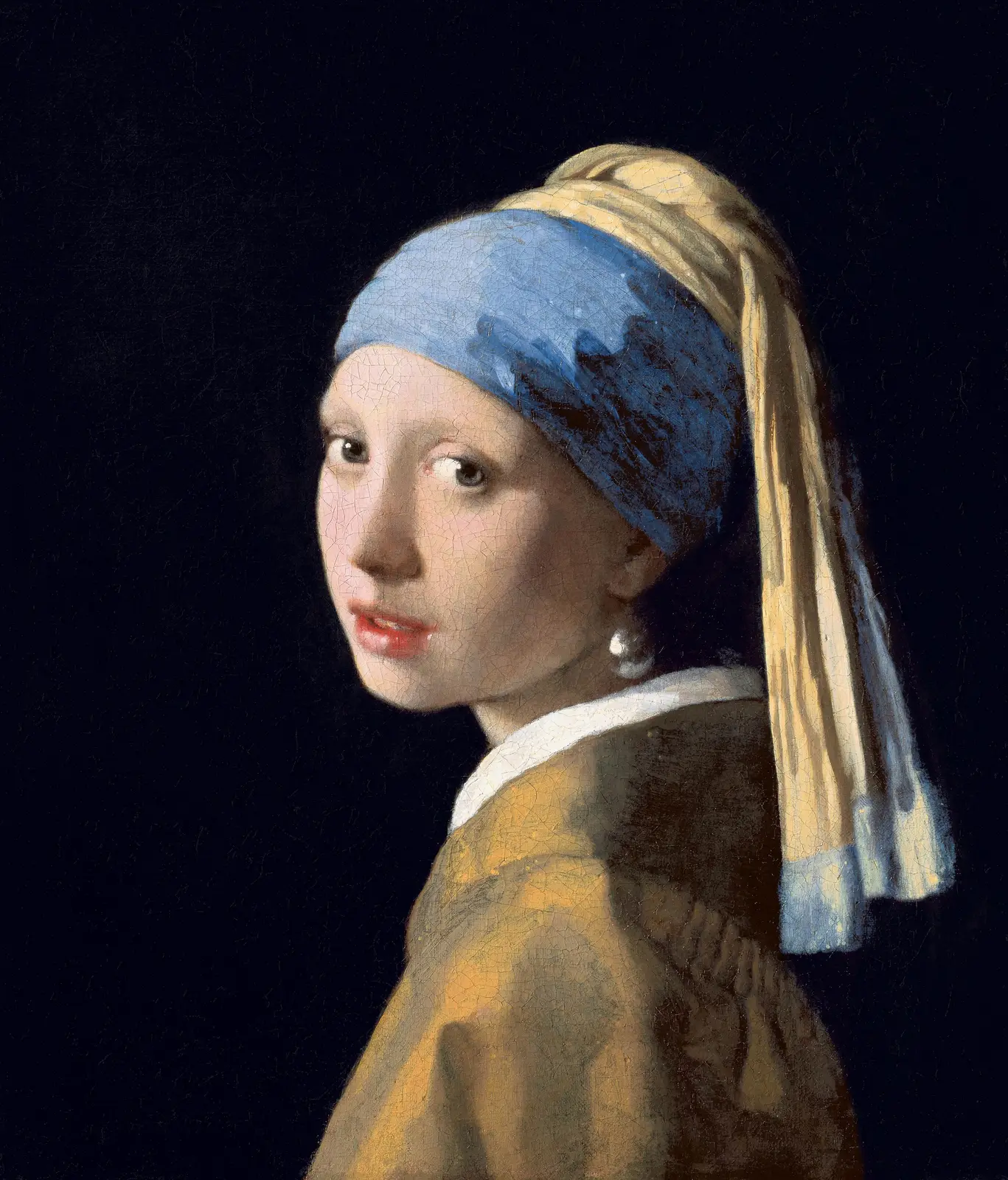
Girl with a Pearl Earring (Meisje met de parel), which the Mauritshuis dates c. 1665 and lists as oil on canvas, 44.5 x 39 cm.
Collection: Mauritshuis, The Hague, 670
"Girl with a Pearl Earring" by Mauritshuis, The Hague — https://commons.wikimedia.org/wiki/File:Meisje_met_de_parel.jpg — Public domain (US: published before 1931; DE/FR: Vermeer died in 1675 per the Mauritshuis object page 670, more than 70 years ago; faithful reproduction of a two-dimensional work)
Card and share picture, a 3:2 copy of this object’s photograph: "Girl with a Pearl Earring (card)" by Mauritshuis, The Hague — https://commons.wikimedia.org/wiki/File:Meisje_met_de_parel.jpg — Public domain (US: published before 1931; DE/FR: Vermeer died in 1675 per the Mauritshuis object page 670, more than 70 years ago; faithful reproduction of a two-dimensional work); modified: cropped to a 3:2 frame from the centre (full width, 4095 by 2730 pixels, from 1032 pixels down) and reduced to 2400 by 1600 pixels
The pearl on the girl's ear is a few touches of white paint and nothing more. A press release from the Mauritshuis in The Hague, the museum that holds the painting, reports that “the hook to hang the ‘pearl’ from her ear is missing” full text. Look just beneath the earlobe, the place where that missing hook would have to be painted.
The museum's page for the painting full text, inventory number 670, identifies the painter as Johannes Vermeer, who was born and died in Delft (1632 and 1675). It dates the picture c. 1665 and describes it as oil on canvas measuring 44.5 x 39 cm. Because the page does not specify which measurement is the height, this page relies on the upright format of the canvas, which is consistent with 44.5 centimetres being the vertical dimension.
As for who she is, the same page explains that the picture “is not a portrait, but a ‘tronie’ – a painting of an imaginary figure”, meaning a study of a head representing a type or character, in this case a girl wearing a turban. Its catalogue text acknowledges that “there would probably be a sitter”, while the 2020 release describes the girl's identity as an unanswered question, so this page does not offer a guess.
Where are the three details?
In February and March 2018, an international team of scientists and conservators carried out a technical examination of the painting at the Mauritshuis, in a research project the museum called the Girl in the Spotlight. According to the release, the team combined “non-invasive imaging and scanning techniques, digital microscopy and paint sample analysis”. The museum's announcement of 28 April 2020 reports the results. Three of the findings come with a specific location on the canvas.
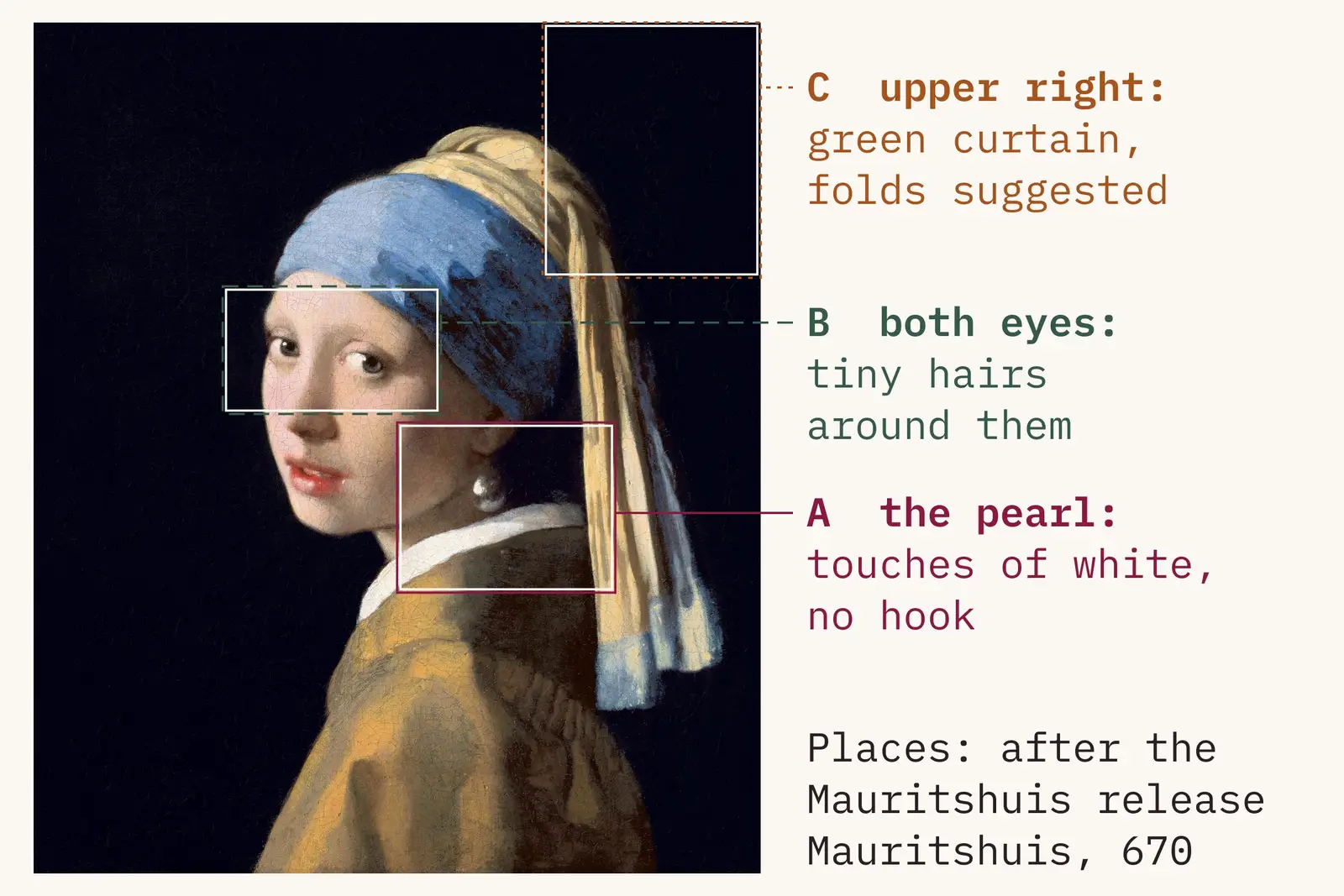
The whole painting with the three crops used on this page: A, the pearl (solid frame); B, both eyes (dashed frame); C, the upper right-hand corner (dotted frame). Each place is named in a Mauritshuis text.
Collection: Mauritshuis, The Hague, 670
Source: Mauritshuis press release, 28 April 2020, and the Mauritshuis object page for inventory number 670
“Girl with a Pearl Earring: where the three crops sit”, Kiln, Easel & Anvil; CC BY 4.0.
Complete credit
"Girl with a Pearl Earring: where the three crops sit" by Kiln, Easel & Anvil, https://kilneaselandanvil.com/paintings/girl-with-a-pearl-earring/ — CC BY 4.0, https://creativecommons.org/licenses/by/4.0/. Base layer: "Girl with a Pearl Earring" by Mauritshuis, The Hague — https://commons.wikimedia.org/wiki/File:Meisje_met_de_parel.jpg — Public domain (US: published before 1931; DE/FR: Vermeer died in 1675 per the Mauritshuis object page 670, more than 70 years ago; faithful reproduction of a two-dimensional work); modified: scaled to 760 of 800 frame units high and set on a paper ground, 3:2 frame, labels added: three frames at the crop boxes of this page (solid, dashed, dotted) with words from the Mauritshuis texts, source name and inventory number lettered beside the photograph.
Data: Mauritshuis press release, 'Closer to Vermeer and the Girl' (published 28 April 2020); Mauritshuis object page 670, Girl with a Pearl Earring
A high-resolution photograph is a legitimate way to examine these locations, although for one of them even a detailed photograph is not enough. The release notes that, to an unaided viewer, the girl “has always appeared to have had no eyelashes”, which is why the study depended on specialised instruments to detect them.
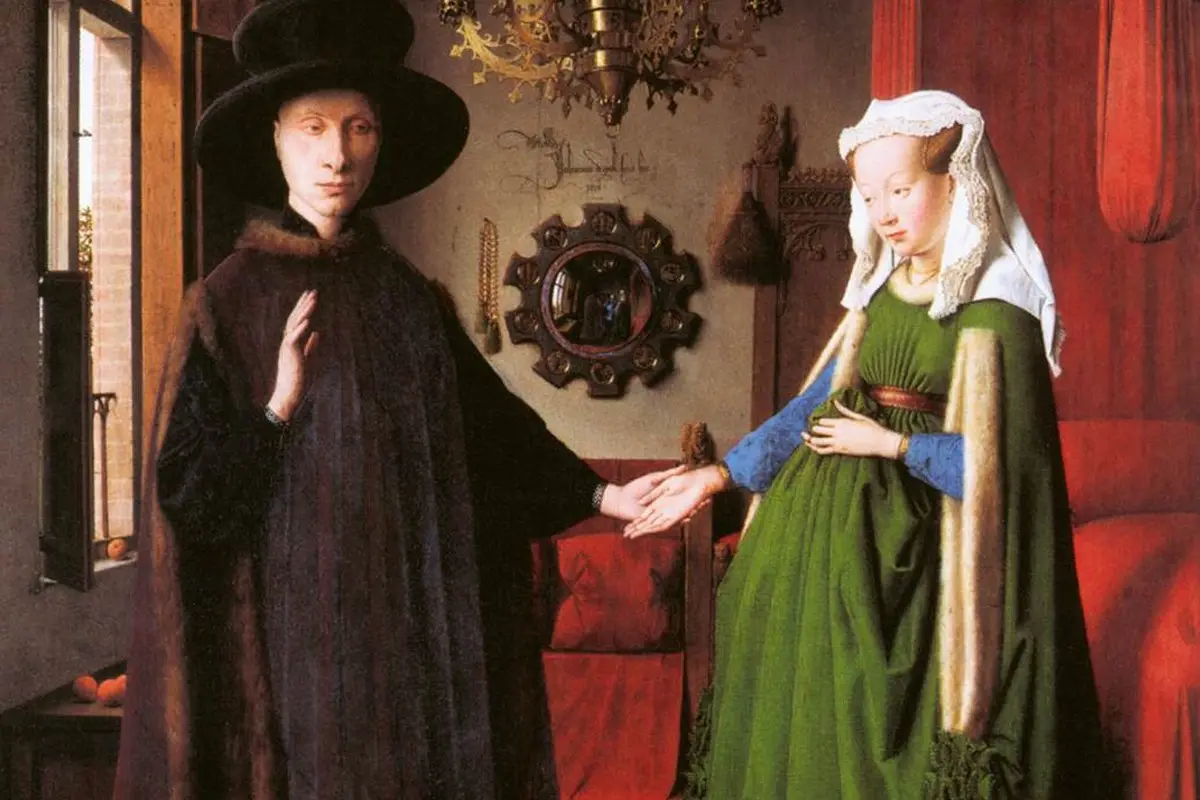
Each crop below comes from the same photograph, and each frame on the map marks the area that crop covers. For another painting examined in the same way, one documented detail at a time, see the Arnolfini Portrait.
How is the pearl painted?
The release calls the pearl “an illusion – translucent and opaque touches of white paint”, and the catalogue text on the museum's page is more precise about where the white is placed. According to that text, the pearl “consists of little more than two brushstrokes: a bright highlight at upper left and the soft reflection of the white collar on the underside.”
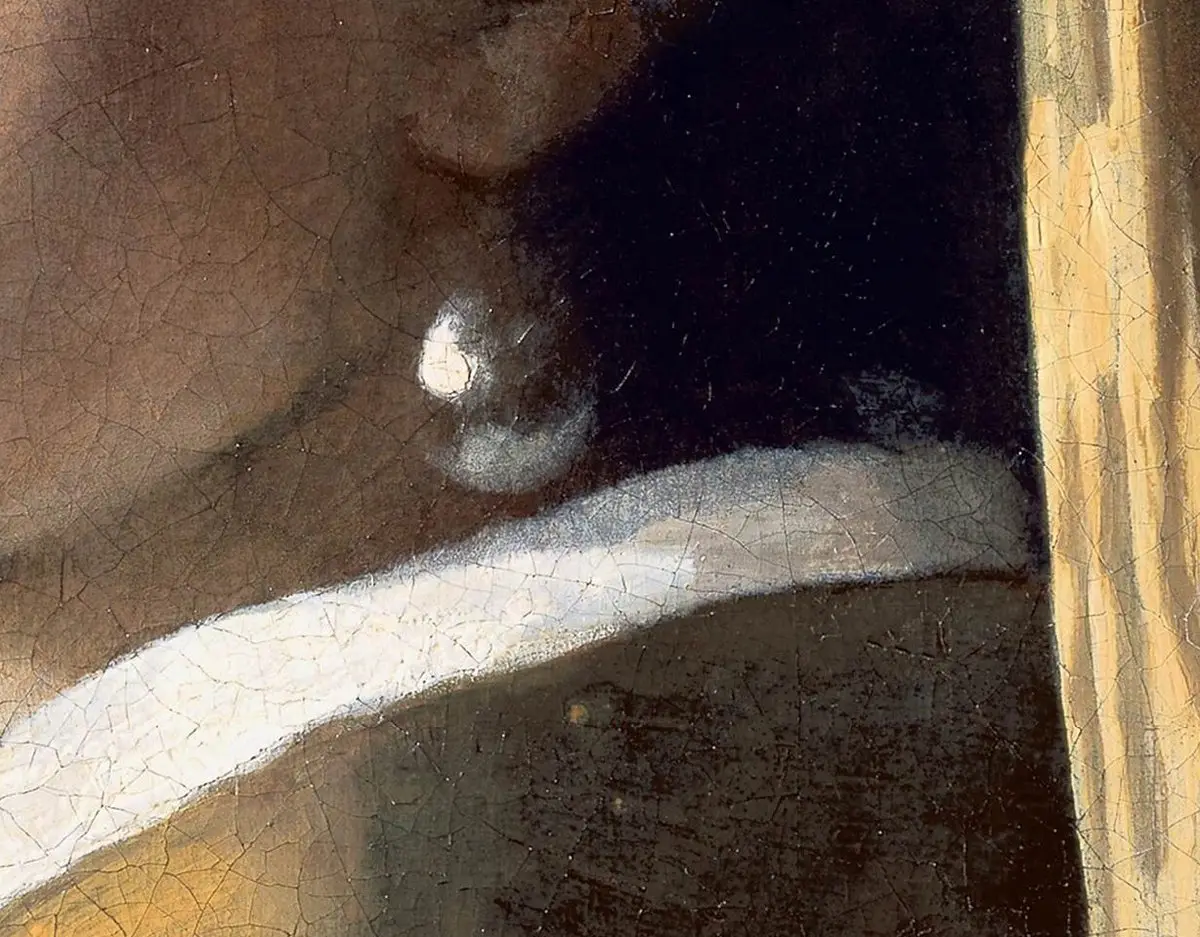
The pearl below her ear. The Mauritshuis catalogue text places a bright highlight at its upper left and the reflection of the white collar on its underside.
Collection: Mauritshuis, The Hague, 670
Detail. The small picture marks where it sits in the whole object.
“Girl with a Pearl Earring, the pearl (detail)”, Johannes Vermeer / Mauritshuis, The Hague; public domain.
Complete credit
"Girl with a Pearl Earring, the pearl (detail)" by Mauritshuis, The Hague — https://commons.wikimedia.org/wiki/File:Meisje_met_de_parel.jpg — Public domain (US: published before 1931; DE/FR: Vermeer died in 1675 per the Mauritshuis object page 670, more than 70 years ago; faithful reproduction of a two-dimensional work); modified: cropped to the detail of the pearl below the ear (x 0.5, y 0.47, width 0.3, height 0.2 of the whole picture), long side 1200 pixels
A shorter story on the same page counts two strokes of white paint, “one at the bottom to reflect the collar and a thick dab at the top”, and concludes: “There is nothing more, not even a silver hook.” The two descriptions position the highlight slightly differently, one at the upper left and the other at the top, and both are reported here exactly as the museum published them.
Follow the crop downward from the highlight to the collar. Per the catalogue text, the lower glow is the reflection of the white collar, which the same text describes as “painted in impasto”, meaning with paint applied thickly enough to stand up from the surface. That reflection ties the pearl to the collar beneath it, while nothing painted ties the pearl to the ear.
The pearl was also one of the final additions. According to the release, Vermeer worked “from the background to the foreground”, painting the greenish background and the skin of the face first and then, successively, her yellow jacket, the white collar, the headscarf and the pearl.
Was it a real pearl?
The museum's page states that the pearl “is too large to be real”, and its catalogue text offers two possible explanations. Perhaps the girl wears “a pearl drop made of glass, which has been varnished to give it a matte sheen”, or perhaps the pearl was “a product of Vermeer’s imagination”.
The shorter story on the same page is more definite, calling it “probably an imitation pearl”. The museum's texts therefore leave the question unresolved, although they agree about what is on the canvas: white paint, and no hook.
What did the study find around the eyes?
The release describes the eyes as the examination revealed them: “While to the naked eye the Girl has always appeared to have had no eyelashes, macro-X-ray fluorescence scanning and microscopic examination also revealed that Vermeer painted tiny hairs around both eyes”.
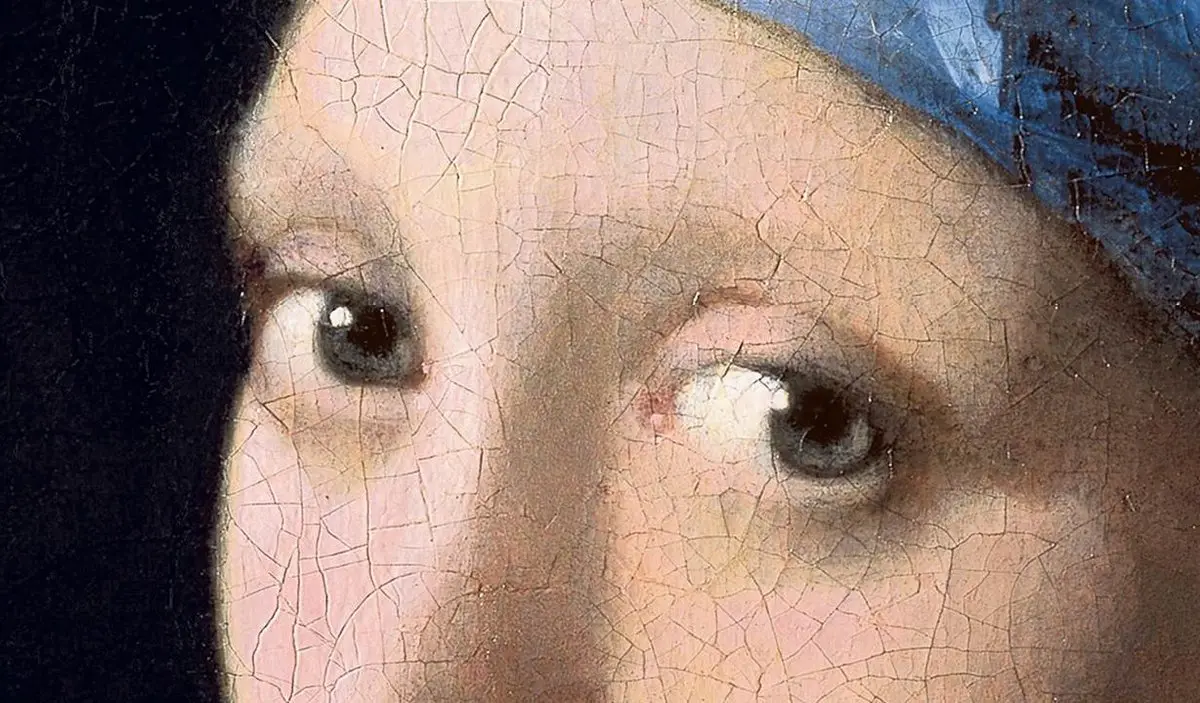
Both eyes, where the Mauritshuis study found tiny painted hairs that, the release says, the naked eye does not see.
Collection: Mauritshuis, The Hague, 670
Detail. The small picture marks where it sits in the whole object.
“Girl with a Pearl Earring, both eyes (detail)”, Johannes Vermeer / Mauritshuis, The Hague; public domain.
Complete credit
"Girl with a Pearl Earring, both eyes (detail)" by Mauritshuis, The Hague — https://commons.wikimedia.org/wiki/File:Meisje_met_de_parel.jpg — Public domain (US: published before 1931; DE/FR: Vermeer died in 1675 per the Mauritshuis object page 670, more than 70 years ago; faithful reproduction of a two-dimensional work); modified: cropped to the detail of both eyes (x 0.26, y 0.31, width 0.3, height 0.15 of the whole picture), long side 1200 pixels
The catalogue text describes the same eyes in more ordinary language, noting that “there is a gleam in her greyish-blue eyes”. According to the release, the hairs were identified through scanning and microscopy, not by the naked eye, so a sharper photograph is not where this page looks for them.
The release counts these hairs among the discoveries that make the girl “more ‘personal’ than previously thought”. It also documents changes made during the painting process: “the position of the ear, the top of the headscarf and the back of the neck were shifted.”
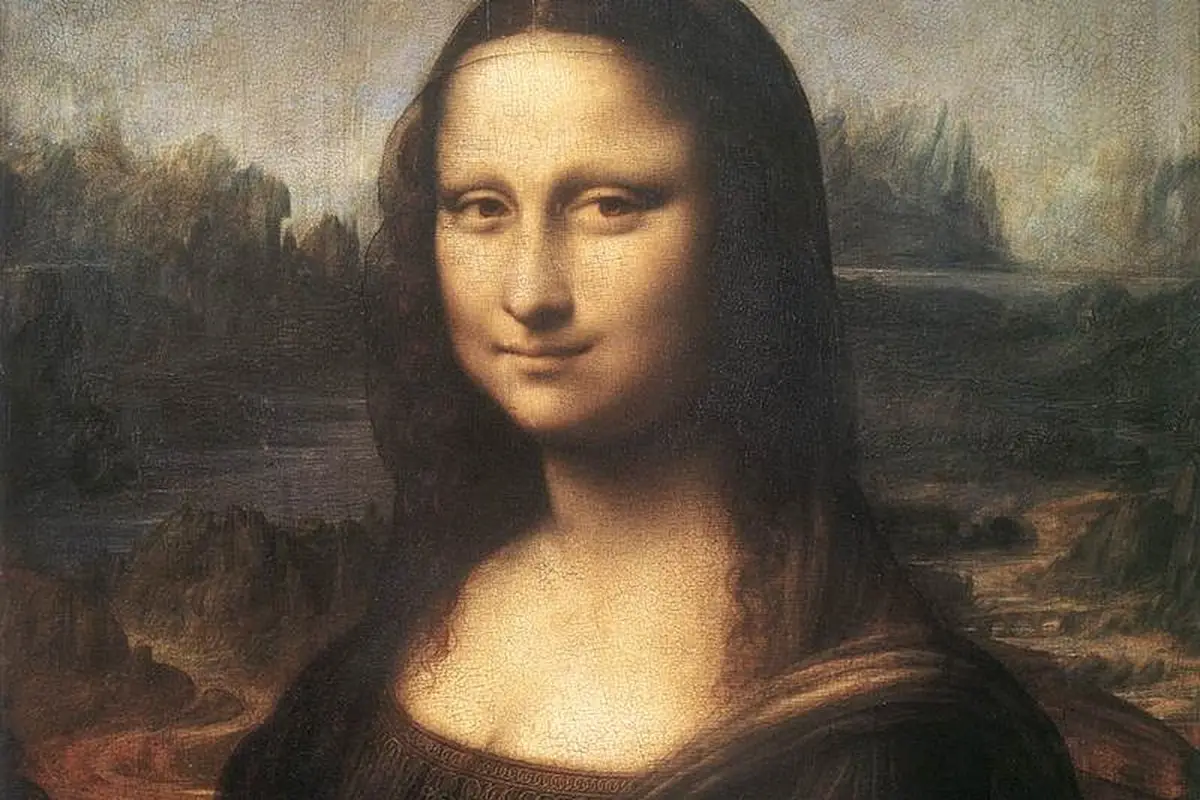
Infrared imaging revealed broad, vigorous brushstrokes in underlayers of brown and black that now lie beneath the visible paint, and according to the release Vermeer drew “the contours of the Girl with thin black lines”. Girl with a Pearl Earring is painted on canvas; for a portrait that the Louvre's record gives as painted on a wooden board, see the Mona Lisa.
What is behind her?
The dark background is not what Vermeer originally painted. The release states it directly: “the background is not simply an empty dark space; Vermeer painted the Girl in front of a green curtain.”
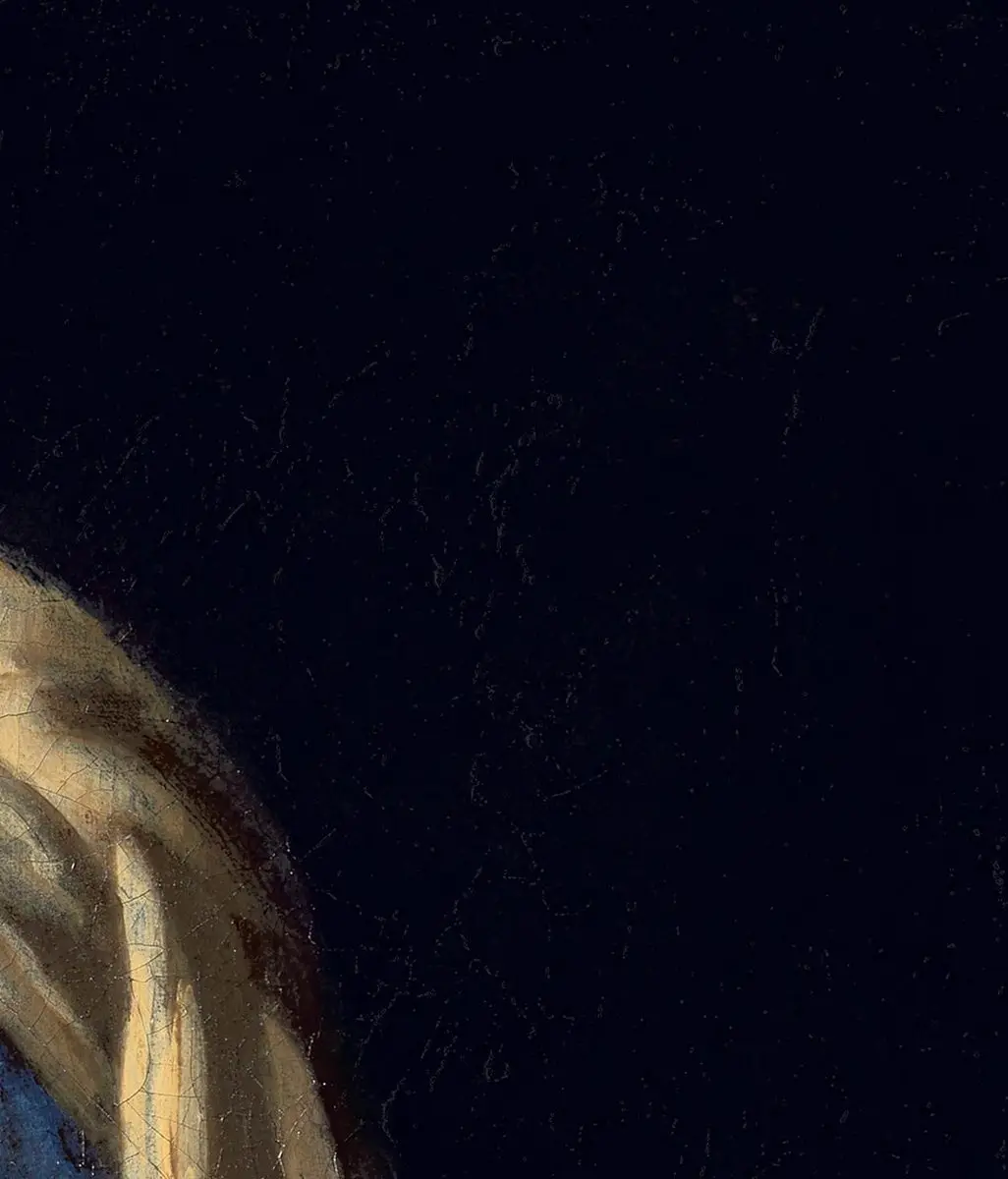
The upper right-hand corner, where the Mauritshuis release says imaging found signs of folded fabric from a green curtain.
Collection: Mauritshuis, The Hague, 670
Detail. The small picture marks where it sits in the whole object.
“Girl with a Pearl Earring, upper right-hand corner (detail)”, Johannes Vermeer / Mauritshuis, The Hague; public domain.
Complete credit
"Girl with a Pearl Earring, upper right-hand corner (detail)" by Mauritshuis, The Hague — https://commons.wikimedia.org/wiki/File:Meisje_met_de_parel.jpg — Public domain (US: published before 1931; DE/FR: Vermeer died in 1675 per the Mauritshuis object page 670, more than 70 years ago; faithful reproduction of a two-dimensional work); modified: cropped to the detail of the upper right-hand corner (x 0.7, y 0, width 0.3, height 0.3 of the whole picture), long side 1200 pixels
According to the release, imaging “visualised diagonal lines and colour variations that suggest folded fabric in the upper right-hand corner of the painting”, and “The curtain has disappeared over the course of the centuries”.
The release places the folds in the imaging rather than on the visible surface, so this page marks the corner on the map and leaves the description to the museum.
Where is the signature?
On the opposite side of the canvas, the museum's page records the signature as “IVMeer”, placed upper left, with the letters IVM joined in a ligature, and the release locates it “in the upper left-hand corner”. This page shows no crop of the signature.
The painting also reached the public relatively late. The catalogue text says it “has been known to the general public only since 1881”, and the provenance on the same page concludes with a bequest from Arnoldus Andries des Tombe of The Hague, recorded under 1903. For a craft associated with Vermeer's own town, see the tin-glazed pottery on Delftware.
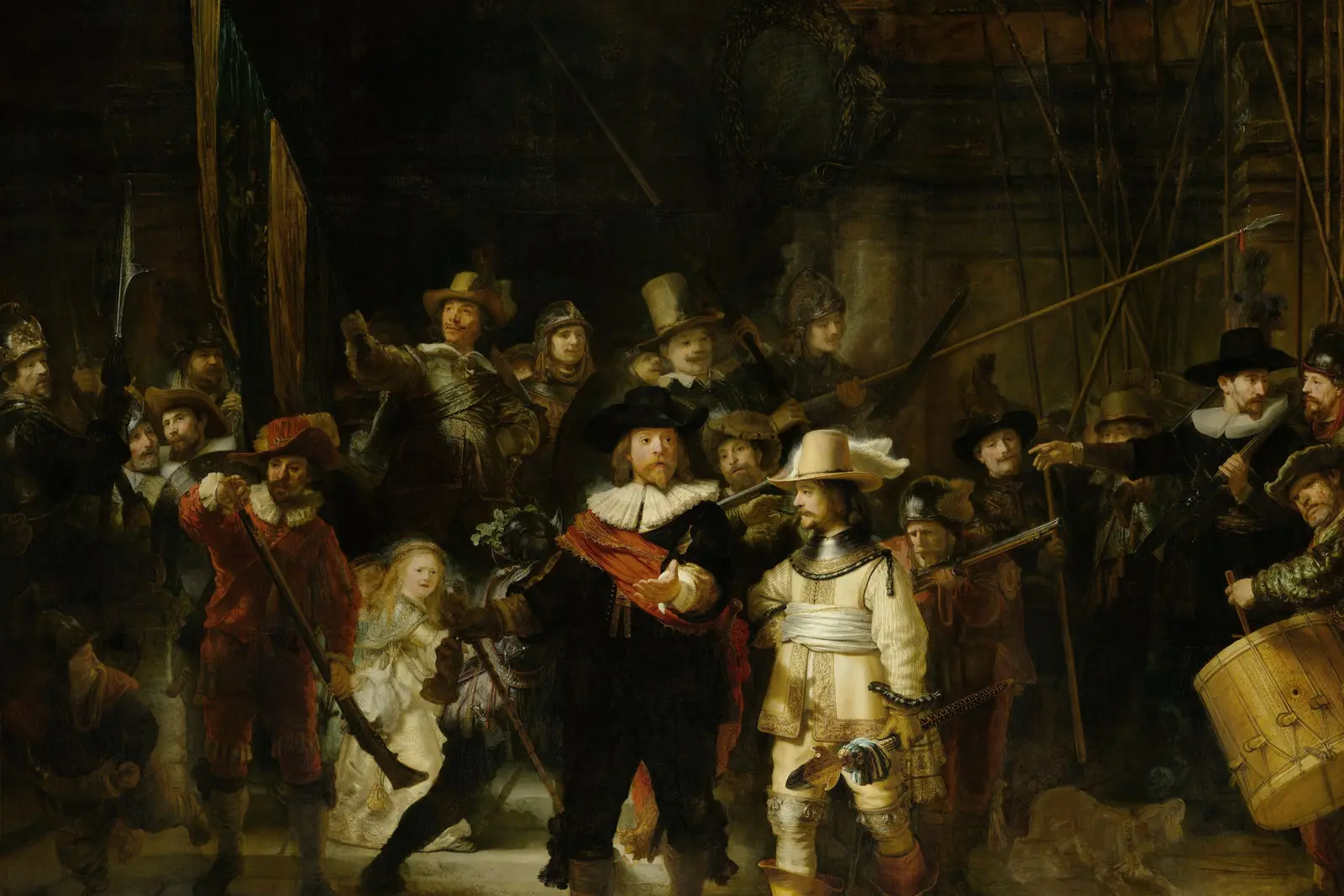
Under the loupe: go back to the pearl's underside, where the catalogue text places the soft reflection of the white collar, then compare the strips cut from The Night Watch in 1715, per the Rijksmuseum.
The pearl below her ear. The Mauritshuis catalogue text places a bright highlight at its upper left and the reflection of the white collar on its underside.
Collection: Mauritshuis, The Hague, 670
Detail. The small picture marks where it sits in the whole object.
“Girl with a Pearl Earring, the pearl (detail)”, Johannes Vermeer / Mauritshuis, The Hague; public domain.
Complete credit
"Girl with a Pearl Earring, the pearl (detail)" by Mauritshuis, The Hague — https://commons.wikimedia.org/wiki/File:Meisje_met_de_parel.jpg — Public domain (US: published before 1931; DE/FR: Vermeer died in 1675 per the Mauritshuis object page 670, more than 70 years ago; faithful reproduction of a two-dimensional work); modified: cropped to the detail of the pearl below the ear (x 0.5, y 0.47, width 0.3, height 0.2 of the whole picture), long side 1200 pixels
Sources and reading levels
- Mauritshuis, 'Closer to Vermeer and the Girl: New discoveries and insights from the international scientific examination of Vermeer’s Girl with a Pearl Earring', press release, 28 April 2020 www.mauritshuis.nl/en/press-releases/closer-to-vermeer-a…Read: full text
- Mauritshuis, object page 670, Johannes Vermeer, Girl with a Pearl Earring, c. 1665 (details, catalogue text and provenance) www.mauritshuis.nl/en/our-collection/artworks/670-girl-w…Read: full text
- Rijksmuseum, 'For the first time in 300 years The Night Watch is complete again', press release, 23 June 2021 www.rijksmuseum.nl/en/press/press-releases/for-the-first…Read: full text
More objects in Paintings
Object reading
The Night Watch: How Much of the Canvas Was Cut in 1715
Catalogued
Picture credit
"The Night Watch (card)" by Rembrandt van Rijn — https://commons.wikimedia.org/wiki/File:The_Nightwatch_by_Rembrandt_-_Rijksmuseum.jpg — Public domain (US: published before 1931; DE/FR: Rembrandt died in 1669 per the Commons creator template on the file page, more than 70 years ago; faithful reproduction of a two-dimensional work); modified: cropped to a 3:2 frame from the centre (full width, 14168 by 9445 pixels) and reduced to 2400 by 1600 pixels
Object reading
Arnolfini Portrait: Two Figures at the Door, per Weale
Catalogued
Picture credit
"Portrait of Giovanni Arnolfini and his Wife (Jan van Eyck)" by Jan van Eyck — https://commons.wikimedia.org/wiki/File:Jan_van_Eyck_-_Portrait_of_Giovanni_Arnolfini_and_his_Wife_-_WGA7689.jpg — Public domain (US: published before 1931; DE/FR: Jan van Eyck died in 1441 per the Commons creator template on the file page (not checked against a library record), more than 70 years ago; faithful reproduction of a two-dimensional work); modified: cropped to a 3:2 frame from 150 px below the top edge (heads, mirror and hands), enlarged from 1,035 to 1,200 px wide
Technique, diagrammed
Mona Lisa: Painted on Poplar, Not Canvas, per the Louvre
Catalogued
Picture credit
"Mona Lisa (Leonardo da Vinci)" by Leonardo da Vinci — https://commons.wikimedia.org/wiki/File:Leonardo_da_Vinci_-_Mona_Lisa_(La_Gioconda)_-_WGA12712.jpg — Public domain (US: published before 1931; DE/FR: Leonardo da Vinci died in 1519 per the Louvre collection record, more than 70 years ago; faithful reproduction of a two-dimensional work); modified: cropped to a 3:2 frame from 120 px below the top edge (face), enlarged from 800 to 1,200 px wide
Cite this page
Kiln, Easel & Anvil. “Girl with a Pearl Earring: No Hook, per the Mauritshuis.” Published 28 November 2026. https://kilneaselandanvil.com/paintings/girl-with-a-pearl-earring/ (accessed on the day you read it).
How a record is checked Every correction, dated Report an error on this page (contact@kilneaselandanvil.com)