The Night Watch: How Much of the Canvas Was Cut in 1715
Short answer
Per the Rijksmuseum, The Night Watch was cut down on all four sides in 1715, when it was moved into Amsterdam’s City Hall, and the widest strip came off the left. Look at the left edge of the picture below: on that side the canvas once ran another 64.4 centimetres.
Object record
- Object
- The Night Watch (De Nachtwacht); record title: The Night Watch Militia Company of District II under the Command of Captain Frans Banninck Cocq
- Maker
- Rembrandt van Rijn
- Date
- 1642 (signed and dated 'Rembrandt f 1642')
- Material
- oil on canvas
- Dimensions
- 379.5 × 453.5 cm, height by width, in the collection record (as published)379.5 × 436 cm, height by width of the remaining original canvas, per the press release (decimal commas written as points)
- Collection
- Rijksmuseum, Amsterdam, SK-C-5; on loan from the City of Amsterdam
This record as CSV (the-night-watch-record.csv) (notes on this file)
Data: Rijksmuseum collection record SK-C-5 (CC0); Rijksmuseum press release, 'For the first time in 300 years The Night Watch is complete again' (published 23 June 2021)
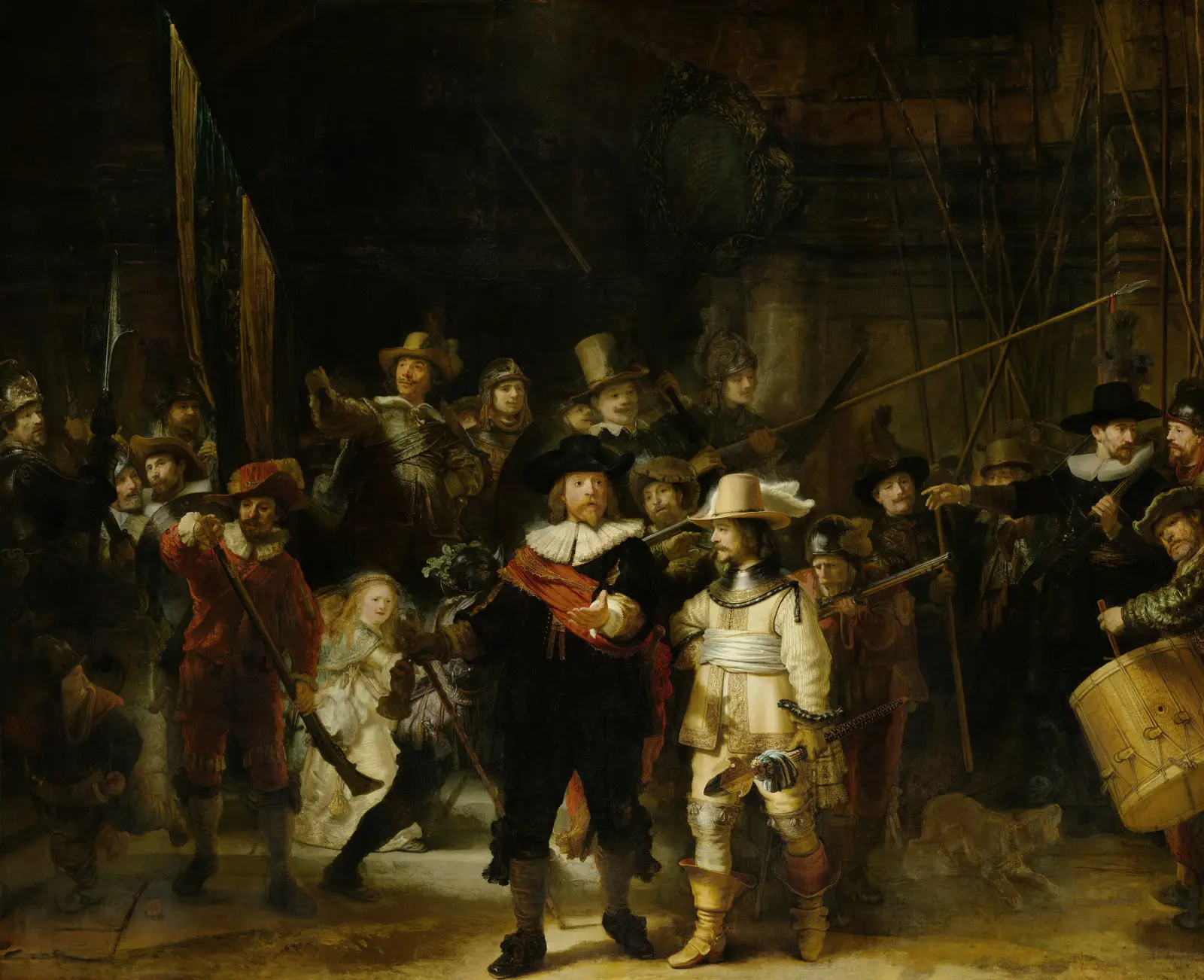
The Night Watch as it survives. The Rijksmuseum’s press release gives the remaining canvas as 379.5 by 436 centimetres and says strips were cut from all four sides in 1715.
Collection: Rijksmuseum, Amsterdam, SK-C-5
"The Night Watch" by Rembrandt van Rijn — https://commons.wikimedia.org/wiki/File:The_Nightwatch_by_Rembrandt_-_Rijksmuseum.jpg — Public domain (US: published before 1931; DE/FR: Rembrandt died in 1669 per the Commons creator template on the file page, more than 70 years ago; faithful reproduction of a two-dimensional work); modified: resized to 4000 pixels on the long side (4000 by 3255) from the 14168 by 11528 original
Card and share picture, a 3:2 copy of this object’s photograph: "The Night Watch (card)" by Rembrandt van Rijn — https://commons.wikimedia.org/wiki/File:The_Nightwatch_by_Rembrandt_-_Rijksmuseum.jpg — Public domain (US: published before 1931; DE/FR: Rembrandt died in 1669 per the Commons creator template on the file page, more than 70 years ago; faithful reproduction of a two-dimensional work); modified: cropped to a 3:2 frame from the centre (full width, 14168 by 9445 pixels) and reduced to 2400 by 1600 pixels
Start at the left edge of The Night Watch (De Nachtwacht), the side where the canvas lost the most. The painting is Rembrandt’s group portrait of an Amsterdam civic guard company, signed and dated 1642, and the edge visible in the museum’s photograph is not the edge he painted. A Rijksmuseum press release of 23 June 2021 full text says that the canvas was moved in 1715 and that “Strips were cut from all four sides, with the largest section being removed from the left side.”
The museum’s own page for an early copy says three sides, not four. This page sets the two accounts side by side.
The release prints its measurements with decimal commas (64,4 cm); here they are written with points.
How much was cut from each side?
The release ends with a short table of dimensions, which lists one strip for each side: 64.4 centimetres from the left, 23.3 from the top, 11.3 from the bottom and 7 from the right. The same table gives the remaining canvas as 379.5 centimetres high and 436 wide, and a reconstruction of the uncut picture as 393.1 by 507.4 centimetres, height first.
The widths add up: the left strip, the remaining width and the right strip make 64.4 + 436 + 7 = 507.4 centimetres, exactly the width the table gives for the reconstruction. The heights do not. Added together, the top strip, the remaining height and the bottom strip come to 414.1 centimetres, while the same table gives the reconstruction as 393.1 centimetres high. Because the release does not explain the difference, this page prints both figures as published and does not pick one.
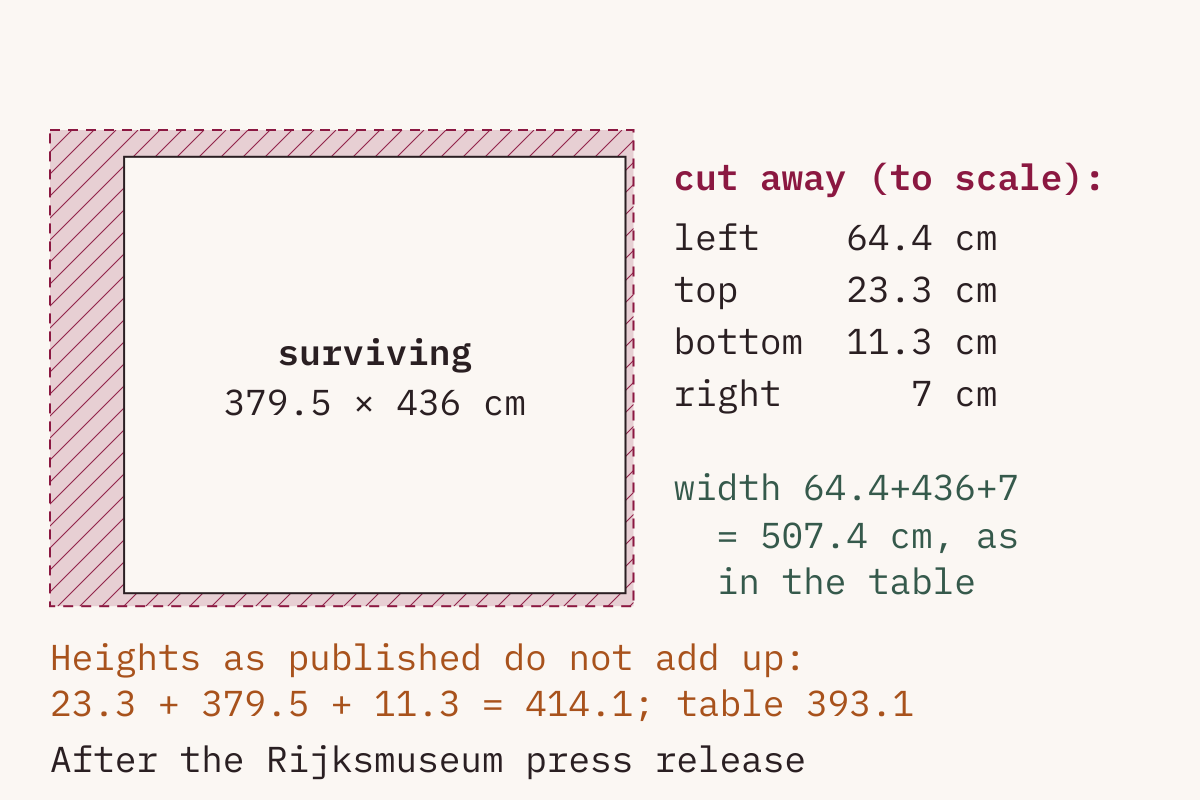 schematic
The strips cut from The Night Watch in 1715, drawn to scale in centimetres from the Rijksmuseum’s table; the published heights do not add up, so both figures are shown as published.
Source: Rijksmuseum press release, 23 June 2021, table of dimensions (decimal commas written as points)
"Strips cut from The Night Watch in 1715" by Kiln, Easel & Anvil, https://kilneaselandanvil.com/paintings/the-night-watch/ — CC BY 4.0, https://creativecommons.org/licenses/by/4.0/
Data: Rijksmuseum press release, 'For the first time in 300 years The Night Watch is complete again' (published 23 June 2021), table of dimensions
| Part | Height (cm) | Width (cm) | Note |
|---|---|---|---|
| Left strip | 64.4 | the largest strip | |
| Right strip | 7 | ||
| Top strip | 23.3 | ||
| Bottom strip | 11.3 | ||
| Surviving canvas | 379.5 | 436 | the remaining original, per the press release |
| Reconstruction | 393.1 | 507.4 | widths add up; heights add up to 414.1 against 393.1 |
| Copy attributed to Gerrit Lundens | 66.5 | 85.5 | oil on panel; its record says three sides |
Download the data (CSV, the-night-watch-dimensions.csv) (notes on this file) Data: Rijksmuseum press release, 'For the first time in 300 years The Night Watch is complete again' (published 23 June 2021); Rijksmuseum collection record SK-C-1453, Copy of The Night Watch attributed to Gerrit Lundens (CC0)
Where was the widest strip removed?
The left side lost 64.4 centimetres, nearly three times the depth of the top strip and more than nine times the width of the right one. The crop below frames the left edge of the surviving canvas and marks where the cut ran, not what was painted on the strip that went.
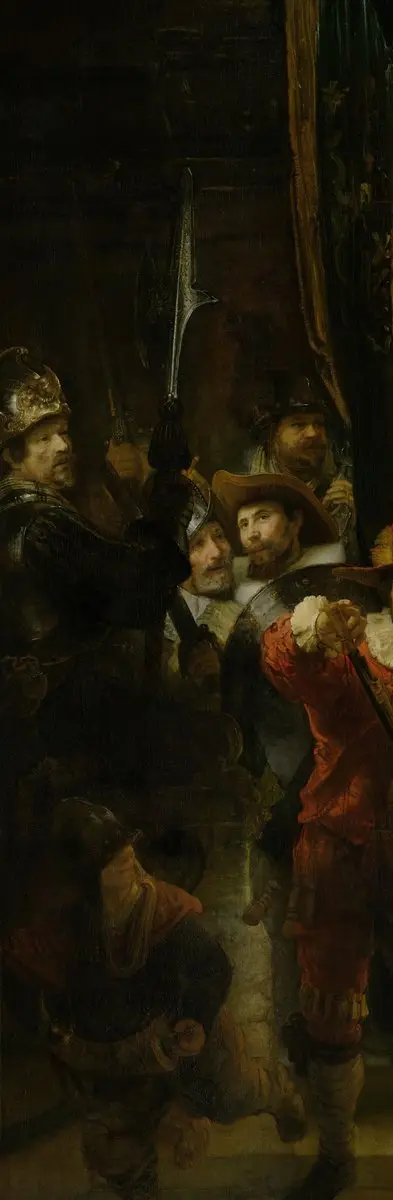
The left edge of the surviving canvas, where the press release says “the largest section” was removed.
Collection: Rijksmuseum, Amsterdam, SK-C-5
Detail. The small picture marks where it sits in the whole object.
“The Night Watch, left edge (detail)”, Rembrandt van Rijn; public domain.
Complete credit
"The Night Watch, left edge (detail)" by Rembrandt van Rijn — https://commons.wikimedia.org/wiki/File:The_Nightwatch_by_Rembrandt_-_Rijksmuseum.jpg — Public domain (US: published before 1931; DE/FR: Rembrandt died in 1669 per the Commons creator template on the file page, more than 70 years ago; faithful reproduction of a two-dimensional work); modified: cropped to the detail of the left edge (x 0, y 0.15, width 0.2, height 0.75 of the whole picture), long side 1200 pixels
The press release gives the uneven cut a visible consequence. With the strips put back in the reconstruction, it says, the two main figures, Captain Frans Banninck Cocq and Lieutenant Willem van Ruytenburch, “are now positioned to the right of centre, rather than in the middle of the canvas.” On the trimmed canvas, by the same account, the pair stand in the middle.
The reason for the cut was the new room. According to the press release, “The painting was too large for its new location, so it was reduced in size.” The Rijksmuseum’s record for the copy full text adds that “It had to fit in between two doors in its new location.”
The collection record for the painting full text names the room as the Small Council of War Chamber in the Town Hall on Dam Square. It quotes the city order of 23 May 1715, which speaks of cleaning the painting and then placing it in the “Kreygsraats Kamer van het Stadhuys” (the War Council Chamber of the City Hall; translated here). The words quoted in the record say nothing about cutting.
Where can the missing parts still be seen?
They cannot be seen on canvas, because the press release says “These pieces have never been found” and the copy’s record says the strips “were not preserved.” What survives is a small painted copy, which the press release describes as commissioned by Captain Frans Banninck Cocq and “probably painted by Gerrit Lundens in the period from 1642 to 1655”.
The record for the copy calls it “attributed to Gerrit Lundens”, dates it c. 1642 to c. 1655 and lists it as on loan from the National Gallery, London. According to the press release, the museum’s 2021 reconstruction of the missing strips was based on this copy.
The trimmed edges record a change made more than 70 years after the painting’s date, not the way it was painted. So they are not a maker’s tell, this site’s name for a trace that a source places and explains as part of how an object was made, and the painting has no confirmed one. For a page on how a bronze statue is made, see lost-wax casting.
What does the top edge look like now?
Look along the top of the canvas at the upper left, where the collection record places the ensign: “Linksboven de vaandrig met de uitgestoken vaandel” (upper left, the ensign with the standard held out; translated here). The top strip was 23.3 centimetres high, per the press release’s table, and the same release says the reconstruction gives “space above the standard”.
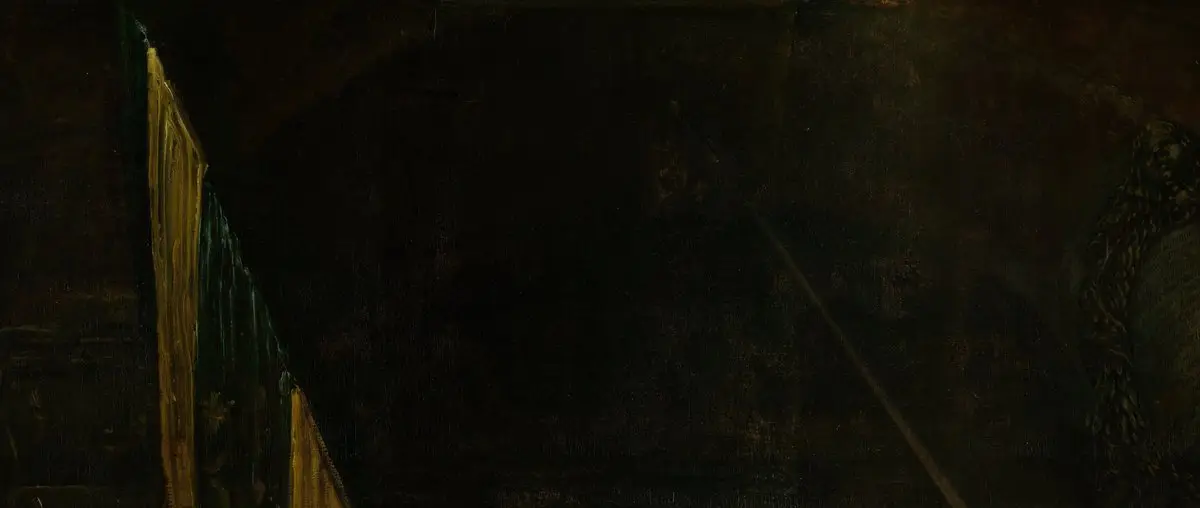
The top edge at the upper left, where the record places the ensign with the standard held out; the press release gives the top strip as 23.3 centimetres.
Collection: Rijksmuseum, Amsterdam, SK-C-5
Detail. The small picture marks where it sits in the whole object.
“The Night Watch, top edge at the upper left (detail)”, Rembrandt van Rijn; public domain.
Complete credit
"The Night Watch, top edge at the upper left (detail)" by Rembrandt van Rijn — https://commons.wikimedia.org/wiki/File:The_Nightwatch_by_Rembrandt_-_Rijksmuseum.jpg — Public domain (US: published before 1931; DE/FR: Rembrandt died in 1669 per the Commons creator template on the file page, more than 70 years ago; faithful reproduction of a two-dimensional work); modified: cropped to the detail of the top edge at the upper left (x 0.08, y 0, width 0.5, height 0.26 of the whole picture), long side 1200 pixels
Here the museum’s two accounts part ways. The press release lists a top strip in its table and says strips were cut “from all four sides”, while the record for the copy says “The painting was cut down on three sides”, above all on the left, when it was moved in 1715. The two pages do not refer to each other, and neither says which count is the later one.
The smallest strip in the press release’s table is the 7 centimetres on the right, and neither page says which side, if any, the three-sides account leaves out.
A later change can also be kept in view on purpose. For The Thinker in Cleveland, the museum chose to leave damage in place.
How big is it in centimetres?
The surviving canvas is 379.5 centimetres high in both the press release and the collection record, but the two pages give different widths. The press release gives 436 centimetres for the remaining original, while the record lists the painting as “height 379.5 cm x width 453.5 cm” and says nothing about how that width was measured. Both figures are printed here with their sources.
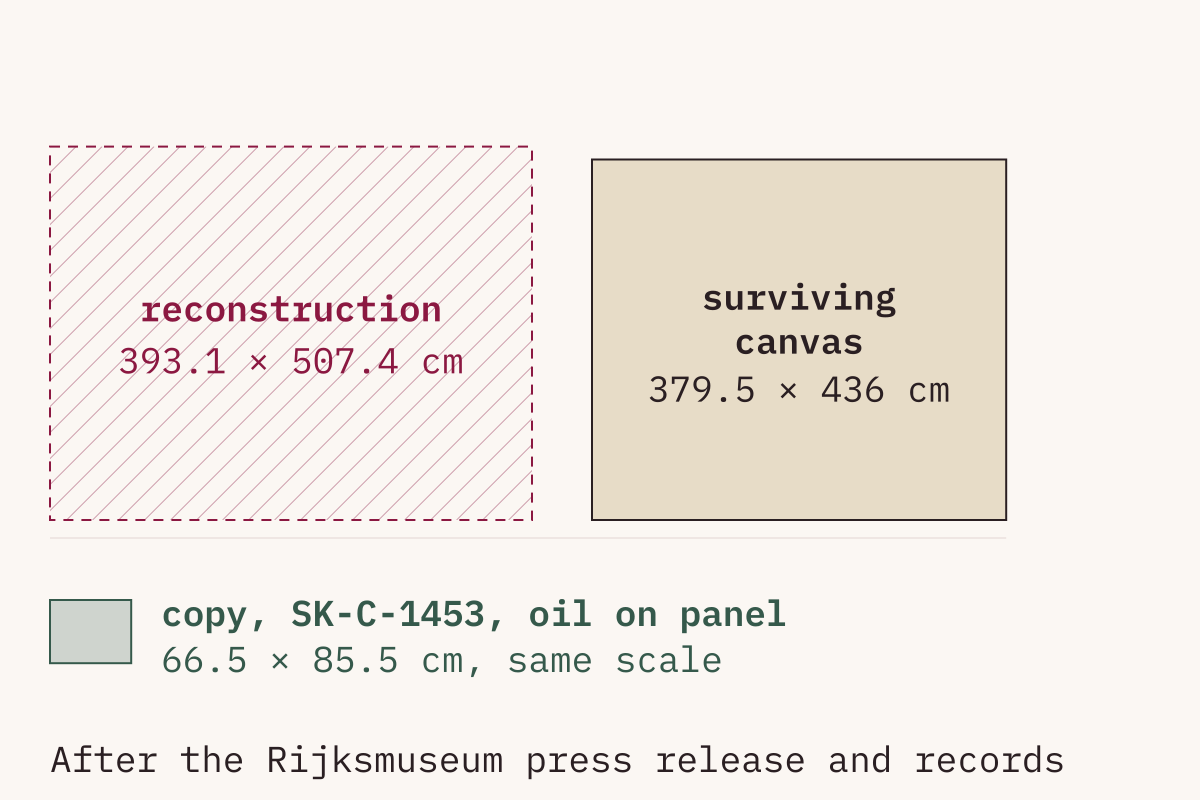 schematic
The reconstruction and the surviving canvas from the Rijksmuseum press release, and the copy attributed to Gerrit Lundens from its record, drawn to one scale in centimetres, height by width.
Source: Rijksmuseum press release, 23 June 2021, table of dimensions, and Rijksmuseum record SK-C-1453 (decimal commas written as points)
Read the figure as text
- Reconstruction, per the press release: 393.1 cm high, 507.4 cm wide
- Surviving canvas, per the press release: 379.5 cm high, 436 cm wide
- Copy attributed to Gerrit Lundens, record SK-C-1453: 66.5 cm high, 85.5 cm wide, oil on panel
"The Night Watch, its reconstruction and the copy, to one scale" by Kiln, Easel & Anvil, https://kilneaselandanvil.com/paintings/the-night-watch/ — CC BY 4.0, https://creativecommons.org/licenses/by/4.0/
Data: Rijksmuseum press release, 'For the first time in 300 years The Night Watch is complete again' (published 23 June 2021), table of dimensions; Rijksmuseum collection record SK-C-1453, Copy of The Night Watch attributed to Gerrit Lundens (CC0)
The copy is 85.5 centimetres wide, a little under a fifth of the width of the surviving canvas in the press release, and it is painted in oil on a wooden panel, where The Night Watch is oil on canvas. For the same kind of close look at another Dutch painting, see the pearl in Girl with a Pearl Earring.
Where is it, and why the name?
The painting is in the Rijksmuseum in Amsterdam, which holds it on loan from the City of Amsterdam; the record says the loan dates from 1808. According to the record’s provenance, the group portrait was commissioned for the great hall of the Kloveniersdoelen, the headquarters of the arquebusiers’ civic guard, and is first mentioned there in 1653.
The name came later. The record’s Dutch description says the painting has been “sinds het einde van de 18de eeuw bekend als ‘De Nachtwacht’” (known as The Night Watch since the end of the 18th century; translated here), and its English title reads The Night Watch Militia Company of District II under the Command of Captain Frans Banninck Cocq. The record gives no reason for the nickname, and this page does not offer one.
Under the loupe: go to the far right edge, to the helmet of the militiaman on the extreme right, which the press release says is “now complete” in the reconstruction, then turn to the mirror in the Arnolfini Portrait, where, per Weale, two more figures stand at a doorway.
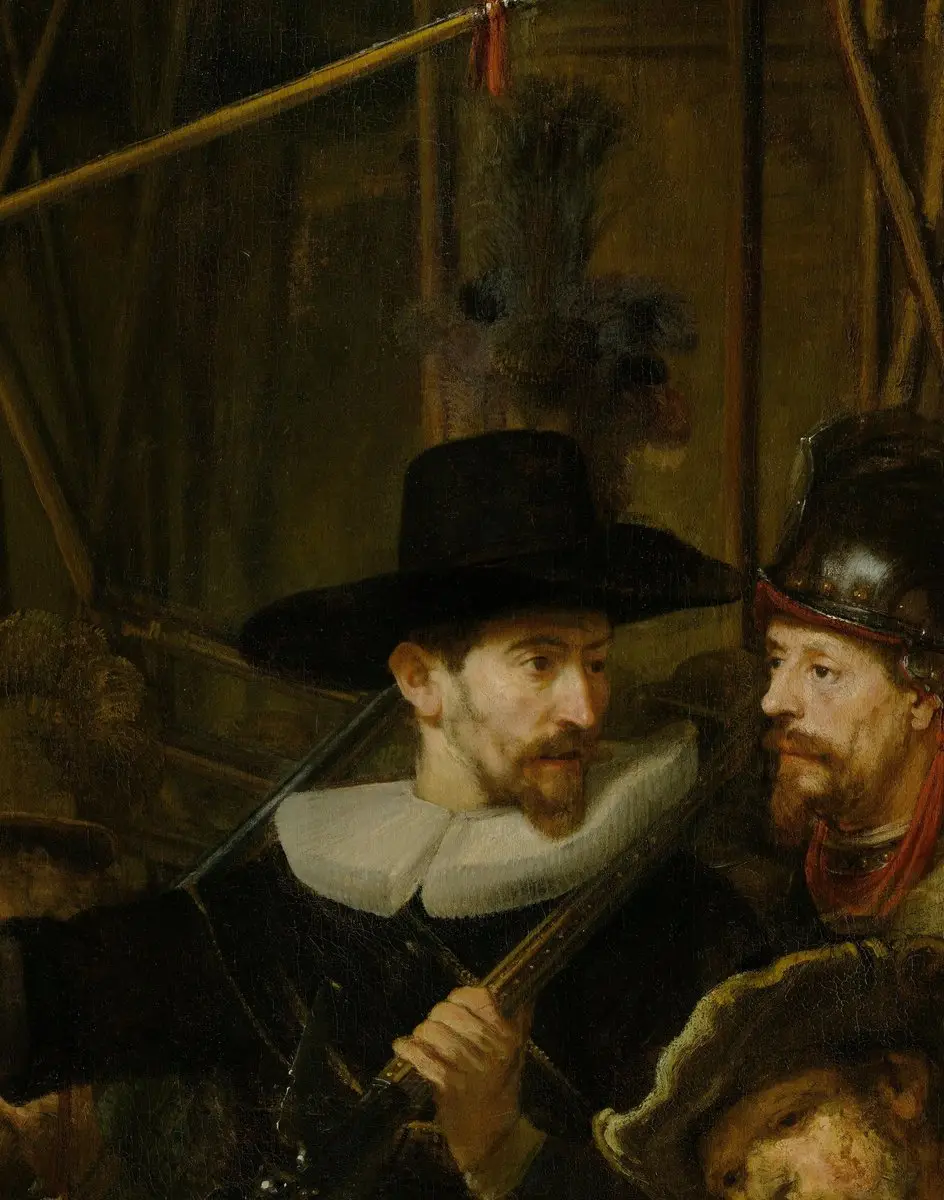
The right edge of the surviving canvas, where the 7-centimetre strip was cut; the press release says the helmet of the militiaman on the extreme right is complete in the reconstruction.
Collection: Rijksmuseum, Amsterdam, SK-C-5
Detail. The small picture marks where it sits in the whole object.
“The Night Watch, right edge (detail)”, Rembrandt van Rijn; public domain.
Complete credit
"The Night Watch, right edge (detail)" by Rembrandt van Rijn — https://commons.wikimedia.org/wiki/File:The_Nightwatch_by_Rembrandt_-_Rijksmuseum.jpg — Public domain (US: published before 1931; DE/FR: Rembrandt died in 1669 per the Commons creator template on the file page, more than 70 years ago; faithful reproduction of a two-dimensional work); modified: cropped to the detail of the right edge (x 0.84, y 0.3, width 0.16, height 0.25 of the whole picture), long side 1200 pixels
Sources and reading levels
- Rijksmuseum, 'For the first time in 300 years The Night Watch is complete again', press release, 23 June 2021 www.rijksmuseum.nl/en/press/press-releases/for-the-first…Read: full text
- Rijksmuseum, collection record SK-C-5, Rembrandt van Rijn, The Night Watch, 1642 www.rijksmuseum.nl/en/collection/object/The-Night-Watch-…Read: full text
- Rijksmuseum, collection record SK-C-1453, Copy of The Night Watch, attributed to Gerrit Lundens, c. 1642 to c. 1655 www.rijksmuseum.nl/en/collection/object/Copy-of-The-Nigh…Read: full text
- Bruce Christman, "Twenty-Five Years after the Bomb: Maintaining Cleveland's The Thinker", Journal of the American Institute for Conservation 37, no. 2 (1998): 173–186; quoted briefly, copyright of the American Institute for Conservation cool.culturalheritage.org/jaic/articles/jaic37-02-002.htmlRead: full text
More objects in Paintings
Object reading
Girl with a Pearl Earring: No Hook, per the Mauritshuis
Catalogued
Picture credit
"Girl with a Pearl Earring (card)" by Mauritshuis, The Hague — https://commons.wikimedia.org/wiki/File:Meisje_met_de_parel.jpg — Public domain (US: published before 1931; DE/FR: Vermeer died in 1675 per the Mauritshuis object page 670, more than 70 years ago; faithful reproduction of a two-dimensional work); modified: cropped to a 3:2 frame from the centre (full width, 4095 by 2730 pixels, from 1032 pixels down) and reduced to 2400 by 1600 pixels
Object reading
Arnolfini Portrait: Two Figures at the Door, per Weale
Catalogued
Picture credit
"Portrait of Giovanni Arnolfini and his Wife (Jan van Eyck)" by Jan van Eyck — https://commons.wikimedia.org/wiki/File:Jan_van_Eyck_-_Portrait_of_Giovanni_Arnolfini_and_his_Wife_-_WGA7689.jpg — Public domain (US: published before 1931; DE/FR: Jan van Eyck died in 1441 per the Commons creator template on the file page (not checked against a library record), more than 70 years ago; faithful reproduction of a two-dimensional work); modified: cropped to a 3:2 frame from 150 px below the top edge (heads, mirror and hands), enlarged from 1,035 to 1,200 px wide
Technique, diagrammed
Mona Lisa: Painted on Poplar, Not Canvas, per the Louvre
Catalogued
Picture credit
"Mona Lisa (Leonardo da Vinci)" by Leonardo da Vinci — https://commons.wikimedia.org/wiki/File:Leonardo_da_Vinci_-_Mona_Lisa_(La_Gioconda)_-_WGA12712.jpg — Public domain (US: published before 1931; DE/FR: Leonardo da Vinci died in 1519 per the Louvre collection record, more than 70 years ago; faithful reproduction of a two-dimensional work); modified: cropped to a 3:2 frame from 120 px below the top edge (face), enlarged from 800 to 1,200 px wide
Cite this page
Kiln, Easel & Anvil. “The Night Watch: How Much of the Canvas Was Cut in 1715.” Published 28 November 2026. https://kilneaselandanvil.com/paintings/the-night-watch/ (accessed on the day you read it).
How a record is checked Every correction, dated Report an error on this page (contact@kilneaselandanvil.com)