Lost Wax Casting: Cellini's Own Account of His Perseus
Short answer
Lost-wax casting makes a bronze by melting wax out of a clay mould and letting metal fill the space it leaves, as J. A. Symonds’s notes to the 1888 translation of Cellini’s Life explain for his Perseus scanned page. In the photograph below, look at the front of the Cleveland Pomona’s left leg, where the museum record places casting pins.
Technique sheet
- Technique
- Lost-wax casting (bronze sculpture); known in French as cire perdue, as Symonds believed
- Kind of work
- Casting: metal run into a mould in the space a wax layer once filled
- Principle in one line
- The wax is drawn out of the mould, and the metal fills the space between the outside mould and the inner block
- What to look for
- On the Cleveland Pomona: a hole drilled at the top of the head for removal of the core; casting pins in the back of the right shoulder and the front of the left leg; the record does not name the casting method, so linking these traces to lost wax is an inference on this page
- Usual period and place
- Described by Theophilus in book III of his treatise and by Cellini, for his Perseus, in Book Second of his Life
- Example in a collection
- Cleveland Museum of Art, 1948.486: Pomona, c. 1500, circle of Andrea Riccio, bronze, overall 15.5 cm; the record does not name the casting method
This record as CSV (lost-wax-casting-technique.csv) (notes on this file)
Data: Cleveland Museum of Art, 1948.486 collection record (CC0); Cellini, Life, tr. J. A. Symonds (1888), and Theophilus, tr. R. Hendrie (1847), short phrases with page numbers
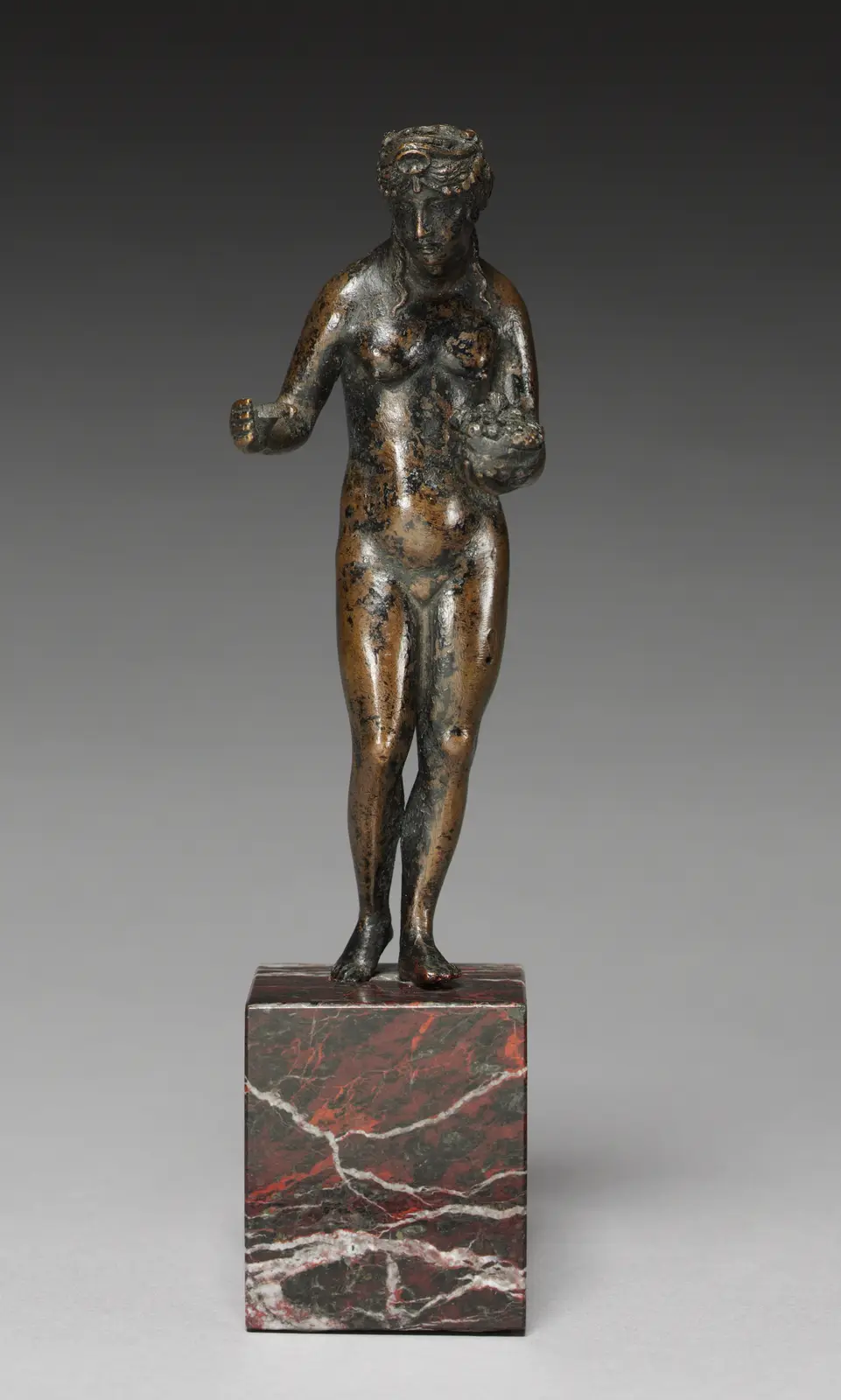
Pomona, c. 1500, in the Cleveland Museum of Art; the record gives the maker as the circle of Andrea Riccio, the material as bronze and an overall height of 15.5 cm.
Collection: Cleveland Museum of Art, 1948.486
"Pomona, circle of Andrea Riccio" by Cleveland Museum of Art — https://www.clevelandart.org/art/1948.486 — CC0 1.0 (https://creativecommons.org/publicdomain/zero/1.0/)
Card and share picture, a 3:2 copy of this object’s photograph: "Pomona, circle of Andrea Riccio (card)" by Cleveland Museum of Art — https://www.clevelandart.org/art/1948.486 — CC0 1.0 (https://creativecommons.org/publicdomain/zero/1.0/); modified: padded with the photograph's own background to a 3:2 frame, left and right, with a feathered seam
Before any bronze went in, the wax had to come out. Benvenuto Cellini says he drew it off his statue “by means of a slow fire” through “numerous air-vents I had made” (p. 230) scanned page, so that the finished bronze would take the shape of a wax layer that had already melted away. In the photograph above, the top of the head is where the Cleveland record says a hole was drilled for removal of the core, though this front view does not show the hole itself.
Symonds, the translator, explains in a footnote that the metal ended up “filling up exactly the space which had previously been occupied by the wax” (p. 233). Because this page describes the method only through historical accounts and a museum record, it contains no working instructions; do not try to melt or cast metal from it.
What does a cast bronze show of its making?
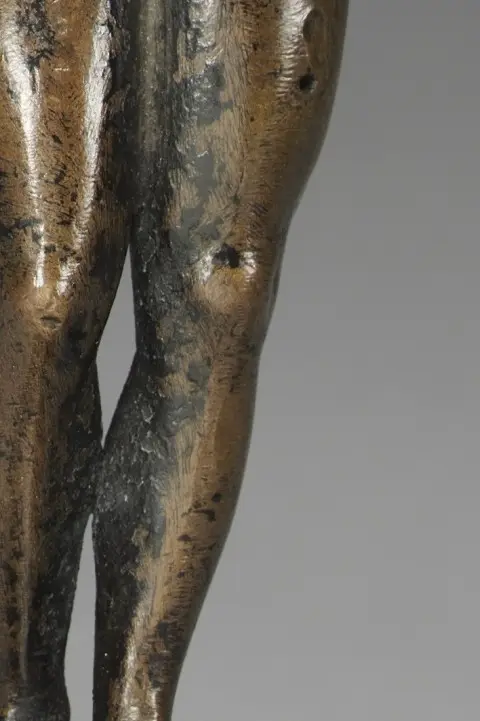
Detail of the front of the left leg, where the Cleveland record says casting pins appear.
Collection: Cleveland Museum of Art, 1948.486
Detail. The small picture marks where it sits in the whole object.
"Pomona, circle of Andrea Riccio (detail of the left leg)" by Cleveland Museum of Art — https://www.clevelandart.org/art/1948.486 — CC0 1.0 (https://creativecommons.org/publicdomain/zero/1.0/); modified: cropped to the detail of the front of the left leg, from the thigh to below the knee (no enlargement)
The Cleveland Museum of Art lists the figure as “Pomona”, dated c. 1500, in bronze, with an overall height of 15.5 cm full text, and its description shows the nymph standing with her weight on her left leg and holding a bowl of fruit in her left hand.
The record then points to traces of the making: “A hole has been drilled at the top of the figure's head for removal of the core and casting pins appear in the back of the right shoulder and on the front of the left leg.”
Because the record gives both the place and the cause, these traces count as what this site calls the maker's tell, a trace on an object that shows how it was made. The record does not explain the pins further, and this page does not guess at their purpose.
Neither does the record name the casting method, so calling this statuette a lost-wax casting remains an inference on this page: a hollow bronze with a core removed through a drilled hole is consistent with the outside mould and inner block that Symonds describes for Cellini, but the museum does not say so. Unlike the Venus de Milo, a marble made of two joined elements, this figure shows its making through what was taken out of it.
Who made it
The record gives two accounts of the maker. Its heading reads “Circle of Andrea Riccio”, while its description notes other examples of the statuette in Oxford, Paris, Berlin and Washington.
The same description then states that “Only the Washington and Cleveland versions have been attributed to Riccio because of their superior quality of casting and the rich patinas.” Both statements come from one museum record, so this page reports them side by side rather than choosing between them.
How does the wax turn into bronze?
 schematic, not to scale
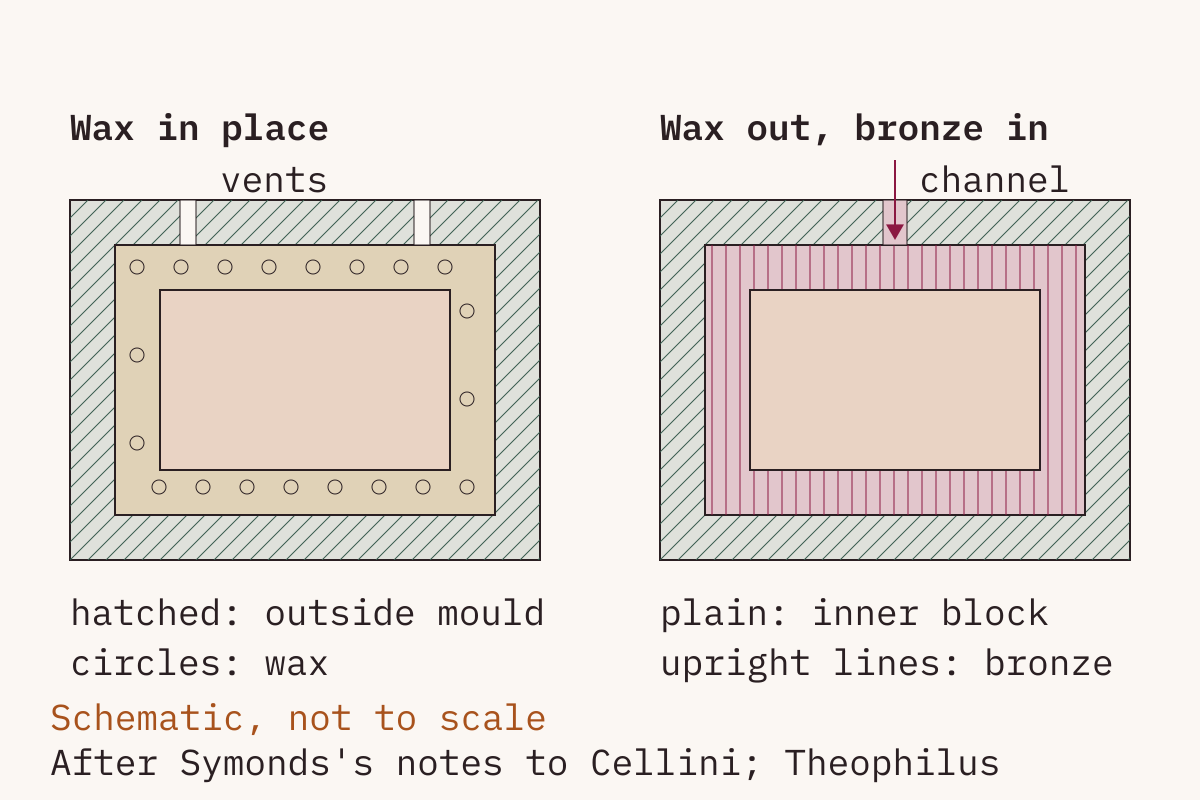
The principle in section: a layer of wax between an outside mould and an inner block, then the wax gone and bronze in its place. The sources give no thicknesses or temperatures.
Source: Cellini, The Life of Benvenuto Cellini, tr. J. A. Symonds (1888), vol. 2, pp. 230, 231, 233; Theophilus, De diversis artibus, tr. R. Hendrie (1847), pp. 297–301
Read the figure as text
- Outside mould: the tonaca, a clay tunic laid over the model (Symonds, p. 231), drawn with hatching
- Wax: the layer that gives the bronze its shape (Symonds, p. 233), drawn with circles
- Inner block: the anima, standing a short way inside the mould (Symonds, p. 233), left plain
- Vents: openings for drawing off the wax (Cellini and Symonds, pp. 230–231)
- Channel: the way the metal comes in from the furnace (Symonds, p. 233)
- Bronze: fills the space the wax occupied (Symonds, p. 233), drawn with upright lines
"Lost wax casting in section: wax in place, then bronze" by Kiln, Easel & Anvil, https://kilneaselandanvil.com/sculpture/lost-wax-casting/ — CC BY 4.0, https://creativecommons.org/licenses/by/4.0/
Data: Benvenuto Cellini, The Life of Benvenuto Cellini, translated by J. A. Symonds (1888), vol. 2, pp. 230, 231, 233, with the translator's notes; Theophilus, De diversis artibus, edited and translated by R. Hendrie (1847), pp. 297–301
Symonds’s footnotes name the principal parts of the mould with the Italian words that Cellini used. The outer part is the tonaca, “or clay tunic laid upon the original model of baked clay and wax” (p. 231). The inner part is the anima, and when the metal reached the mould, he writes, it entered “between the tonaca, or outside mould, and the anima, or inner block” (p. 233). He adds that he believes the process is known by the French name cire perdue, meaning lost wax.
The air-vents did two jobs on Symonds’s account: “drawing off the wax, whereby a space was left for the molten bronze to enter”, and letting air and gas escape so that the metal could get in (p. 231). Cellini puts the same point in his own words: “the more there are of these, the better will the mould fill” (p. 230).
The name describes what happens to the wax: it melts away before the casting, and the shape it held survives only as metal. Material matters elsewhere too: the Cleveland record for a Roman marble athlete with a tree trunk beside its right leg ties its added supports to working in marble rather than bronze.
What did Theophilus write about casting?
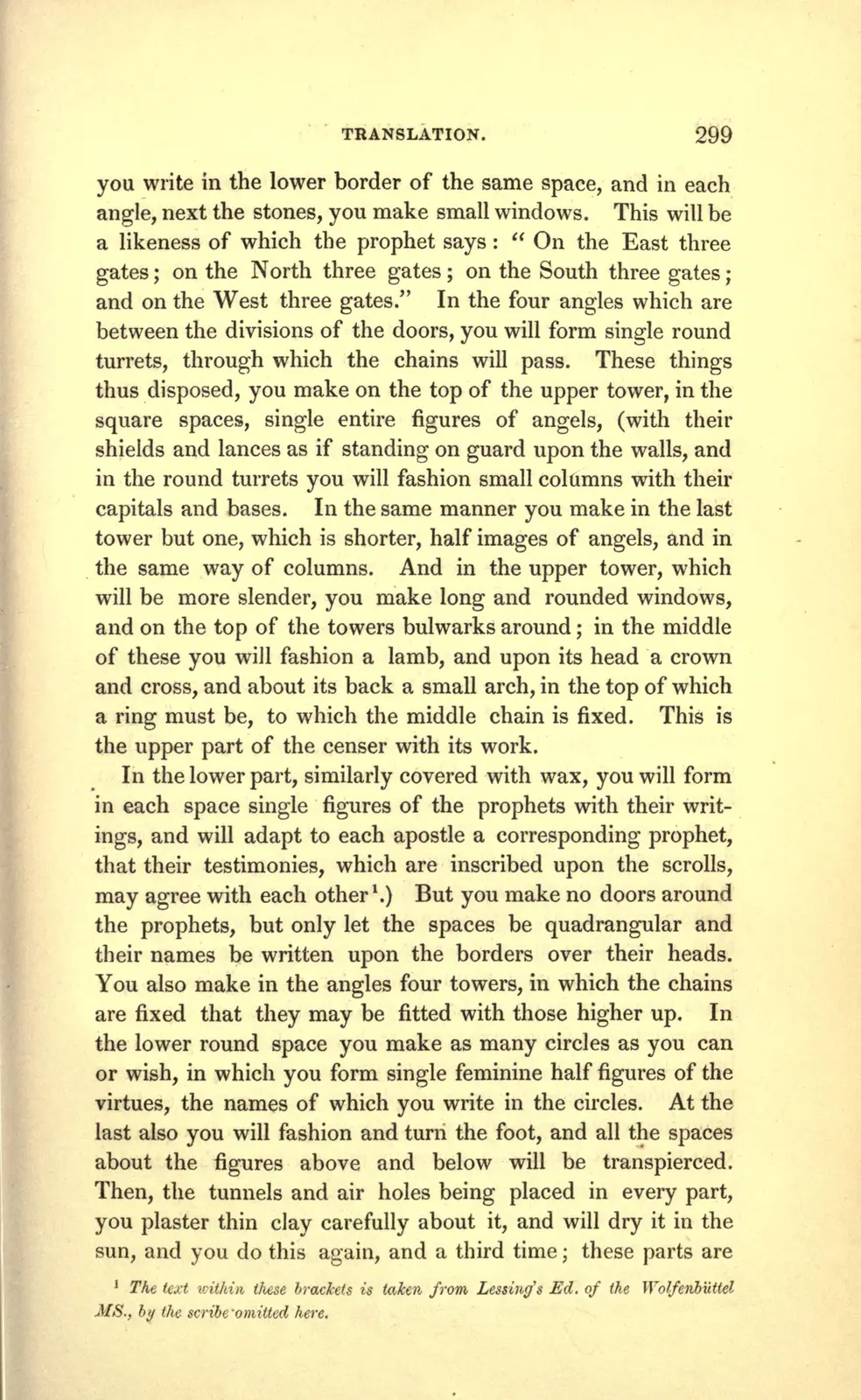
Page 299 of Robert Hendrie’s 1847 English translation of Theophilus, from the chapter on a cast censer: figures formed in the wax, then tunnels, air holes and coats of thin clay.
Collection: University of Toronto, Robarts Library copy, Theophilus, De diversis artibus, ed. and tr. R. Hendrie (London: J. Murray, 1847), p. 299, scanned for the Internet Archive
“Theophilus, De diversis artibus, tr. Hendrie, page 299”, Theophilus; Robert Hendrie (translator) / Theophilus, tr. Robert Hendrie (London, 1847); University of Toronto copy, Internet Archive; public domain.
Complete credit
"Theophilus, De diversis artibus, tr. Hendrie, page 299" by Theophilus, tr. Robert Hendrie (London, 1847); University of Toronto copy, Internet Archive — https://archive.org/details/theophiliquietru00theouoft — Public domain (US: published in 1847, before 1931; DE/FR: medieval text; the translation was published in 1847, and a translator old enough to publish it then cannot have died later than 1955, so the 70 years after his death, counted to the end of the calendar year, have run out in any case (his death year was not found in a readable source))
Another description of the method sits in book III of the treatise by Theophilus, whom the book’s Latin title calls a priest and monk. The treatise was printed in 1847 with Robert Hendrie’s English translation facing the Latin scanned page. The object in that chapter is a censer, a vessel for burning incense, not a statue, and the metal is “the brass which you wish to cast” (p. 301).
Theophilus shapes the censer in clay and covers it with wax, insisting that “the wax be in no place thicker or thinner than in another” (p. 297). Figures of apostles, prophets and angels are then modelled in the wax itself, under arches and in the towers of the censer’s decoration (pp. 297–299).
Next come “the tunnels and air holes being placed in every part” and three coats of thin clay, after which the clay parts are “now called moulds” (pp. 299–301). The moulds are warmed and the melted wax poured out, and this is repeated “until you have removed all the wax” (p. 301).
Theophilus wrote his description as a sequence of instructions addressed directly to a craftsman, so this page quotes it only as a historical record of how the method was described, leaving out the fuel, the furnace and the other working details.
What does Cellini record about the Perseus casting?
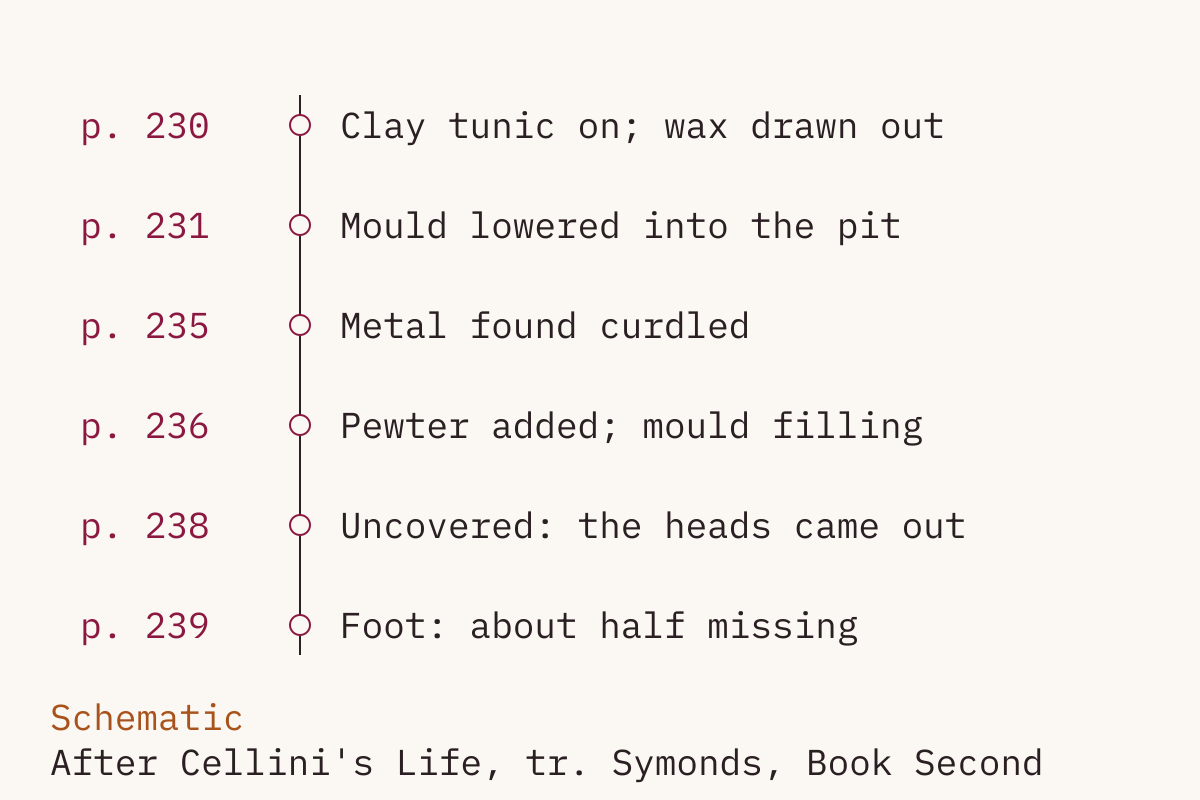 schematic
Six moments in Cellini’s account of casting his bronze statue, in the page order of the 1888 translation. The statue itself is not pictured on this page.
Source: Cellini, The Life of Benvenuto Cellini, tr. J. A. Symonds (1888), vol. 2, Book Second, pp. 230–239
Read the figure as text
- p. 230: the statue clothed in a clay tunic; the wax drawn out through air-vents
- p. 231: the mould lowered into a pit and banked with earth
- p. 235: the metal found “all curdled”
- p. 236: pewter added; the mould filling
- p. 238: the statue uncovered; the heads had come out
- p. 239: about half the foot missing
"Cellini's casting account in page order" by Kiln, Easel & Anvil, https://kilneaselandanvil.com/sculpture/lost-wax-casting/ — CC BY 4.0, https://creativecommons.org/licenses/by/4.0/
Data: Benvenuto Cellini, The Life of Benvenuto Cellini, translated by J. A. Symonds (1888), vol. 2, Book Second, pp. 230–239
Cellini tells the story in chapters LXXV to LXXVIII of Book Second, and everything in this section is his own account, not independently confirmed. After the wax was drawn off, he lowered the mould “into the very bottom of the furnace”, banked it with earth and added air-vents made of “little tubes of earthenware” (p. 231). The furnace held “pigs of copper and other bronze stuff” (p. 231).
According to Cellini’s own description, the pour itself nearly failed. He found “that the metal was all curdled”, an accident that, he says, founders expressed as “being caked” (p. 235).
Then “the cap of the furnace had blown up”, and the bronze “did not flow as rapidly as usual”. Cellini sent for all his “pewter platters, porringers, and dishes” and had them thrown into the channels and the furnace until the mould was filling (p. 236).
When he uncovered the cooled statue, he notes that “the mouths of the mould were placed above the head of Perseus and behind his shoulders” (p. 238). The right foot was the weak point: the toes and a little above them were unfinished, “so that about half the foot was wanting” (p. 239). Cellini explains that more of the foot had formed than he expected because “the bronze was hotter than our rules of art prescribe” (p. 239).
The stages, source by source
| Step | What the source records | Source |
|---|---|---|
| Wax over clay | wax laid over the clay, no thicker or thinner in one place than another | Theophilus, p. 297 |
| Vents and coats | tunnels and air holes, then thin clay plastered round three times | Theophilus, p. 299 |
| Wax removed | moulds warmed and the melted wax poured out until none is left | Theophilus, p. 301 |
| Wax drawn out | a clay tunic over the statue, the wax drawn out by a slow fire through air-vents | Cellini, p. 230 |
| Mould set | the mould set upright in a pit and banked with earth | Cellini, p. 231 |
| Metal enters | metal fills the space between outside mould and inner block that the wax had occupied | Symonds’s note, p. 233 |
| Metal caked | the metal found curdled in the furnace | Cellini, p. 235 |
| Pewter added | pewter thrown in because the metal did not flow as rapidly as usual | Cellini, p. 236 |
| Mouths of the mould | placed above the head and behind the shoulders | Cellini, p. 238 |
| The foot | about half the foot wanting | Cellini, p. 239 |
Download the data (CSV, lost-wax-casting-sources.csv) (notes on this file) Data: Theophilus, De diversis artibus, tr. R. Hendrie (1847), pp. 297–301, short phrases with page numbers; Benvenuto Cellini, The Life of Benvenuto Cellini, tr. J. A. Symonds (1888), vol. 2, pp. 230–239, short phrases with page numbers
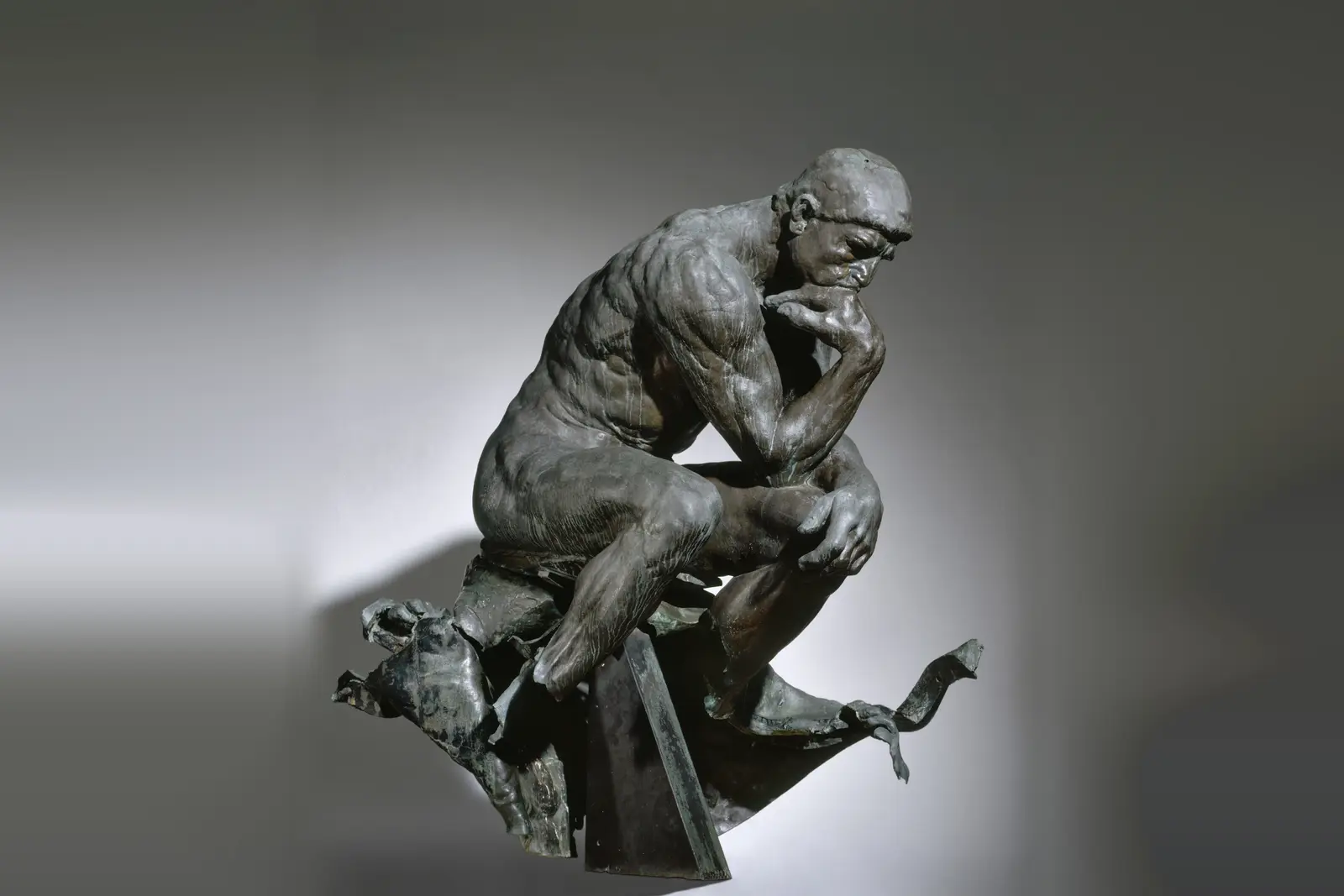
For a much later bronze in Cleveland, see The Thinker, a bronze cast during Rodin's lifetime.
Under the loupe: look again at the front of Pomona’s left leg, where the Cleveland record says casting pins appear, then compare a change made long after the making in The Night Watch, a painting that lost its edges per the Rijksmuseum.
Detail of the front of the left leg, where the Cleveland record says casting pins appear.
Collection: Cleveland Museum of Art, 1948.486
Detail. The small picture marks where it sits in the whole object.
"Pomona, circle of Andrea Riccio (detail of the left leg)" by Cleveland Museum of Art — https://www.clevelandart.org/art/1948.486 — CC0 1.0 (https://creativecommons.org/publicdomain/zero/1.0/); modified: cropped to the detail of the front of the left leg, from the thigh to below the knee (no enlargement)
Sources and reading levels
- Cleveland Museum of Art, Pomona, c. 1500, circle of Andrea Riccio (Italian, c. 1470–1532), bronze, accession number 1948.486, collection online record (CC0) www.clevelandart.org/art/1948.486Read: full textText licence: CC0 1.0 (terms)
- Benvenuto Cellini, The Life of Benvenuto Cellini, newly translated into English by John Addington Symonds (New York: Scribner & Welford, 1888), vol. 2, Book Second, chapters LXXV–LXXVIII, pp. 230–239, with the translator's notes; public domain in the US and EU (Cellini died 1571, Symonds died 1893) archive.org/details/gri_33125007632397Read: scanned page
- Theophilus, Theophili, qui et Rugerus, presbyteri et monachi, libri III de diversis artibus, edited and translated by Robert Hendrie (London: John Murray, 1847), book III, chapter on a cast censer, pp. 297–301; published 1847, public domain in the US and EU (a translator old enough to publish it in 1847 cannot have died later than 1955; his death year was not found in a readable source) archive.org/details/theophiliquietru00theouoftRead: scanned page
- Cleveland Museum of Art, Statue of an Athlete, 1–100 CE, marble, accession number 1924.1046, collection online record (CC0) www.clevelandart.org/art/1924.1046Read: full textText licence: CC0 1.0 (terms)
- Cleveland Museum of Art, The Thinker, 1880–81, Auguste Rodin (French, 1840–1917), bronze, accession number 1917.42, Gift of Ralph King, collection online record (CC0) www.clevelandart.org/art/1917.42Read: full textText licence: CC0 1.0 (terms)
- Rijksmuseum, 'For the first time in 300 years The Night Watch is complete again', press release, 23 June 2021 www.rijksmuseum.nl/en/press/press-releases/for-the-first…Read: full text
More objects in Sculpture
Object reading
Venus de Milo: Joined at the Hips, per the Louvre's Record
Catalogued
Picture credit
"Venus van Milo, Louvre. Musée du Louvre. - La Vénus de Milo" by Rijksmuseum — https://commons.wikimedia.org/wiki/File:Venus_van_Milo,_Louvre_Mus%C3%A9e_du_Louvre._-_La_V%C3%A9nus_de_Milo_(titel_op_object),_RP-F-F16588.jpg — CC0 1.0 (http://creativecommons.org/publicdomain/zero/1.0/deed.en); modified: cropped to a 3:2 frame from the top of the head to the hip line, with the printed caption line left out
Technique, diagrammed
Contrapposto: The One-Leg Stance Leonardo Describes
Catalogued
Picture credit
"Statue of an Athlete (side view, card)" by Cleveland Museum of Art — https://www.clevelandart.org/art/1924.1046 — CC0 1.0 (https://creativecommons.org/publicdomain/zero/1.0/); modified: padded with the photograph's own background to a 3:2 frame, left and right, with a feathered seam
Object reading
The Thinker: Cleveland Chose Not to Repair Its 1970 Damage
Catalogued
Picture credit
"The Thinker, Auguste Rodin (card)" by Cleveland Museum of Art — https://www.clevelandart.org/art/1917.42 — CC0 1.0 (https://creativecommons.org/publicdomain/zero/1.0/); modified: padded with the photograph's own background to a 3:2 frame, left and right, with a feathered seam
Cite this page
Kiln, Easel & Anvil. “Lost Wax Casting: Cellini's Own Account of His Perseus.” Published 28 November 2026. https://kilneaselandanvil.com/sculpture/lost-wax-casting/ (accessed on the day you read it).
How a record is checked Every correction, dated Report an error on this page (contact@kilneaselandanvil.com)